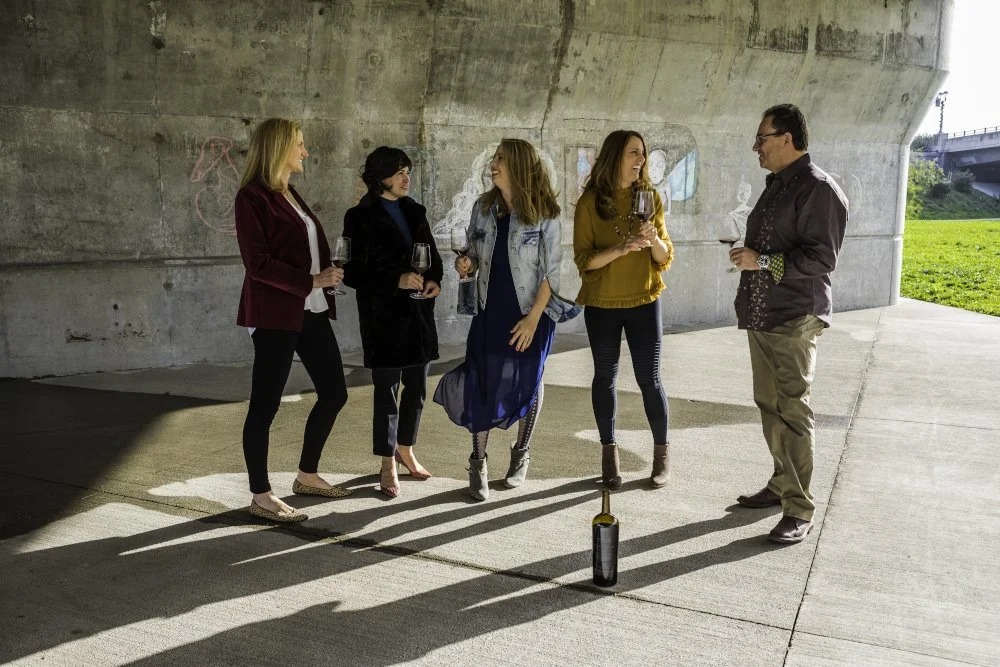
In Studio 707’s team photograph, five people stand beneath a concrete structure, holding wine glasses. A bottle rests on the pavement between them. There is no vineyard panorama, no polished tasting counter, no immaculate table setting. The conversation appears to have found a perfectly serviceable home under a bridge. For a company that sells ways of getting people interested in wine, it is an unusually apt picture.
The Napa communications agency works in a business where the product can explain only so much on its own. A bottle can carry a name, a vintage and a place. Someone still has to make another person care about the people behind it. Studio 707 supplies that second story through publicity, photographs, video, social campaigns and digital advertising. Its customers include wineries, restaurants, food businesses and lifestyle organizations.
The interesting part is how the company arrived at that combination. Studio 707 has an inheritance, an apprenticeship and a relaunch. It also has a documented encounter with the limits of promotion: a perfectly plausible communications plan can lose its purpose when the event it is meant to promote disappears.
01An apprenticeship with the name still on the door
Pamela Hunter established Hunter Public Relations and Marketing in 1978. Later, after more than 25 years running that business, she created the smaller Studio 707, choosing a handful of clients and leaving more room for travel. Her approach depended on curiosity. A chef’s childhood food memories or a winemaker’s early travels could offer a better opening than another set of product claims.
Ashley Teplin learned the work beside her. Teplin’s 2011 résumé places her at Studio 707 from 2006 to 2009, with duties that stretched from pitching media and organizing promotional events to photography, website updates and email campaigns. The same person might find the story, take its picture and put it online. That is a practical education in how much happens after someone has a good idea.
Hunter closed the business in 2010 to attend to her health and died that year. Teplin went on to co-found Teplin+Nuss with Holly Nuss in 2012. Wine Enthusiast included her among its 2017 40 Under 40 Tastemakers. By April 2019, she was bringing Studio 707 back, explicitly linking the new agency to her mentor’s work.
The name came with history; the offer came with a revision. At the relaunch, Teplin described clients needing a wider range of communications services. The agency combined publicity with content and media production. It also introduced a local-artist feature, Line + Ink + Lifestyle, beginning with Teplin’s own drawings. A communications business was giving some of its own space to other people’s work.

02The event disappeared before the campaign could begin
One of the clearest accounts of Studio 707’s work comes from a client describing something that did not happen. Russian River Valley Winegrowers’ 2020 annual report says it had engaged the agency for a mix of publicity, influencer outreach, brand engagement, paid media partnerships and digital advertising. Then the organization canceled its events, postponed the work and released the agency from its contract.
The report describes an event cancellation, not a campaign that underperformed. That distinction matters. In this case, the thing being promoted vanished before the proposed work could prove itself. Better targeting would not have restored the occasion. It is a useful reminder for anyone buying marketing: first examine what the customer will actually be able to do when the message reaches them.
Separately, in June 2020, Studio 707 announced expanded digital and virtual capabilities in response to people staying home. Teplin pointed to wine tastings from a vintner’s kitchen and video conversations with a personal shopper as examples of the experiences brands could offer. The emphasis was on access and a more informal relationship.
“Virtual experiences aren’t going away,” she said. The agency also expanded its advertising options, including geofencing, retargeting and audience-specific display advertising. Its announcement described digital advertising as a service clients had often requested. Two pressures are visible here: customers already wanted more help distributing content, and the pandemic made familiar ways of meeting an audience harder.
“Virtual experiences aren’t going away.”
Ashley Nicole Teplin · June 2020
03A fact sheet is a small machine for removing friction
Consider a less photogenic piece of agency work: the media fact sheet. Auteur’s Winter 2025 document lists wines, prices, visitor information and media contacts at Studio 707. Its Spring 2025 releases include a $50 Sonoma Coast Chardonnay and several $85 vineyard-designated Pinot Noirs. Those are wine prices, but their usefulness to a publicist is informational. A writer can locate a specific bottle without starting an email chain.
A December 16, 2025 announcement from The Duckhorn Collection at Paraduxx names Studio 707 as its media contact for a new culinary experience. The accompanying fact sheet describes Gather & Graze, a $125-per-person tasting with seasonal small plates. Here the story has several doors: the destination’s evolution, the food, the wines and culinary director Dominic Orsini’s involvement. The agency sits between that material and the people who might tell others about it.
These documents show a concrete part of what clients receive: organized, usable information with someone responsible for follow-up. Their presence does not establish a sales lift. It does make the agency’s role visible. A journalist, producer or editor can move from an interesting premise to the practical details needed to cover it.
The customer list reaches beyond individual bottles. Studio 707 names Far Niente Wine Estates, Paula Kornell, Kitchen Door and La Toque among its featured clients, while its wider past-and-current roster includes wine associations, retailers and arts organizations. That concentration gives the company a recognizable place in the market: specialist communications for businesses selling taste, place and an experience.
a reason to care.
someone to call.
a reservation.
04A small agency with several kinds of fluency
Teplin assembles consultants around each client’s needs. The team’s published backgrounds help explain the range. Communications director Aimee Sands Carney came from nearly seven years at Jackson Family Wines. Online and design consultant Shelly Allen previously oversaw merchandising, wine club and ecommerce departments at the Coppola Companies. These are people who have worked near the machinery of selling and serving, as well as describing.
The services run from media training and crisis communications to photography, podcast creation, search marketing and website content. The business model is a professional services agency: clients hire people to plan and execute communications. A useful buying brief would separate the work into deliverables, media spending, production and measurement. A tasting launch and an ongoing social program require different amounts of each.
The alternative is to build that combination internally or coordinate a publicist, photographer, web specialist and advertising provider yourself. Studio 707’s proposition is coordination within a familiar industry. That advantage matters most when a brand needs several disciplines to tell a consistent story. A business seeking only one isolated task should judge the proposal against that narrower need.
05Give the story somewhere useful to go
The most transferable lesson is visible in the distance between the team photograph and the media fact sheet. One invites interest; the other makes action easier. A useful campaign needs both. Start with a detail worth noticing, decide who would care, then prepare the information and experience that person will find after they pay attention.
For a winery, that might mean connecting an interview with a clear tasting description and a functioning reservation page. For a food business, it might mean having product information ready before approaching an editor. These are practical applications of the agency’s mix of services, rather than claims about a particular client’s results.
Studio 707’s history offers an equally practical boundary. Publicity cannot hold a canceled event, and an attractive story cannot substitute for an experience a business is ready to deliver. The work becomes useful when the promise and the next step agree. In that photograph, the setting is improvised. The glasses, the bottle and the people are already there.
Keep the conversation going
Explore Studio 707, its services and client portfolio. Read about Pamela Hunter or the team and agency news.