There is a particular kind of Tuesday when the home worker begins negotiating with the refrigerator. The laptop is open. The work is technically happening. Yet the day has the acoustics of a waiting room. Story Louisville built a business around that small, modern misery - not by promising another office, but by giving independent work some witnesses.
Story occupies 22,000 square feet over two floors at 828 East Market Street in NuLu. It sells the familiar pieces of flexible work: open coworking, private offices, phone booths, meeting rooms and a classroom. But the catalogue is not the point. Founder Natalia Bishop, a photographer before she became an ecosystem builder, kept noticing that the people around her needed company as much as they needed tables. The business is best understood as hospitality attached to real estate, with founder support running through the walls.

01 / THE ORIGINAL CLUEA photo studio accidentally finds a bigger market
The first version was modest: Story's own history dates a 1,500-square-foot shared photographers' studio to 2016, while its public company record lists 2015 as the founding year. Creatives and freelancers started using the room as a place to gather and work. Bishop saw the signal. One Ikea trip later, Story widened its invitation beyond photographers and moved toward the doers, founders and remote workers it serves today.
By 2017, it had added 12,000 square feet at the Center by SIDIS. In 2019, the venue became the physical home of Louisville's Microsoft-backed Future of Work initiative, a civic push around artificial intelligence, data science and workforce skills. That partnership did more than lend a famous logo. It positioned Story as neutral ground where a city, a technology company, educators and founders could plausibly sit at the same table.
An outside operating partner, Open Eye, later documented the less photogenic work underneath the growth. Story had a space people liked, but not yet a crisp service product. Customer interviews, tighter questions and project management helped turn instinct into an offer. Open Eye says the community quadrupled and revenue rose more than 400 percent during its engagement. The precise base is private, so the percentages should not be mistaken for a current income statement. They are useful for what they reveal: Story's bottleneck was definition, not demand.
“I wish I would have recognized the value of the investment earlier, so I wouldn't have had to struggle for as long.”Natalia Bishop on bringing in operating help
02 / THE USEFUL FAILUREThe second address lasted only months
Then came the experiment every place-based company eventually considers: another place. Story opened at Germantown Mill Lofts in August 2020, when the office market was performing a global fire drill. The location closed a few months later. It was bad timing, but Story's own diagnosis was more interesting. In 2021, during a planned leadership handoff to operations director Lauren VanCleave, she said the company had been doing too many things.
The retreat concentrated Story on its roughly 20,000-square-foot NuLu operation at the time and forced a cleaner question: who should this serve, and how? VanCleave described the goal as building the most replicable model possible without repeating the heartache. Bishop moved to board chair while taking a University of Louisville role. The succession was presented not as a founder disappearing, but as an operator getting the controls.
A copycat would be tempted to take the wrong lesson: close the weak branch and renovate the strong one. The portable move is narrower. Before duplicating a physical community, identify which routines make strangers return and which revenue lines pay for those routines. Furniture scales instantly. Trust does not. Story's Germantown chapter suggests that a second lease cannot compensate for an unsettled first model, especially when work habits are moving underneath it.
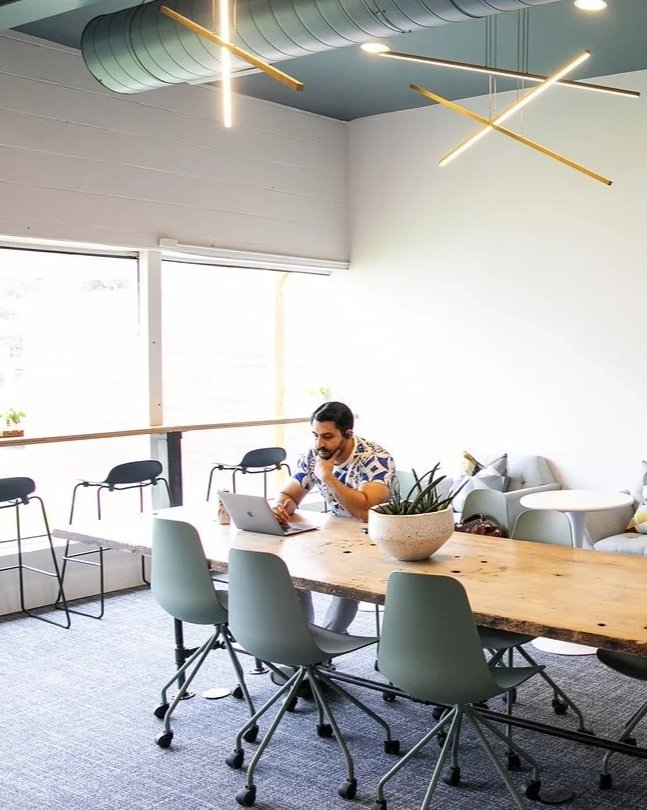
03 / THE MONEYMembership starts the engine; rooms broaden the bet
Today the entry offer is simple. For $159 month to month, a coworker gets 24/7 access, fast internet, huddle rooms, phone booths, a wellness room, events, neighborhood discounts, coffee and kombucha. Story advertises a money-back promise if the first month feels wrong. Private offices for teams from one to 30 start at $650 a month. That adds higher-value recurring licenses without turning every customer into a long-term tenant.
Rooms provide the transactional layer. A four-person huddle room starts at $55 an hour. Conference rooms for eight to 18 begin at $75 or $85. A classroom accommodating 25 to 43 starts at $140. Displays, video conferencing, water and basic refreshments are included. Full buyouts and catering add-ons stretch the same square footage into offsites, trainings and events.
The blend matters. A pure desk-rental business competes with spare bedrooms and coffee shops, both brutally priced. A pure events business starts each month at zero. Story combines recurring access with bookable inventory, then uses hospitality and programming to make the commodity feel particular. Each product also catches a customer at a different moment: the solo worker today, the growing team next quarter, the offsite organizer on Thursday. In economic terms, the product is utilization. In human terms, it is being greeted by name and knowing where to find a charger before a presentation.
04 / THE DIFFERENCELocal density beats a giant network - in one city
National coworking brands can offer addresses in many cities. Story's advantage runs in the opposite direction: it knows one ecosystem densely. Members get local discounts and a regional Coworking Passport. Quills coffee and Elixir kombucha turn nearby companies into daily rituals. Founder Fridays, launched with Amplify Louisville in 2022, opens the doors free to startup and small-business founders on the first Friday of each month. A pay-what-you-can accessibility program tries to keep the membership fee from becoming a velvet rope.
Wild, the affiliated founder-support nonprofit that Story calls its flagship program, extends the proposition beyond workspace. It offers a virtual incubator, an in-person accelerator, education and mentorship for founders commonly overlooked by capital networks. Wild reports more than 100 founders supported, more than $500,000 raised by alumni, and participant groups that are 70 percent women or nonbinary and 80 percent BIPOC. Those figures belong to Wild, not Story's membership roll, but they show what Story wants the building to do.
Even its in-kind event rules are revealing. Story welcomes educational workshops, creative collaborations and programs that enrich members' lives. It explicitly declines for-profit events and marketing pitches disguised as community. Supported events must remain open to members and generally carry at least a $350 staffing and cleaning fee. It is a small policy with a large idea behind it: community attention is inventory too.
“When we first started, we were doing too many things, but now we've been able to get really crystal clear about who we want to serve and how we want to do it.”Lauren VanCleave, 2021
05 / THE COPYABLE PARTProgram the room before multiplying it
Story's playbook is not “buy attractive chairs.” The repeatable sequence is more disciplined: start with a specific lonely customer, invite that customer through a useful low-friction event, observe what makes them return, and only then package recurring access. Add rooms and offices once the daily experience works. Let local partners improve the offer instead of decorating a sponsor wall.
Use free founder days as both public service and product sampling. The visitor experiences the community before being asked to subscribe.
Track return visits, introductions made, room utilization and conversion by program - not merely event attendance.
Hospitality is labor. Someone must remember names, make introductions, fix the screen and protect the room from thinly disguised pitches.
The model needs enough nearby independent workers, small teams and partners to create repeated collisions. Sparse demand becomes expensive décor.
The conditions matter. A single-city network will not satisfy customers who need a desk in 40 markets. Community programming will not rescue bad access, unreliable internet or rent that assumes full occupancy. Pay-what-you-can access needs a subsidy elsewhere in the model. And founder energy can become cliquish unless staff actively welcomes the person who knows nobody.
Story now calls itself a “third space” - neither home nor conventional office. The phrase can sound like brochure vapor. Here it has a practical definition: a place where independent people can concentrate alone, meet without improvising, and occasionally encounter someone who changes the work. The company has learned to charge for the square feet while giving people a reason to care which square feet they choose.