Steve Sorensen began with a piece of wire from a hardware store. It became a ball, the ball went inside a bottle, and a home business followed. There is something pleasingly unceremonious about that sequence. Before the retail displays, the water-bottle colors and the Lehi campus, there was an object small enough to lose in a kitchen drawer. Sorensen had given it a job: break up the lumps that shaking alone left behind.
In 2000, he and his wife, Kim, founded BlenderBottle in the den of their home in Orem, Utah. Steve would serve as CEO and Kim as COO. Their eventual company, Trove Brands, would encompass BlenderBottle, Owala, Whiskware and EcoBrite. But the interesting part of Sorensen’s story is how often the next development began with a very small inconvenience. A lump. An awkward drinking opening. A customer who kept walking.
A hardware-store answer
Sorensen’s first invention has the appeal of something you can understand without a demonstration video. The BlenderBall is a loose wire whisk. Shake the bottle and it moves through the contents, doing the mixing work. The cleverness sits inside the container, where it can be useful without requiring a motor, a cord or a counter.
The origin carries through into the company’s identity. BlenderBottle’s own account places that hardware-store wire at the beginning and credits both Steve and Kim with recognizing a business in it. This was a partnership from the outset. The den supplied the office; the invention supplied a reason for someone to buy. The more elaborate infrastructure came later, as customers gave the couple reasons to keep going.
By January 2012, Sorensen was demonstrating the SportMixer at the Outdoor Retailer Winter Showcase. The bottle had a carrying loop, measuring marks and odor-resistant Tritan construction. It came in 20-ounce and 28-ounce versions. These were practical adjustments to the circumstances in which people carried and used the original idea. A container that performs well while being shaken still has to travel in someone’s bag.
Sorensen approached the demonstration with an inventor’s willingness to push the example a little further. He said the bottle could blend peanut butter and whip cream. A wire ball making whipped cream is a fairly economical sales pitch. You can imagine the question it leaves with a shopper: what else could this little thing do?
Color arrives before the cult bottle
Long before Owala’s color combinations became part of its appeal, BlenderBottle was working on the relationship between usefulness and appearance. In July 2013, the Classic gained full-color versions in red, pink, orange, green, blue, purple, black and aqua. Sorensen connected the expanded palette to personalization. People could buy a mixing tool and still have an opinion about its shade.
That summer also brought a broader identity project with the creative agency Struck. The work covered the logo, typography, packaging and retail displays, as well as several product lines. The new logo used a stylized BlenderBall. Even when the company changed its outward appearance, the little whisk remained the identifying mark. It was an unusually literal way to keep an origin story in view.
Sorensen wanted the brand to remain approachable as it changed. That detail matters when looking at the business he helped build. Bottles are everyday companions; a company selling them has many opportunities to become pompous about a lid. An informal voice gives a useful object room to be enjoyable. Later, Owala would take that permission considerably further.
Small parts, different jobs.
The design work extended beyond graphics. The 2017 European Product Design Award listing for the BlenderBottle Radian names Sorensen alongside Manny Carreon and Dave Myers on its design team. The entry describes a twist-cap, a detachable carrying loop and a tapered shape suited to cup holders. Those are decisions about fingers, bags and cars, expressed through the shape of a bottle.
The Radian also supported different materials, including glass, Tritan and insulated stainless steel. That range exposes a difficulty hidden by the word “bottle.” One customer wants to see through it; another wants insulation; another wants a particular feel. A designer has to work through those preferences while preserving the basic usefulness that made the object worth carrying.
The den acquires neighbors
The early business reached customers through Good Earth Natural Foods in Orem. By September 2017, Steve and Kim were celebrating a second headquarters building in Lehi. The original 100,000-square-foot facility, opened in 2013, had been expected to meet their needs for five years. They outgrew it in a year and a half.
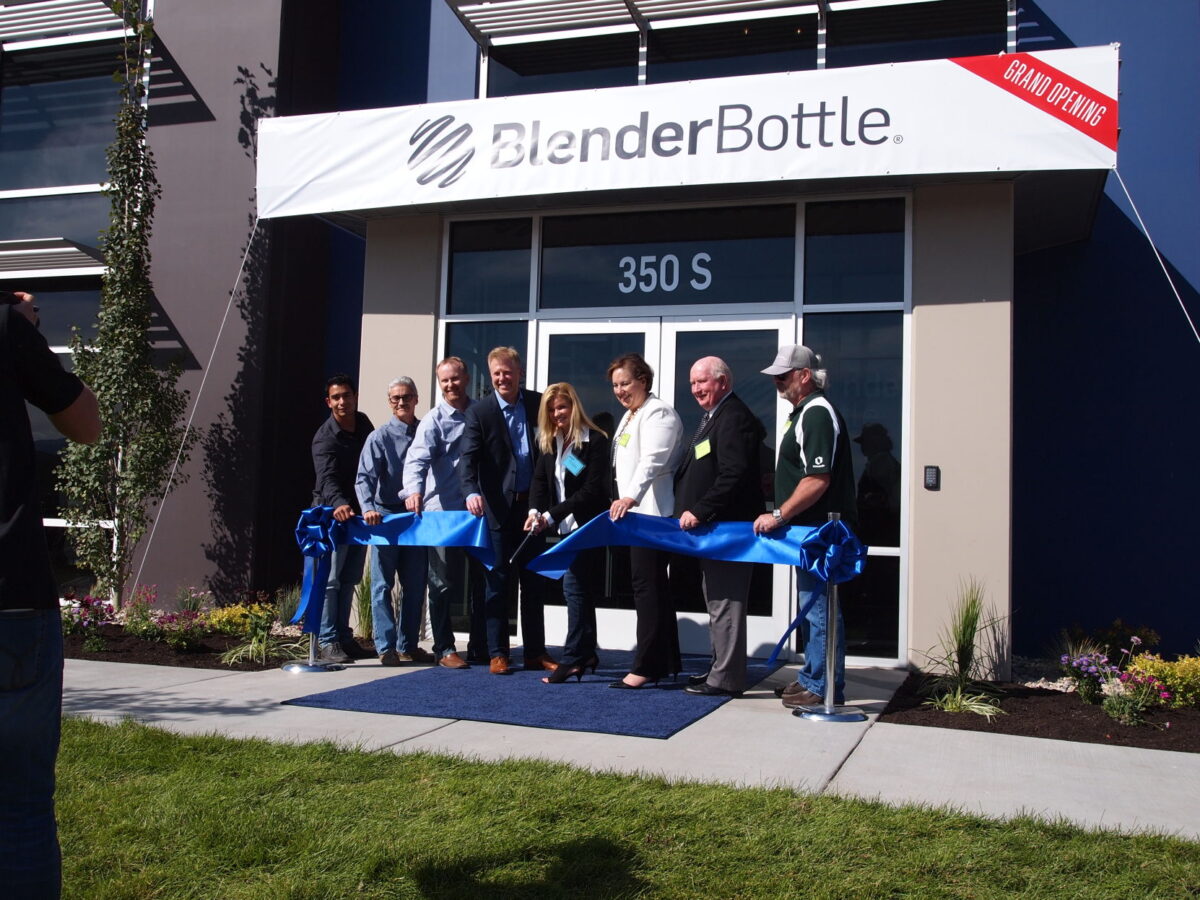
The additional building brought roughly 110,000 square feet. Growth becomes rather less abstract when it requires another roof. For the Sorensens, a business intended to operate from home had become an organization with warehouse space, colleagues and a campus. Kim described the new building as a tribute to employees. The ribbon-cutting photograph puts the couple among other people, a fitting composition for the business they would later describe.
A bottle with two constituencies
The opening for another invention emerged from customers who were already carrying BlenderBottles as ordinary water bottles. Sorensen noticed that behavior. A product designed for mixing was being recruited for another job. The observation raised a reasonable question: what would a bottle designed specifically for that job look like?
There was another division to address. Some people preferred drinking through a straw; others preferred an open spout. The FreeSip put both options into one drinking opening. Its built-in straw lets the user sip while holding the bottle upright; the wider opening allows a different way to drink. Choosing a bottle no longer required settling that particular domestic argument in advance.
The design would earn a place on TIME’s 2023 Best Inventions list. Sorensen is credited with the FreeSip invention as well as the BlenderBall. The connection between them is visible: both concentrate the useful change in a small component. A bottle is familiar enough to escape attention. Its interior, or the place where your mouth meets it, can still contain a design problem.
“You have the straw people, and you have the spout people.”
Steve Sorensen, 2023
The shoppers who kept walking
Getting that invention onto shelves did not settle the commercial question. The bottle initially appeared in 2019 as BlenderBottle Hydration. In Michael Sorensen’s later account, Steve watched shoppers pass the display and choose a competitor. He and Kim decided a separate brand was needed, and Steve contacted Michael that evening. The team had eight months to prepare the relaunch.
That episode gives the inventor a less flattering, more useful setting than an awards announcement. The product existed. The established name existed. The shopper still walked past. Sorensen had to respond to the distance between what the company believed it had made and what someone saw while choosing a water bottle.
Owala launched in March 2020. Giving the product a new name created room for a different personality, with color and playfulness central to its presentation. The retail encounter belongs in Sorensen’s story because it shows observation continuing after invention. Watching a bottle work and watching someone decline to buy it both supply information. The second experience is considerably harder to enjoy.
- 2000Steve and Kim establish BlenderBottle in Orem.
- 2017A second Lehi headquarters building opens.
- 2020Owala launches in March.
- 2023FreeSip joins TIME’s Best Inventions list.
- 2024The founders move into board co-chair roles.
The next handoff
On January 1, 2024, Steve and Kim shifted from daily operations to co-chairing Trove’s board. Their son Michael, previously vice president of marketing, became CEO. The change followed 23 years of the couple running the company together. Their stated plan kept them involved in strategic and advisory work across the business.
“We’re not retiring,” they said jointly when announcing the transition. They emphasized the team they had built and their confidence in its next leadership. For founders associated with particular inventions, that choice of emphasis is revealing. An object may begin with one person bending wire; the company that gets it into customers’ hands requires many more people.
Their aspiration at this stage was continued involvement with more responsibility passing to others. Board work offered a way to stay close to the company while changing how they contributed. There is a practical continuity here: the founders who once divided the CEO and COO jobs were again arranging the work between people, only now across a much larger organization.
The campus keeps growing. In May 2026, Trove broke ground on a third Lehi building. The planned 100,000-square-foot addition would bring the campus above 300,000 square feet, with completion expected in summer 2027. The company then had nearly 500 employees. Michael was leading it through the next expansion.
Look at the sequence and the work changes scale several times. First comes a component, then a product someone can carry, then a brand someone can recognize from the aisle. Eventually there are buildings and a leadership structure. Each stage adds decisions that the original piece of wire could never answer. That is what makes the partnership with Kim, the design colleagues and the eventual handoff to Michael part of the invention story too. Getting an idea into use brings other people into the picture. Keeping it useful gives them something to work on after the first version is finished.
Sorensen’s career offers plenty of things to count, but the small objects remain the most illuminating. A loose whisk. A drinking opening. A bottle on a shelf that fails to stop a shopper. His story turns on paying attention to each of them, then accepting the work the observation demands. The hardware-store wire was a modest beginning. The interesting habit was to keep looking.
Keep the bottle conversation going
Visit Trove Brands, explore BlenderBottle and Owala, or read about the leadership handoff, Owala’s relaunch and the 2026 campus expansion.