Steve Axelrod’s daughters had a suggestion for the license plate on his BMW 330 convertible: XRAY BMR. Their father was helping develop a miniature X-ray source. The car supplied the other half of the joke. In 2008, he reported that colleagues appreciated it, though strangers had been less forthcoming. “Maybe people are scared that the car emits X-rays.” A technical career had acquired an unusually cheerful piece of signage.
The plate is a useful place to begin. A list of senior positions would introduce an executive. The family joke introduces someone whose work had followed him home, where it could be teased. Physics was sufficiently present in daily life for his daughters to turn it into seven characters. The convertible, obligingly, became a small public noticeboard for their wit.
Axelrod is now a co-founder, CTO and board member at G-Tech Medical. He began serving as its CEO in November 2011. Behind those titles lies a career in instruments: devices that detect, quantify and distinguish things that would otherwise remain difficult to see. His industrial inventions concern alignment, calibration, static electricity and the handling of moving material. Precision, in this story, comes with plenty of moving parts.
A laboratory education, with a terminal attached
He earned his undergraduate physics degree at the University of Connecticut and a doctorate in elementary particle physics at Yale. His doctoral adviser was Michael Zeller. The dissertation examined a particle reaction involving negative kaons and sigma-plus formation, comparing measurements with existing analyses. Even the title has the density of a suitcase packed by someone who distrusts checked baggage.
Yale identifies him as an experimentalist. That word matters. The dissertation dealt with recorded cross sections at specified beam momenta. It was concerned with what an experiment could establish, and how those observations compared with other descriptions of the same physics. The instrument and the interpretation had to meet somewhere measurable.
His Stanford postdoctoral work included Brookhaven’s E-791 experiment, which searched for a particular forbidden kaon decay. His account records no such events at the experiment’s sensitivity. An experimental result can be an absence with a carefully established boundary. A scientist still has to explain what was sought, how closely the search looked and what the equipment could have missed.
Axelrod also remembers communicating with friends at distant accelerators over Bitnet and Arpanet, using PDP-10 and VAX terminals before the World Wide Web. His biography includes particle detectors, fast electronics, vacuum equipment and superconducting magnets. The early email recollection adds a different sort of instrument: a terminal that could reach another laboratory. Technical work was already a conversation across distance.
The factory floor tests the physicist
After Stanford, Axelrod stayed in the Bay Area. His next substantial chapter lasted 15 years at Measurex, which later became part of Honeywell. He developed measurement systems for industrial use and held sensor and hardware engineering leadership roles. The work included infrared moisture sensors, nuclear and X-ray measurement systems, and large electromechanical scanning equipment.
His patent record makes that chapter tangible. A nuclear gauge invention names Axelrod alongside John Goss, Mathew Boissevain, Philip Hegland and Scott Wiley. It concerns the measurement of material moving through continuous sheet-making processes. A rotating assembly carries a radiation source between a measurement position and a shielded position. The mechanics determine when the source can face the passing sheet.
There is a wonderfully unromantic specificity to this kind of invention. It includes stops, apertures, a source enclosure and measures to discourage unwanted adjustment. A mechanism responding to excessive heat helps return the assembly to its closed position. The document follows the instrument into circumstances less agreeable than an orderly demonstration.
That makes the factory chapter more than an interval between universities and startups. It supplies concrete examples of engineering that must accommodate motion, positioning and failure conditions. A passing sheet cannot politely suspend production while its measuring equipment gathers its thoughts. The machine has to have done some of that thinking beforehand.
Small errors, carefully named
Another invention addresses the alignment of a measuring head in an X-Y plane. Axelrod is one of its named inventors. Here the problem is the relationship between sensor position and the properties being measured. Detecting misalignment makes correction possible. The reading depends on where the hardware actually sits, rather than where everyone would prefer it to sit.
A later Honeywell patent, co-invented with Harriss King, Wesley French and Scott Wiley, tackles automated calibration of an optical thickness sensor. It describes measurement components that can drift as temperature changes or equipment ages. A device can begin in calibration and gradually depart from it. The system therefore needs a way to establish its own measurement relationships again.
The proposed arrangement uses a moving platform and a displacement measurement to calibrate sensors. It gives the instrument a controlled reference within the apparatus. For a reader outside engineering, the human-sized point is simple: yesterday’s correct answer does not relieve a machine of checking today’s. The patent makes room for that check in the machinery.
Static electricity receives its own treatment in another invention carrying Axelrod’s name, alongside Lee Chase, Robert Beaman and Leon Tao. Moving paper or plastic can acquire charge through contact and friction. That charge can interfere with electronics and sensors. The invention describes an arrangement to drain charge and measure what is being removed.
Its needle-like projections sit close to the moving material, creating a path for charge to reach ground. Measurements can then inform a manufacturing controller. The system both manages a disturbance and makes the disturbance observable. Across these inventions, the same practical concern recurs: something surrounding the desired measurement may alter the answer.
These are modest-sounding nouns with considerable consequences. Alignment, calibration and charge control seldom supply the glamorous part of a product description. They do help determine whether a measurement can be used. Axelrod’s patents show an executive biography rooted in that less theatrical work, with colleagues’ names printed beside his own.
A company needs somewhere to live
In 2003, he joined Xoft, working on a miniature X-ray source and the systems around it. His professional history includes senior applied-research responsibilities there, followed by startup consulting. By late 2011, he was leading G-Tech. The shift brought a further set of measurements into his working life: money available, people needed and time remaining.
Axelrod and Anand Navalgund spent their first two and a half years without income. He later credited three organizations with helping the company continue: the Kenneth Rainin Foundation, Breakout Labs and the Fogarty Institute. Early funding supported work on data analysis. Fogarty supplied workspace and day-to-day support. The place to work was part of the invention’s circumstances.
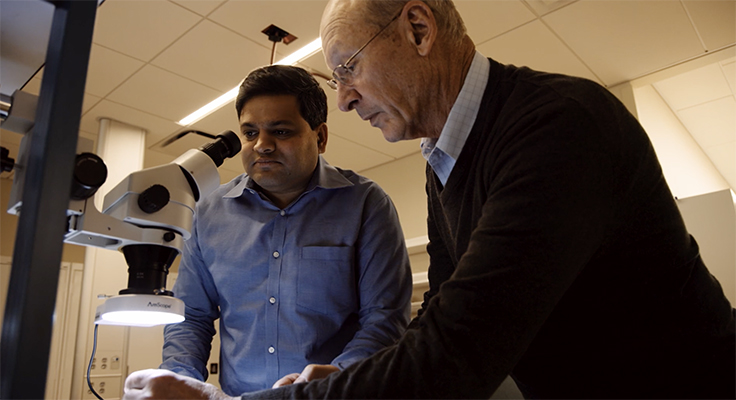
A photograph of the two colleagues beside a microscope puts the team back within arm’s reach of the equipment. Axelrod stands on the right, leaning toward the work. Navalgund stands on the left. It is a useful image for a career that has moved between research and management: two people attending to something smaller than either of them.
In March 2026, Axelrod described a difficult funding environment. Investors were protecting existing portfolios, making substantial new backing harder to obtain. He asked funders to stay the course. The language was about continuity: securing enough support to keep development moving. Years into a company’s life, the resources required for the next stage remained part of the daily problem.
Credit belongs in the plural
Axelrod has also objected to how company stories distribute attention. Commenting on an interview that included his colleagues, he pointed out that the chief executive often receives an oversized share of attention. It is a concise correction to the single-person version of a startup. His industrial patents, with their lists of co-inventors, provide an earlier example of a record that makes collaboration visible.
“CEOs often get too much credit for team accomplishments.”
Steve Axelrod
When Rob Kirby joined G-Tech in 2021 as vice president of strategy and business development, Axelrod emphasized versatility and cultural fit. Kirby’s experience included Xoft, and he had known Axelrod for years. Their working connection had crossed company boundaries. A small organization was adding someone who could perform in several kinds of role.
Kirby described watching the idea develop over time. Axelrod’s comments on the appointment focused on what the new colleague could contribute to the team. The emphasis was practical. In a small company, a job title can occupy less territory than the actual job. Someone may need to understand a plan, coordinate its execution and help explain it to the next person.
Investor conversations occupy another part of that work. At a major industry conference, Axelrod said he derived particular value from meetings he had arranged with potential backers. The formal talks had their place; the surrounding conversations helped a founder pursue resources. An experimental background does not exempt anyone from putting appointments in a calendar.
Back to the instrument
The career joins several scales of work: particle reactions, moving sheets, miniature sources and company building. Each chapter has its own equipment and its own collaborators. The recurring concern is the reliability of what can be learned. An optical head needs alignment. A sensor needs calibration. A growing company needs people capable of carrying the work into its next phase.
That thread gives Axelrod’s present technical and board responsibilities a history. His path to leadership included years spent on the apparatus that makes an answer possible. The titles record increasing responsibility. The inventions record particular problems confronted with others. Read together, they produce a more useful portrait than the titles alone.
And then there is the convertible. For all the careful language of measurement, his daughters found a compact description that would fit on a license plate. XRAY BMR offered colleagues a joke and strangers a small puzzle. After a career spent making difficult things legible, Axelrod could apparently tolerate a little ambiguity in the driveway.