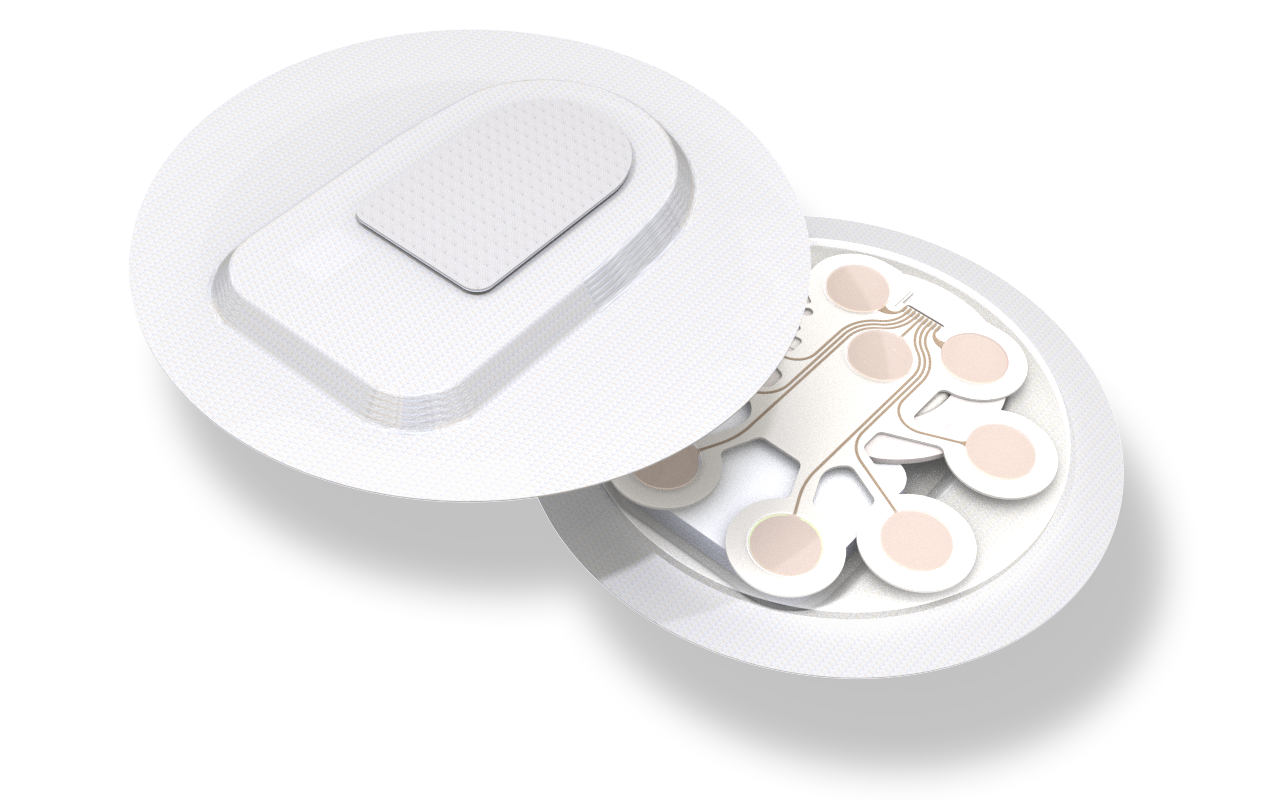
An "EKG for the gut" - a thin patch that listens to your digestion for six days straight.
The logo of a company that decided the gut deserved its own monitor. Yes, really.
Somewhere in a patient's kitchen, a thin adhesive patch sits quietly on an abdomen, doing what no four-hour clinic test ever could. It is recording. Not blood, not images - the faint electrical pulses that push food through the stomach, small intestine, and colon. The patient is making coffee. The patch is making a six-day diary of a digestive system at work.
This is G-Tech Medical's whole proposition, and the company has the regulatory paperwork to back it up. In January 2022 the FDA cleared its Wireless Patch System. It has its own reimbursement code. It has a name that the team cannot resist using: the "EKG for the Gut."
The pitch sounds almost too tidy. Cardiologists have listened to the heart's electrical rhythm for a century. The gut has its own slow electrical waves, firing every few seconds, coordinating digestion. Until recently, almost nobody was recording them outside a hospital. G-Tech decided that was an oversight worth a company.
"It's the difference between measuring for four hours and measuring for six days."
- Steve Axelrod, Co-Founder & CTOHere is the uncomfortable truth about digestive disease: most of it does not show up on a scan. Gastroparesis, IBS, chronic constipation, the murky category doctors call "functional GI disorders" - these are problems of function, not anatomy. The plumbing looks normal. The plumbing is not behaving.
Traditional tests were built for a different question. Scintigraphy measures gastric emptying for a few hours under a camera. Manometry threads a catheter. The motility capsule travels through once. Each one captures a single organ, in an artificial setting, for a sliver of time - then asks a physician to extrapolate a chronic, intermittent condition from a snapshot.
It is a bit like diagnosing a car that only stalls on Tuesdays by test-driving it on Friday. Technically a measurement. Rarely the answer.
"For most people with digestive issues, everything looks fine - but isn't working correctly."
- G-Tech Medical, on why functional GI disorders hideSteve Axelrod is a PhD, not a gastroenterologist, which turned out to matter. He came to the gut the way physicists tend to arrive at problems - convinced that a signal exists and that someone simply has to build a sensitive enough instrument to capture it. He took the CEO seat at G-Tech in late 2011.
The motivation was not purely intellectual. Axelrod's mother died of colon cancer. His daughter, Lindsay, went through the frightening onset of Crohn's disease and the long search for a treatment that worked. Lindsay now works at the company as its Clinical Science Manager, which is either a touching family story or a quietly damning comment on how badly the field needed better tools. Probably both.
The bet itself was simple to state and hard to win: that you could read the gut's electrical activity from the skin's surface - non-invasively, wirelessly, for days - and that the resulting flood of data would say something useful. Incubated at Fogarty Innovation, the medtech institute founded by balloon-catheter inventor Thomas Fogarty, the team set out to prove the signal was real.
"Our ultimate goal is a motility solution that localizes the sources and identifies the nature of GI disorders."
- Steve Axelrod, on the company's missionG-Tech Medical is established in Mountain View to measure gut function non-invasively.
The physicist co-founder becomes CEO and CTO, setting the science-first direction.
DigiTx Partners leads the round; EMV Capital and the Kenneth Rainin Foundation join.
The Wireless Patch System is cleared for non-invasive myoelectric measurement.
Pilot results on functional dyspepsia, gastroparesis, and vomiting are presented.
A clever patch is a science project until the data hold up. G-Tech's case rests on the published record: more than seven peer-reviewed studies, a demonstration that the surface patch agrees with internally implanted electrodes, and a reported result where the system outperformed scintigraphy - the field's gold-standard gastric emptying test.
The endorsements followed. Dr. Brian Lacy, a Mayo Clinic professor and former editor of the American Journal of Gastroenterology, lends his name. Scott Schorer joined as CEO and board chairman to steer commercialization. The Kenneth Rainin Foundation funds the patch's use in inflammatory bowel disease research.
Approximate, illustrative comparison of typical monitoring durations. The point isn't precision - it's the order of magnitude.
"We are excited to receive our first regulatory clearance - a key achievement toward identifying the nature of GI disorders."
- G-Tech Medical, on its 2022 FDA clearanceThe physicist who bet a signal was there - and built the instrument to hear it.
Came aboard to take an FDA-cleared device from lab bench to gastroenterology clinics.
Biomedical engineer, 9+ journal articles, turning electrical noise into evidence.
Lived the problem as a Crohn's patient; now helps prove the solution.
The buyers are gastroenterologists, GI physician groups, and the hospital committees that decide what gets reimbursed. The end users are people the system has failed before - patients with gastroparesis, IBS, IBD, chronic constipation, and post-surgical patients whose bowel function needs watching. For them, the value is brutally simple: a test that happens at home and lasts long enough to catch the problem in the act.
Return to that patient making coffee. For years, their version of this morning ended at a clinic, under a camera, for four hours that may or may not have caught the symptom they came in about. They left with a snapshot and a shrug.
Now the patch does the watching. Six days of it. The symptom that only shows up on a bad afternoon finally lands on a chart. The gastroenterologist sees the whole gut, in motion, in the real world - and for the first time has data shaped like the disease itself: chronic, intermittent, personal.
G-Tech Medical did not cure anything. It did something quieter and, arguably, harder. It made an invisible system visible. The coffee is still brewing. The difference is that now, somebody is finally listening.