The story of Stephanie Cho’s career is best understood through a room full of people who are tired of doing the wrong work. At AdvancedMD, that room is metaphorical: thousands of independent-practice owners and employees spending precious hours on billing, claims, denials, eligibility checks, scheduling, and charting after everyone else has gone home. Cho’s job, as the company’s chief marketing officer, is to make that friction visible, then build a marketing organization capable of helping remove it.
She arrived in May 2026 with an unusual collection of vantage points. Cho has been the analyst studying a campaign, the executive shaping a financial product, the small-business owner watching a promotion succeed or fail in real time, and the software marketer translating a complicated service into a reason to care. Her undergraduate degree is in chemical engineering. Her operating instinct is similarly structural: identify the inputs, inspect the system, measure what changes, and do not confuse motion with progress.
AdvancedMD announced her appointment in June alongside a new brand platform, Move Care Forward. The phrase gives a polished name to an unglamorous problem. Independent medical practices do not lack meaningful work. They have too much clerical work crowding it. Cho talks about that burden with the specificity of somebody who understands that “administration” is never one blob. It is a stack of small interruptions, each defensible on its own, collectively exhausting.
The customer before the campaign
Cho’s definition of good marketing begins earlier than the advertisement. First comes an almost psychological understanding of what a customer needs, what frustrates them, and what they are trying to accomplish. Then comes the creative expression: the message, campaign, or experience that turns observation into recognition. She likes the pairing because neither half is sufficient. Data without imagination becomes a report. Imagination without customer truth becomes decoration.
One campaign made this argument to her before she made it to anyone else. Intuit’s QuickBooks “Backing You” work was built around the strange emotional double exposure of small-business ownership: exhilaration and loneliness occupying the same day. Cho had already lived that contradiction. From 2012 to 2018, she owned and managed Bar Method studios in Santa Clara and Campbell, California. The second location, a 2,200-square-foot Campbell studio, opened in 2016 after she and her business partner saw demand beyond Santa Clara.
A studio turns business theory into a daily appointment. Customers notice the welcome, the teaching, the changing room, the class timetable, and whether their hour felt worth protecting. Cho also trained and coached other studio owners in sales, marketing, and promotional testing. Every experiment had a physical address. Every spreadsheet eventually met a person at the front desk.
The QuickBooks campaign worked on Cho because it did not flatten the owner into a segment. It described an emotional reality she recognized. That sense of recognition helped draw her to Intuit in 2018, where she went on to lead product marketing for the QuickBooks services portfolio. She repositioned online payroll products and led go-to-market work for QuickBooks Banking. In a pleasing bit of professional symmetry, the customer who had responded to the story became one of the people responsible for telling the next one.
A résumé with its sleeves rolled up
The earlier chapters supplied useful instruments. Cho started in marketing strategy and campaign-effectiveness analysis at Gap, then moved through merchandise planning at Gymboree. At American Express, she worked on product and channel strategy for an invoicing and payments business. At Wells Fargo, her roles included payments-focused corporate strategy and small-business marketing. Stanford Graduate School of Business added an MBA to the chemical-engineering degree she earned at Notre Dame.
The operating route
- Measure the market
- Own the business
- Build the product story
- Design the growth system
After Intuit came SimplePractice, where Cho’s remit widened. As a vice president of marketing, she led work spanning customer, product, and brand marketing; market research; pricing and monetization; communications and public relations. She designed a payments monetization strategy, led the go-to-market program for an acquired managed billing service, and oversaw a packaging and pricing overhaul. AdvancedMD credits each initiative with multimillion-dollar revenue impact.
When she left SimplePractice in spring 2026, Cho reached for a hiking memory. At the summit of Machu Picchu, she had understood the weight of the trip only after turning around to see where she had been. Leaving the company felt similar: progress mattered, but so did the lessons, people, and experiences revealed by looking back. The metaphor avoided the false neatness of arrival. There was no final destination, she wrote, only a new trail.
Four pillars and a foundation
The new trail begins with organizational design. Cho has divided AdvancedMD marketing into four strategic pillars: demand generation, product marketing, customer and lifecycle marketing, and brand communications. Beneath them sits a shared layer of analytics and operations. The picture is less an org chart than an operating circuit. Customer evidence should travel across the functions; the functions should reinforce rather than merely coexist with one another.
Cho also wants the system to handle two distinct ways of growing. Most of her software career has been spent in product-led growth, where the end user, the product experience, fast experiments, and behavioral data sit close together. AdvancedMD also has a sales-led motion. The attraction of the role was partly the chance to become fluent across both. For Cho, product-led habits can improve the sales motion too: test relentlessly, remain close to the customer, and allow evidence to revise the plan.
Her ambition for artificial intelligence is similarly operational. She does not want a conventional marketing department with a layer of clever tools added afterward. She wants workflows designed with AI from their beginning, supported by an operations team that knows the difference between a demonstration and a durable process. The practical promise is a leaner, faster organization that reserves more human attention for judgment, customer understanding, and original creative work.
The mission has a family connection. Cho’s brother is a surgeon, and she has watched administrative burden land on a physician who would rather spend that time on patients. That observation made AdvancedMD’s subject less abstract. She knew the customer category from her SimplePractice years. Through her brother, she also understood the cost of the problem in a more intimate register.
CEO Amanda Sharp mattered too. Sharp began at AdvancedMD as an intern and eventually became its chief executive. Cho was struck by the continuity: a leader who knew the company at many levels because she had worked at many levels. It was an operator’s reason to trust another operator.
Enthusiasm outruns the score
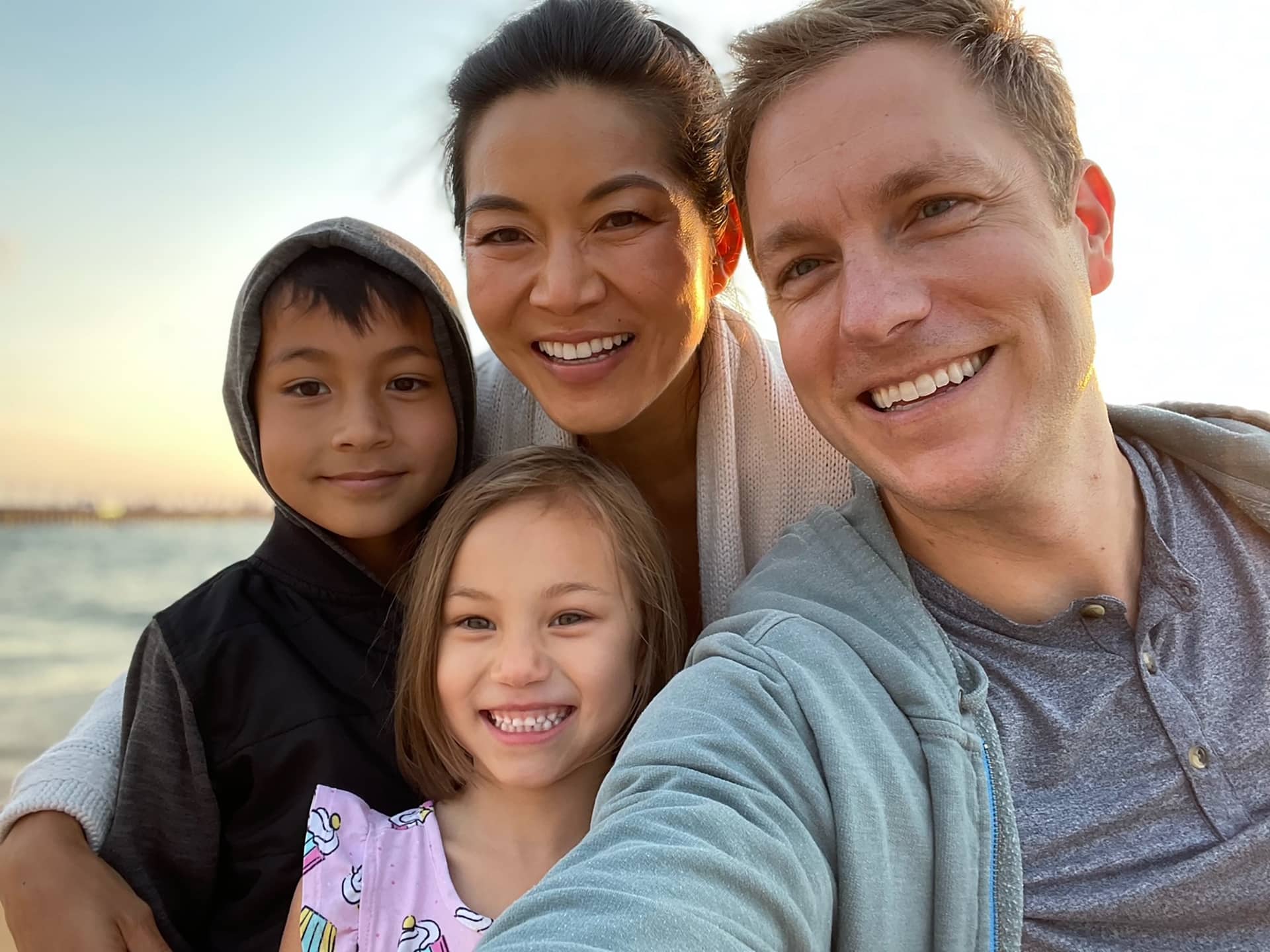
Outside work, Cho and her husband are raising a son and daughter. Her son likes tennis, Fortnite, chess, and expensive sports cars, at least aspirationally. Her daughter makes crafts and ceramics, sings, dances, and invents narratives. Cho calls her the household embodiment of joy, with enough energy for everybody.
Cho’s own hobbies share a useful quality: she is not yet finished learning them. She picked up tennis as an adult and working mother. She is also studying Spanish, partly under her own direction and partly in pursuit of her son’s Duolingo progress. Her description of the tennis project is concise: “My expectations for myself are modest but my enthusiasm is high.” It could double as a humane policy for beginning almost anything.
Then there is Mason, the orange tabby the family adopted in 2025. His cuteness is apparently beyond reason, which has complicated household governance. Cho, her son, and her daughter favor broad feline discretion; her husband is more skeptical. The permissive coalition, she says, is losing on principle and winning in practice. A marketer could admire the outcome. A corporate strategist might request a clearer policy.
These details are funny because they sit beside a career built on rigor. Yet they also complete it. Cho’s style is not measurement in opposition to feeling, or systems in opposition to people. She keeps bringing the pairs together: psychology and creative expression, product-led and sales-led growth, AI and human judgment, analysis and enthusiasm.
That is the real work beneath Move Care Forward. A brand platform can make a promise in three words. Keeping it requires thousands of smaller decisions about products, workflows, messages, and what deserves a person’s time. Cho has spent her career near businesses where those decisions are personal: the owner, the practitioner, the team carrying an invisible load. Her new marketing engine will be judged by growth, naturally. Its more interesting test is whether it remains close enough to the customer to know what growth is for.