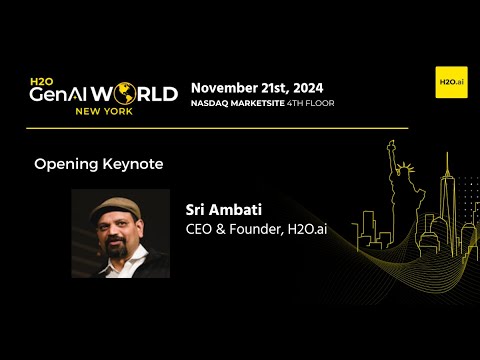
Somewhere around 2012, Sri Satish Ambati looked at machine learning - a field dominated by PhD programs, expensive software licenses, and compute clusters most companies couldn't afford - and made a decision that looked naive at the time: give it away. Not a lite version. Not a freemium hook. The core engine, fully open, with a name borrowed from the periodic table of life: H2O.
Over a decade later, H2O.ai serves more than 20,000 organizations. Over half the Fortune 500 runs on it. The platform that started as an open-source library has evolved into a $1.7B enterprise AI company with AutoML, generative AI, federated learning, and in 2026, tabH2O - a foundation model for tabular data. Sri Ambati is still the CEO. Still shipping.
What makes the story unusual isn't the growth curve. It's the consistency of the thesis. Most AI companies pivoted hard toward generative AI in 2022 as if nothing before it counted. H2O.ai folded it in. The company that built Driverless AI - its automated machine learning platform - launched h2oGPT as open-source. When everyone was licensing their LLMs, Ambati open-sourced H2O-Danube3. When enterprise clients needed on-device, privacy-first vision AI, H2O.ai shipped H2OVL-Mississippi. The pattern holds: capability released, ecosystem built.
By 2025, h2oGPTe hit #1 on the GAIA leaderboard for general AI assistants, outperforming offerings from OpenAI and Google. The H2O AI Super Agent topped the FutureX leaderboard. Gartner named H2O.ai a Visionary in its Magic Quadrant for Cloud AI Developer Services. Ambati didn't rebrand the company around these wins. He announced tabH2O at Dell Technologies World 2026 and kept going.