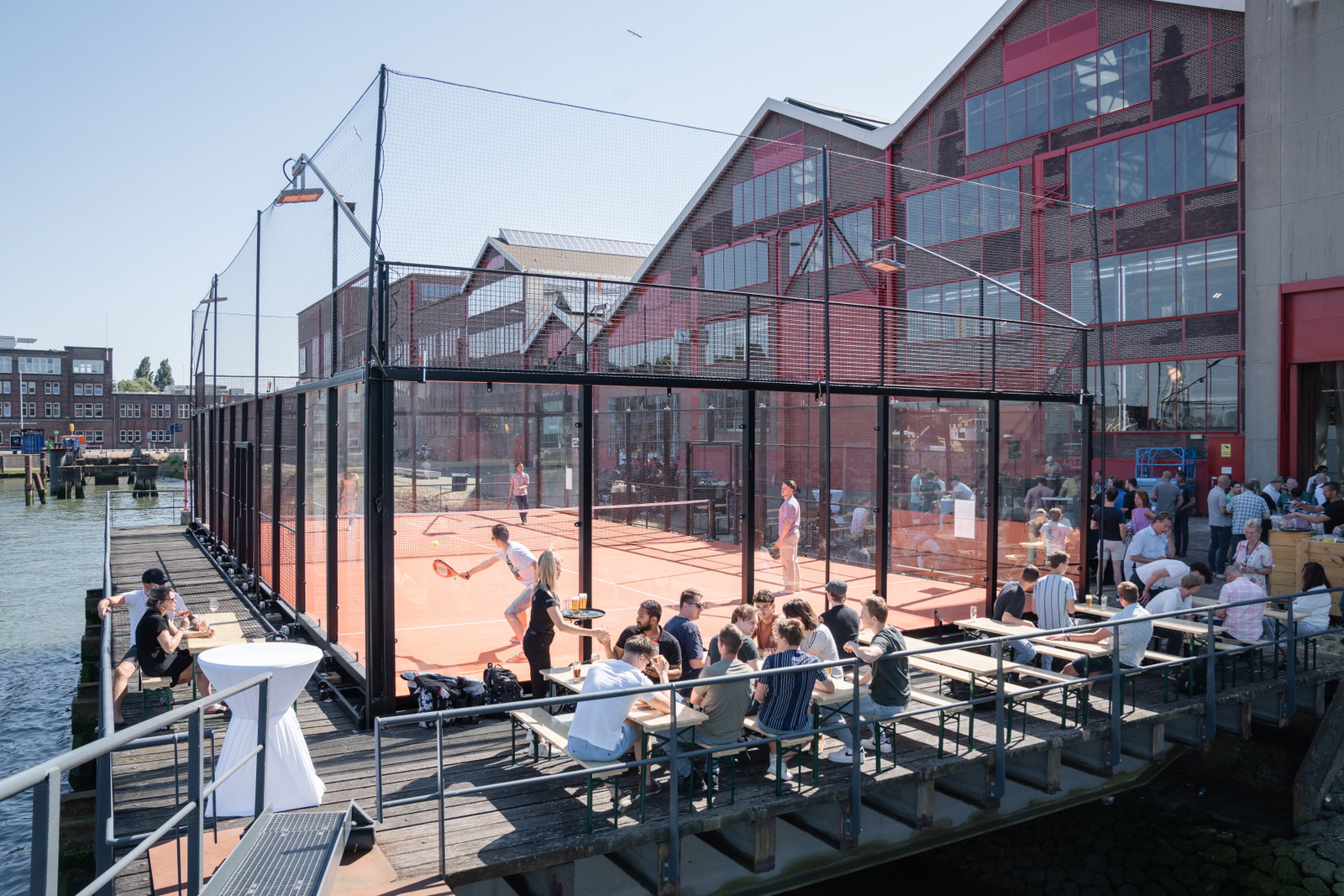
A padel court sits beside the water in Rotterdam, its glass walls framed by industrial buildings and people with drinks. The court belongs to UPCOURT, a business featured by Sportinnovator. Its proposition is pleasantly literal: when permanent sports space is hard to find, bring a court that can move. Getting there was less tidy. Early overseas prototypes required costly corrections; production shifted to VDL in the Netherlands. Assembly still took six to eight hours in May 2026, against a four-hour ambition.
That gap between a promising idea and an everyday operation is Sportinnovator’s territory. The Dutch network helps bring money, expertise and prospective users into the same project. Its remit includes getting people active, improving elite performance and making sports facilities more sustainable. A new invention earns its keep when somebody can actually put it to work.
A public programme with a company-sized front door
Sportinnovator began in 2015 as an initiative of the Dutch Ministry of Health, Welfare and Sport, supported by ZonMw, the health research and innovation organisation. Its origins belong to public policy. The initial government agenda sought better connections between sporting knowledge and practical innovation, with businesses, universities, sports bodies and local authorities contributing resources.
The launch announcement doubled a planned annual €1 million commitment to €2 million in ministry resources. Partnership and cofinancing were explicit conditions. That matters: collaboration was built into the financial proposition from the beginning. The network’s job was to make different institutions useful to one another, with public money helping them take a first step together.
Today, its working vocabulary has four verbs: finance, coach, connect and promote. Companies approach it for development help and introductions. Researchers need somewhere to test. Municipalities bring questions about participation and facilities. Sports organisations supply the practical demands that a clever prototype can easily overlook. These groups are programme users and collaborators; calling them all paying customers would misdescribe the arrangement.
on the market
The introductions are part of the product
Sportinnovator reports more than 1,250 ideas assessed and more than 500 initiatives supported. Its 20 certified centres give the network a physical base. The ambition is to shorten the distance between an inventor and the people needed to develop, test and adopt an invention. Those totals describe activity and market arrival. They should not be read as a count of profitable companies.
The model brings sport, business, research and government together. The official name, “quadruple helix,” sounds like something requiring a microscope. In practice, it means a project can combine a company’s product, a researcher’s methods, a sports organisation’s users and a public body’s local knowledge. The useful question is which of those capabilities is missing from the next experiment.
There is a stage-specific route through the support. Early ideas can use the Academy and centres to develop and validate a prototype. SportUp Boost and other partners address business-model questions. Later-stage ventures can find guidance through the Sports Innovation League and introductions to organisations such as Dutch Sport Tech Fund, Rabobank and LUMO Labs. These are adjacent routes through the market, sometimes partners, rather than a neat list of rivals.
A grant comes with arithmetic
Consider the 2025 centre vouchers. Innovation vouchers ranged from €5,000 to €25,000, while a network voucher could reach €10,000. Each centre could receive up to five vouchers, subject to a combined €25,000 ceiling. Applicants and partners had to contribute at least half the total project budget, in cash or in kind.
A €25,000 award therefore implied a project worth at least €50,000 under that matching rule. Staff time or other eligible contributions could help make up the partner share. This is a useful distinction for a small business: the award is neither the whole budget nor necessarily a requirement to find an equal amount of fresh cash. The terms of the particular call decide what counts.
€50,000 total · partner share may include eligible contributions in kind
For applicants, the copyable habit is to cost the test before polishing the pitch. Identify who supplies equipment, facilities and working hours. Agree on the result that would justify another round. A matching scheme is difficult to use when the partners cannot commit those resources, however attractive the idea looks.
The empty seat and the old pitch
Slinger offers a concrete example of what access can do. The carpooling company won the Sportinnovator Play-Offs in 2024 and participates in the KNVB’s #11 innovation environment. By July 2026, Sportinnovator’s account reported 35,000 users. Slinger connects people travelling to events and gives organisers a view of estimated transport savings.
The revealing detail is its feedback. Founder Marvin Pupping said 80 to 90 percent concerned the experience of travelling together, rather than money or emissions. His advice to organisers was to make sharing a ride part of the occasion. The lesson travels beyond football: a sustainability pitch becomes more usable when it fits what customers already enjoy doing.
Artificial turf presents a different challenge. RSI Sports Group responded to a public innovation tender supported by Sportinnovator after problems in the disposal and recycling chain. The company began work in 2019 on a system that reconsidered the surface and what lies underneath it. It chose PET for the fibres, backing and coating, and developed modular underlayers using old turf.
These are businesses with their own products and responsibilities. Sportinnovator’s role sits around them: identifying questions, helping organise support and making developments visible. Buying a court, arranging event transport or specifying a playing surface takes a buyer to the relevant supplier. The network helps the buyer and innovator find each other.
“We are neither a medicine nor a solar panel.”
Thomas Hoffman, UPCOURT · translated from Dutch
Sometimes the laboratory is a neighbourhood
The broader living-lab network developed with ZonMw contains 33 local labs, eight supported by Sportinnovator. Here the test environment can be a school, neighbourhood or community organisation. Residents help shape experiments alongside researchers, businesses and public or social partners. Their presence changes which problems the project notices first.
Sportinnovator’s own description stresses a shared challenge, an active coordinator and committed partners. It also recognises that different settings require different methods. For anyone copying this approach, that is the operative detail: recruit the people expected to use the result while the design can still change. A trial with little participation from those people will answer a narrower question.
Events offer a faster testing window. In July 2026, Sportinnovator, Innofest and Regieorgaan SIA announced research tests for the Hockey World Cup. Projects included video feedback for training, support for volunteer youth coaches and a setting with fewer sensory distractions. Innofest handles test preparation and execution; SIA and Sportinnovator select and finance the research tests. A crowd becomes a chance to observe comprehension, preferences and willingness to use a product.
Data needs a home; AI needs a decision
Sport Data Valley shows the longer institutional work involved. Developed between 2018 and 2022 by five Dutch higher-education institutions at Sportinnovator’s initiative, it provides infrastructure for analysing sport, activity, sleep and performance data. It became a social-purpose foundation in 2023 and was brought under the Mulier Instituut in March 2025. A data platform needs somewhere to live after the initial development project finishes.
The newer AI Impact Lab has a deliberately practical endpoint. Over five workshops, teams define a sports problem, identify users and data needs, and build a working mock-up. They finish with an implementation decision covering what delivery requires, what it costs and what risks remain. In June 2026, six teams presented prototypes from the first cohort.
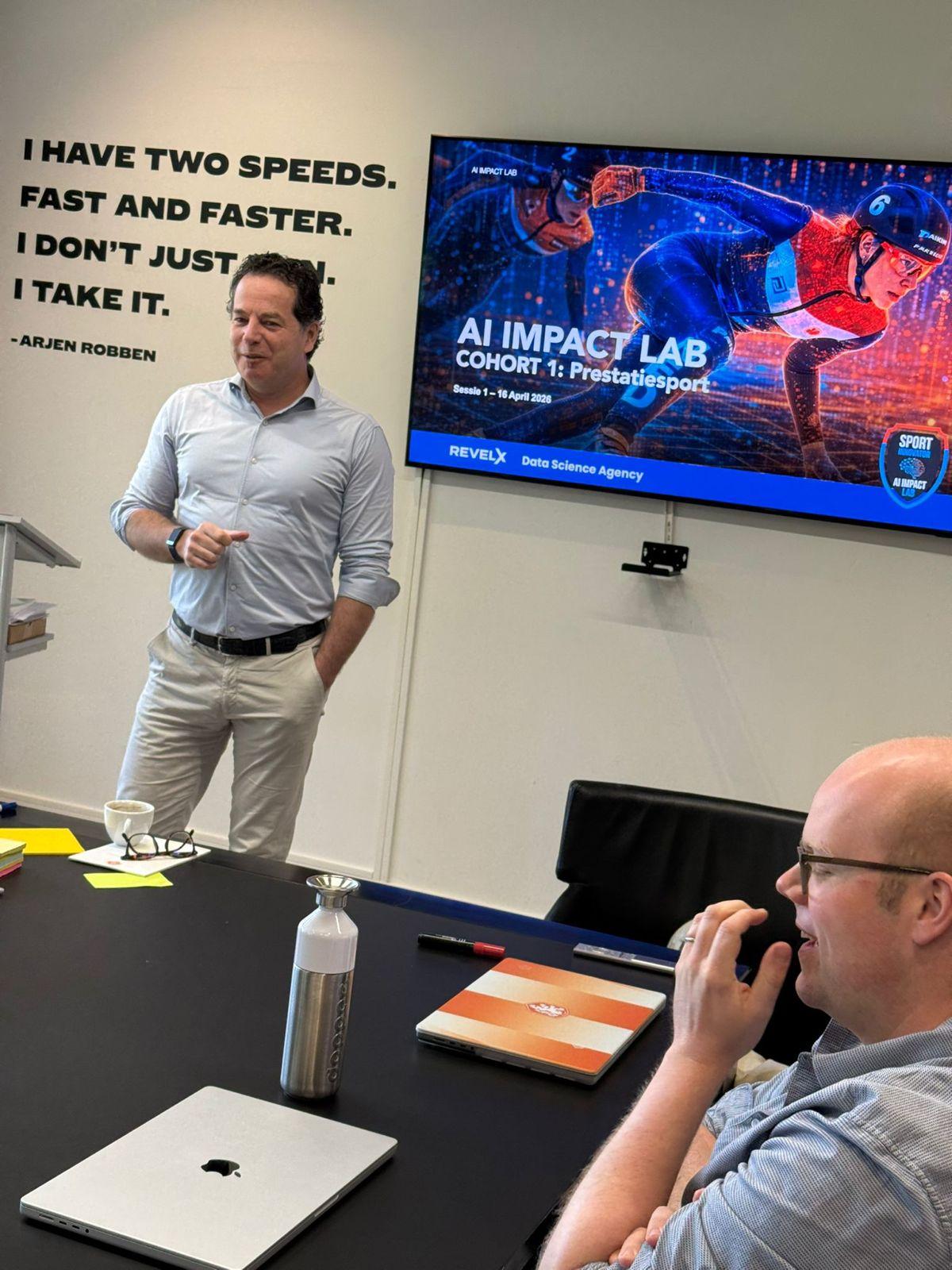
A second cohort, focused on participation and physical activity, was scheduled to begin on September 8 at the KNVB Campus. The programme’s useful discipline is its sequence: establish a problem and a user before deciding how much technology to build. A working demonstration is an intermediate result; the decision about operating it comes next.
A network still has to earn its score
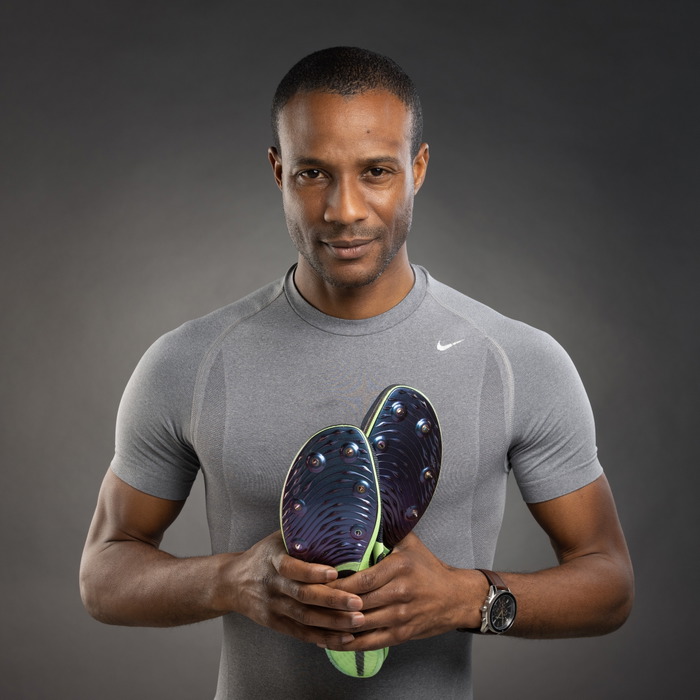
The staff page makes the organisation’s sporting identity unusually visible: professional portraits are paired with sporting ones. Its listed roles cover business development, government, research partnerships, communications and funding, alongside sport innovation officer Merit Clocquet and sports adviser Gregory Sedoc. The mix fits an organisation whose expertise includes navigating institutions as well as understanding sport.
External reach comes through SportsNL and the European Platform for Sport Innovation. Sportinnovator uses those relationships to exchange knowledge, make introductions and promote Dutch ideas abroad. That international route is relevant when a product needs a market larger than its first Dutch pilot.
The independent 2025 KPMG evaluation adds a necessary complication. It put cumulative funding received since inception at approximately €50 million across the first decade, covering innovation support, centres and operations. That is programme funding, not company revenue. It credited the network’s development while questioning alignment between government objectives and the organisation’s priorities. In the accompanying parliamentary letter, the government noted that recipients valued the support but also depended on its financing.
Sportinnovator’s own commissioned monitor supplies another useful check. Published in August 2026, the follow-up reported an average sports innovation score of 6.3 out of 10, broadly unchanged from the 2021 baseline. Innovation was associated with better organisational outcomes; the research explicitly did not establish that it caused them. The network has things to show. Its continuing test is whether more experiments become services that clubs, coaches and residents keep using.