Leon Rutten had explained that the clip stayed on. It had been tested by plenty of riders; it had never fallen off. Then a journalist tried it with her dressage horse, Wim, and within about fifteen minutes it did exactly that. The solution was straightforward: move it lower on the saddle flap, away from her thigh. The universe had supplied a small amendment to the sales demonstration.
The episode, from a 2017 product test, is a useful introduction to Rutten. He was personally delivering the device. He was listening to questions about whether it would work. And the important part happened after the correction: the rider discovered she had made more transitions than she thought. A small piece of equipment had exposed a gap between a ride as remembered and a ride as performed.
Rutten has spent the years since working on that gap. First he built a way to record what a horse did. Now he is building a way to preserve what a coach said. His subject, increasingly, is everything that slips away after a perfectly good riding lesson.
A month upstairs, a lifetime around horses
Early in the SaddleClip’s development, Rutten more or less shut himself in an attic room for a month. He worked toward a device with an internal sensor, attached by a simple clip, with readings accessible through a phone app. Ease of use was part of the premise from the beginning. A rider should be able to attach it and get on with riding.
About 75 test riders tried the sensor during development. One distinction that interested Rutten was the difference between genuine collection and simply going slowly. Both could look like a lower rhythm. The accompanying push-off told a more revealing story. He wanted riders to see whether the work was producing what they intended.
That interest came with practical experience across disciplines. Rutten has a dressage background, competed in show jumping up to 1.45 metres, and later rode eventing through the two-star level. Each asks different questions of a horse and rider. His experience gave him reasons to want a training record that could travel between them.
His family’s equestrian coaching heritage sits alongside more than thirty years of software and hardware product leadership. It is an unusually relevant pairing. One background teaches you to notice small differences in movement. The other teaches you to turn observations into something another person can use.
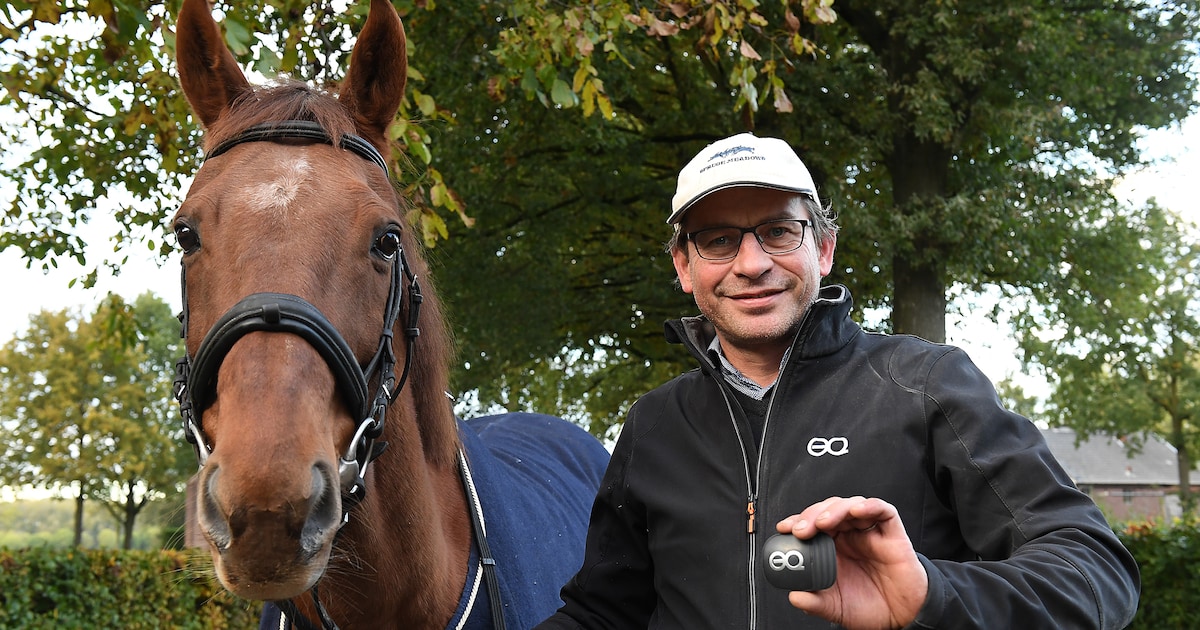
The engineering had to disappear
Rutten took the electronic saddle-clip idea to Brightbird Design, asking for product development and a brand identity. The brief extended to the app and website. For someone making a new instrument for an established sport, the presentation mattered: the object had to be understandable before its readings could become useful.
Brightbird worked on a refined, sturdy design, while engineering partner Fluctus handled the product’s engineering. Its housing used a three-component injection-moulding technique, including two kinds of rubber with different jobs: a soft exterior feel and an internal seal. There is a pleasing amount of industrial effort hidden inside something whose defining instruction is essentially “clip it on.”
That work reveals a recurring feature of Rutten’s approach. He is interested in the whole journey from an idea to an object someone will choose to use. A technically capable device still has to survive the practical questions: where does it sit, how does it feel, and can its owner understand the result?
The early mishap with Wim belongs in that story. A fit adjustment was part of making the instrument work in an actual ride. The elegant box had met a human thigh. Product development had acquired another useful detail.
Getting beyond the demonstration
By March 2018, Rutten was signing a partnership agreement with the Royal Dutch Equestrian Federation, the KNHS, alongside Esther Hendriksen. The ambition was to help coaches and leading riders measure and analyse training. For Rutten, it also offered a route toward wider international adoption. A sensor that makes sense in one arena has to earn its place in many others.
He had also pursued investment for that expansion. In an early funding announcement, Oost NL invested alongside two informal investors. Rutten set out a practical use for the money: hiring people and selling the SaddleClip internationally, with Germany and Great Britain among the initial markets of interest. Growth meant more people doing the work, as well as more riders buying the device.
The pattern is worth noticing. Rutten’s route into a traditional sport ran through institutions and collaborators: a design studio, engineers, investors and a national federation. The clip was small enough to carry in a pocket. The organisation needed to make it useful was considerably larger.
Today Equestic operates as the consumer brand of Smart Horse Technologies B.V. Its current company history dates that business to 2019; Rutten’s product work and partnerships were already under way before then. The business took shape around a problem he had been pursuing for years.
- 2017Early product coverage and rider testing
- 2018KNHS partnership signed
- 2024Coach-Copilot announced; DCTerra collaboration begins
- 2026Coaching forum and British Dressage partnership
The day after the lesson
The sensor created another question. Riders could have more information about their training and still be uncertain about what to do next. Coaches understood what they had taught, yet had little visibility into what happened when the rider went home. Rutten’s next product grew from that separation.
EQ Coach-Copilot records a lesson’s audio and turns it into a structured summary. The coach starts the session in the app, the rider joins, and the lesson proceeds in the coach’s usual style. Afterwards, the coach has an opportunity to review the summary before sending it. The record can then be revisited before the next ride.
For a rider whose lessons are weeks apart, that creates a place to return to the priorities and exercises already discussed. It also gives the next conversation a shared starting point. A coach can refer to the same record as the rider, rather than reconstructing a previous lesson from two separate memories.
Rutten announced the Coach-Copilot software in November 2024. The ambition included a digital twin of horse and rider and more individualised training plans. The everyday attraction of a lesson summary is easier to grasp: tomorrow’s practice can begin with yesterday’s instructions still available.
Three inputs brought into the same training conversation. A conceptual diagram, not a performance measurement.
A room with room for disagreement
At The Dutch Masters in March 2026, Rutten joined a coaching forum with Richard Davison, Di Lampard, Laurens van Lieren, Wout Jan van der Schans and François Mathy Jr. It placed his proposition in front of people with considerable experience of teaching and competition. The discussion included a necessary question: what will the rider actually do with the information?
Van der Schans offered a pointed qualification. An eager student would use both coaching instructions and an app; a student who would not retain the central message might not open the app either. Software still had to encounter the person holding the phone. Giving homework a better filing system could only achieve so much on its own.
Rutten’s own position preserved the coach’s responsibility for interpretation. “Data can show you what’s happening but finding the solution is still the coach’s job.” It is a useful limit to hear from someone selling data tools. The measurement can enter the discussion without deciding its outcome.
That leaves his product with a demanding, sensible task: make the information convenient enough to become part of practice. In his account of development, riders and coaches continuously tested and shaped the system. Adoption depends on whether they find a reason to come back after the novelty has worn off.
“Beyond technology, adoption is always the real challenge.”
Leon Rutten
Into the classroom, then across the Channel
Rutten’s interest in teaching also has a formal educational setting. In December 2024 he met DCTerra’s Erna Daling and Jan-Marc Nieuwenkamp at the start of a partnership involving teachers, students and industry. The collaboration introduced SaddleClip technology into equestrian education, giving students practical experience with movement data and training analysis.
A curriculum creates a different relationship with a tool from a demonstration stand. Students can learn how to interpret a reading, compare it with what they observe, and discuss the result with a teacher. For a founder concerned with what happens to information, the classroom is an appropriate place to put it to work.
On October 15, 2026, British Dressage announced Equestic as its first Official Training and Coach Development Partner. The agreement includes learning opportunities and material for the BD Learning Hub. Approved British Dressage coaches can use Coach-Copilot free for teaching. The partnership brings Rutten’s products directly into an organisation already responsible for developing riders and coaches.
The latest version of the approach includes Rider Reflections, introduced in August 2026, which lets riders capture their own observations after training or competition. The person in the saddle contributes a record alongside the coach’s instructions and the sensor’s readings. Feel has a place in the file.
What survives the ride
Equestic says its sensor has recorded more than 400,000 rides across 65 countries. Coach-Copilot received two Silver recognitions in the 2026 TITAN Innovation Awards. Those are markers of how far Rutten’s work has travelled from an attic and a group of test riders. His stated ambition reaches further: Equestic envisages sensor-equipped sport horses and digital twins by 2030.
Yet the intimate scale of his work remains its most interesting quality. A rider wants to remember an instruction. A coach wants the next lesson to build on the last. Someone looks at a record and notices that the session unfolded differently from how it felt. Rutten keeps returning to these small discrepancies, giving each a place to be examined.
There is something quietly fitting about the original clip falling off during a test. The promise needed an adjustment; the rider made it; the useful work continued. Years later, that remains a good measure of the enterprise. The next ride is where an idea has to earn its keep.
Keep the conversation going
- Equestic website ↗
- Leon Rutten on LinkedIn ↗
- Watch the coaching forum ↗
- British Dressage partnership ↗
- Early SaddleClip development ↗
- The original riding test ↗
- Designing the SaddleClip ↗
- Rutten’s TITAN interview ↗
- The lesson-recording story ↗
- DCTerra education partnership ↗
- Riding background ↗
- KNHS partnership ↗
- Early expansion plans ↗
- Coach-Copilot announcement ↗
- Equestic news ↗
- Rider Reflections coverage ↗
- Equestic on Instagram ↗
- Equestic on Facebook ↗
- Equestic on YouTube ↗