The Startup Teaching Horses to Talk Back
A horse can't tell you its left hind is off. Equestic's SaddleClip listens to the gait instead - and riders in 65 countries are now training to what the data says.
A dressage judge watches your horse for a few minutes and hands you a score. A vet watches for a few minutes and gives you a verdict. The horse itself, meanwhile, has been trying to tell you something for weeks - that the push-off from its left hind is landing a beat short - and it has no way to say so. That gap, between what the animal knows and what the rider can see, is the whole business of Equestic.
Equestic is a Dutch company built around one small object: the SaddleClip, a water- and shock-resistant motion sensor about the size of a car key fob. You clip it to the saddle with one hand, tap Start in the app, and ride. The device records the horse's movement throughout the session and turns it into numbers - rhythm, symmetry, impulsion, balance, transitions, jumps - that show up on your phone the moment you dismount.
What it actually doesReading a stride the eye can't hold
The pitch sounds simple until you consider what a trained rider is up against. A horse at trot cycles its legs faster than a person can reliably parse, and asymmetry - the early signature of strain and injury - often shows up as a difference of milliseconds between one diagonal and the other. Equestic's sensor samples the motion continuously and classifies each stride as walk, trot or canter, then compares the two sides of the body against each other.
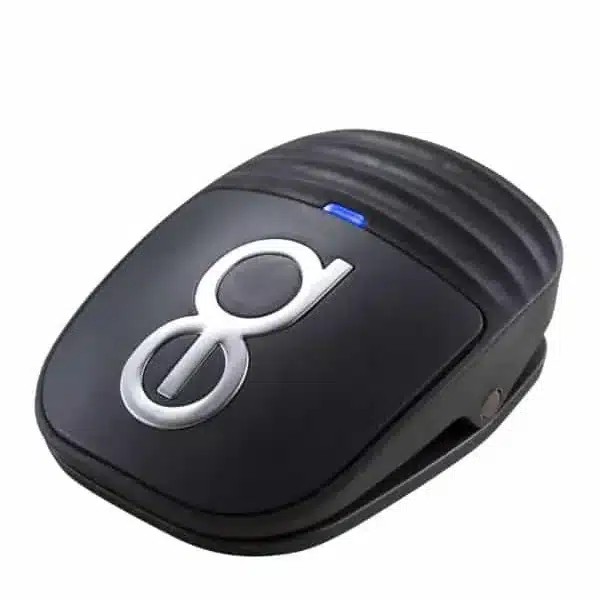
The app breaks a ride into things a rider can act on. A logbook stamps every session with date, duration and notes. A time-balance readout shows how many minutes you spent on the left rein versus the right, in real time, so you can catch yourself over-schooling one direction while you're still in the saddle. It counts transitions between gaits, tallies jumps with the approach they came from, gauges intensity so you can compare how hard two rides really were, and runs trend analysis across your last twenty sessions. When the two sides of the horse drift apart, it raises an asymmetry alert.
Each of those readouts maps to something a coach already talks about, just made countable. Rhythm is the evenness of the beat; a horse that rushes or dawdles between strides shows up as variation the rider might feel but couldn't quantify. Impulsion is the energy pushing the horse forward from behind, and Equestic frames it as a relative measure so you can see whether today's ride carried more power than last week's. Symmetry compares push-off and landing on the left and right in trot. None of this replaces feel. It gives feel a second opinion.
Clip
Attach the sensor to the saddle one-handed and open the app.
Ride
The sensor samples motion and streams it over Bluetooth as you train.
Read
Gaits, symmetry, impulsion and jumps land on your phone at the halt.
Adjust
Trends and asymmetry alerts tell you what to change next session.
The "am I over-schooling one side?" chart
Sample distribution shown for illustration. A lopsided split is exactly the pattern the SaddleClip surfaces mid-ride.The founderSoftware discipline, horse-family instinct
Equestic launched in the Netherlands in 2019 as the consumer brand of Smart Horse Technologies B.V., though the SaddleClip itself reached riders in 2018 after roughly two years of building the gait-classification models. The founder, Leon Rutten, is an unusual match for the problem: an eventing rider from a family with a long line in equestrian coaching, and a product leader with about three decades in software and hardware. The company reads like both halves of that resume - part sports lab, part engineering shop.
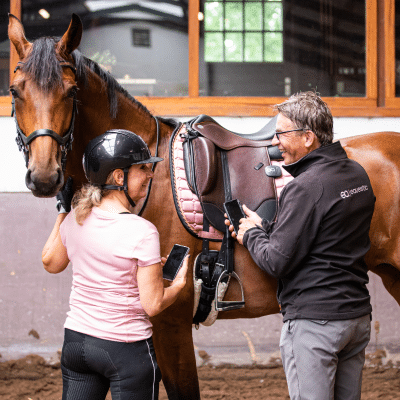
Through this partnership, Equestic reinforces its commitment to innovation, education, and a responsible future for equestrian sport.Leon Rutten, founder
Why it's credibleThe referees signed off
The clearest signal that the data means something is who trusts it. The Fédération Equestre Internationale and US federations have approved the SaddleClip for use in dressage competition, up to level 4, and it is permitted in every FEI discipline except vaulting. That is a governing body agreeing you can wear the thing in the ring - a bar most training gadgets never clear. Along the way the product picked up "Best Equestrian Training Product of the Year" in 2017, a "Best Entrepreneur" nod for Rutten the same year, and a MUSE Design Award Silver in 2019.
The best injury-prevention tool for a horse isn't a vet visit. It's noticing the limp three weeks early.
Who uses itFrom backyard riders to rehab barns
The customer base is broader than the competition angle suggests. Amateur riders use the SaddleClip to see whether their schooling is as balanced as it feels. Professionals and dressage and eventing competitors use it to benchmark progress across a season. And a quieter but important group uses it for rehabilitation: bringing a horse back from injury is a slow, easily-fooled process, and objective symmetry trends give a vet or physio something firmer than "he looks a bit better" to work from. A horse recovering from a soft-tissue strain leaves a numeric trail, and that trail is harder to argue with than a hopeful eye.
That range is why the same €249 device shows up under a teenager's dressage saddle and in a professional rehabilitation program. The data is the same; only the question changes. One rider is asking "am I training this evenly?" and another is asking "is he sound enough to step back up?" The SaddleClip answers both from the identical stream of motion.
The businessA €249 clip, then a subscription
The model is direct-to-consumer hardware wrapped around recurring software. The SaddleClip sells for about €249 with free worldwide shipping, through Equestic's own store and equestrian retailers. The app is free to download, but the depth lives behind Essential and Professional memberships, which unlock extended analysis and multiple horse profiles for riders and coaches running more than one animal. It is the same shape as a consumer fitness wearable: sell the device once, earn on the data afterward.
Hardware once, insight ongoing
Relative emphasis, not revenue figures. The subscription is the piece that compounds as riders add horses and history.The fieldWhoop for horses, and its rivals
Equestic sits in a small but real category of equine wearables and biomechanics tools, alongside names like Arioneo's Equimetre, Seaver and Piavita, plus lab-grade gait systems used by clinics. But its most stubborn competitor is not another gadget - it is the trainer's eye and the occasional vet check, the way the sport has always worked. Equestic's argument is not that the eye is wrong; it is that the eye can't hold twenty rides of history in its head, and a phone can.
That framing matters in an industry estimated in the hundreds of billions of dollars and famously skeptical of gadgets bolted onto a tradition that predates electricity. Getting 400,000 rides logged across 65 countries, in a world where riders distrust anything that beeps, is the part of the story that is hard to fake.
The edge Equestic leans on is the combination it was built from. Sensor hardware is one skill. Turning noisy motion into a gait model that holds up at competition speed is another. Reading that output the way a coach would, and packaging it so a rider acts on it rather than ignores it, is a third. Plenty of teams have one of those. Equestic's argument is that its founder's two-sided background - the software decades and the riding-coach lineage - is why the product speaks the sport's language instead of a lab's.
What's nextCoaches, copilots and digital twins
Equestic has been pushing past the sensor. In early 2026 it partnered with The Dutch Masters to host a "Future of Coaching" forum at the Brabanthallen in 's-Hertogenbosch, drawing a couple of hundred coaches - including four-time British Olympian Richard Davison - to argue about AI, welfare and horsemanship. Around the same time it introduced the EQ Coach-Copilot, an assistant aimed at helping coaches teach and riders learn faster.
The longer-range bet is bolder. Equestic's stated goal for 2030 is a world where every sport horse carries sensors and its own digital twin - a complete, portable training history that follows the animal from stable to stable. Whether the sport goes that far is an open question. But the direction is consistent with the founding idea: give the horse, which cannot speak, a way to leave a record.
By 2030, every sport horse equipped with sensors - and a training history that travels with it.Equestic's stated vision
For now the promise is narrower and more useful: clip on a sensor, ride, and read back the parts of the session your eyes missed. For a rider deciding whether that funny half-step is nothing or the start of something, being three weeks early is the entire point.