The strangest relic of the Alliance of American Football may be the one you cannot frame. The league lasted a single season in 2019, then collapsed. Its founders could have put the cameras in storage and left the engineers to find other jobs. Instead, a small group kept working on a problem the league had exposed: a football game produces many pictures and many numbers, but those records do not arrive wearing the same watch. A coach, a league official and a television producer can all ask for the same play and receive different fragments of it.
The short version
- Tempus Ex synchronized live video, statistics and tracking data as an event happened.
- The NFL used its system across stadiums; the Pac-12 and Chelsea later tested what that shared feed could make possible.
- The company combined with biomechanics specialist Biocore in 2023 under the name Infinite Athlete.
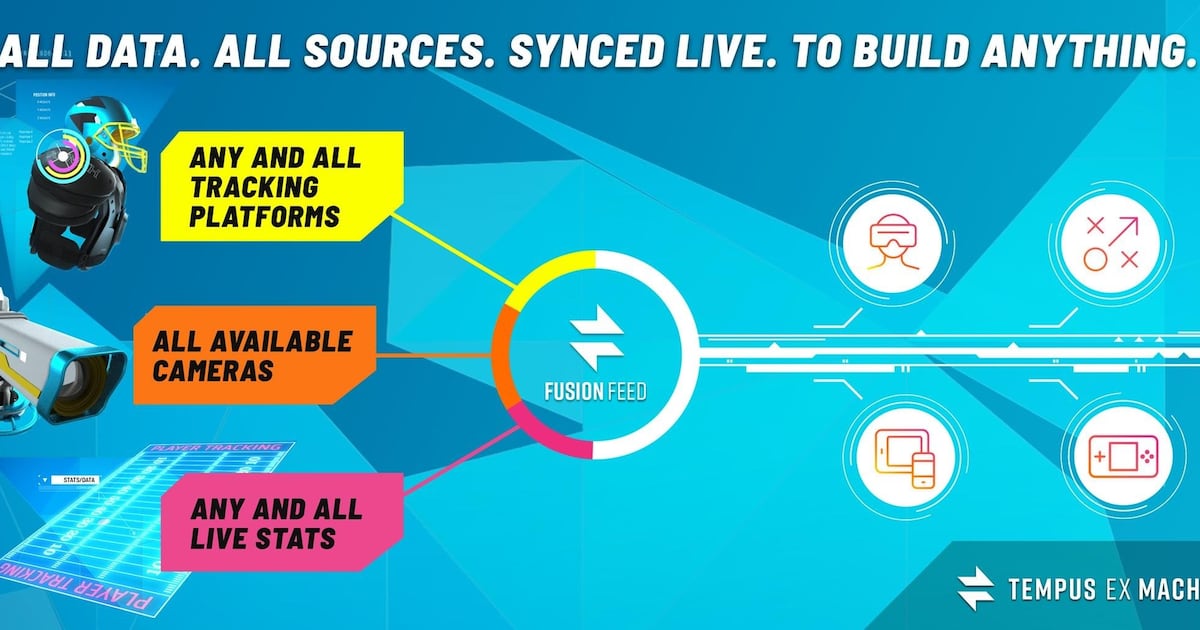
Tempus Ex Machina, founded in 2019, offered a plain answer to a noisy question. Put a reliable timestamp on the material as it is created. Keep that relationship intact as the material travels. The company called the resulting platform FusionFeed. Its customers were leagues, teams and companies building sports products, rather than fans buying a subscription. A fan might meet Tempus Ex through a clip or an app; the buyer saw the machinery beneath it.
The team kept the problem
Charlie Ebersol had co-founded the AAF. Erik Schwartz had led its technology. Annie Gerhart had run operations. When the league failed, the three had a rare inventory: direct knowledge of what breaks when live sport is handled by separate systems. The old AAF technology was not simply polished and resold. According to their account, the team rebuilt the core stack from scratch, helped by faster hardware and a clearer view of the problem. The league’s failure was public; the code’s second act was quieter.
What failed first was the institution that had paid for the experiment. The AAF lost its financing and ceased play. Inside the technical work, the weak point was fragmentation: feeds and applications had been assembled for particular uses, leaving the people who needed the complete game to stitch it together later. Schwartz described legacy sports systems as layers of fixes that had become habit. Ebersol remembered an equipment truck packed so full that it resembled a cartoon van. Their change of mind was practical: stop trying to make one clever fan application and make the underlying material usable by many applications.
“We’re like the operating system for sports.”Erik Schwartz, on the role of Tempus Ex
That metaphor can sound grand, so it deserves a concrete test. Before the 2021 NFL season, Tempus Ex installed servers at league stadiums, ran fiber at some sites and added three supplemental 8K cameras around each field: two high in the end zones and one at midfield. The company’s system also drew from other available cameras and live data. In the NFL’s New York command center, football operations staff could receive multiple angles of a play within roughly four to eight seconds and search, tag and share the result. The camera count mattered; knowing which moment every camera showed mattered more.
Vincent, the NFL executive in charge of football operations, said the dashboard saved his department 234 hours a week in reviewing and tagging plays. That is an attributed operational claim, not an audited return on investment. It is still unusually specific. An official who once used handwritten notes could pin angles, add comments and build collections of plays. If a spectator ran onto the field, a security review that could stretch into the following week became something staff could inspect promptly. The product solved an irritating, expensive sequence of human searches.
The clip has more than one owner
A searchable play need not end at the league office. In 2022, the Pac-12 made Tempus Ex a technology and data partner. A later pilot with Curastory offered conference football players access to custom game highlights, with alternate angles they could edit, narrate and post. Curastory supplied creator tools and a route to sponsors; Tempus Ex supplied the footage and the connection between a play and its many views. The athlete was no longer limited to the broadcast director’s choice of shot.
That arrangement was more complicated than “AI makes highlights.” Rights, athlete approvals, distribution and sponsorship all had to meet in one place. The Pac-12 told athletes to consult their compliance departments on name, image and likeness opportunities. It also started with football, rather than promising every athlete an instant archive. The most useful insight is portable: a rights holder can make a precise, authorized slice of its media available to the person in it, then let another specialist handle editing and monetization. The software is only one part of the transaction.
The same synchronized feed helped a Pepsi and NFL social campaign show alternate views of playoff moments. That is a different customer and a different budget, but the technical request is similar: find the exact play, retrieve the angle television did not air, publish it while it is still interesting. Tempus Ex’s distinction was its position at the source of the video and data. A clipping tool working from the final broadcast can edit only what the broadcast chose to show.
One event, several businesses
The same underlying record can serve an operations dashboard, an athlete’s highlight, a sponsor clip or a viewer-controlled screen.
From the control room to the sofa
Chelsea FC supplied the next visible test. In April 2023, the club agreed to use Tempus Ex technology across its app, fan experiences, sponsor work and club operations. During its summer U.S. tour, Chelsea introduced Match View X inside its official app. Viewers could choose whether to see graphics and which statistics to overlay, alongside match events and player tracking information. A football match suddenly had a menu. The match itself remained stubbornly indifferent to the viewer’s preferences, as it should.
This also shows where Tempus Ex sat in the market. Broadcast technology firms can make pictures, data providers can sell numbers and media platforms can distribute clips. Tempus Ex tried to connect those pieces early enough that the customer could build several experiences from one live event. Its sales motion was enterprise partnerships and licensing, with integrations at venues and in apps. Public prices and contract economics have not been disclosed. A reported $36.9 million Series B in 2021, led by Silver Lake and Endeavor with earlier investors participating, gives a sense of the capital available; it does not tell us the cost of an NFL installation or the margin on a Chelsea product.
The leap from American football to English football mattered because the platform was meant to accept different inputs. It also tested the less glamorous work: permission to use feeds, local venue setup, app integration and a product a club would actually ship. A shared clock is powerful only when partners can reach it and have the rights to use what it contains. A small team without access to venue cameras or league data could copy the synchronization principle, but it could not copy this deployment by buying three cameras and a subscription.
The name changed; the question did not
In August 2023, Tempus Ex combined with Biocore, a biomechanics engineering company, under the name Infinite Athlete. The pairing was coherent: one side organized live video and data, the other studied athlete health, safety and performance. Infinite Athlete still describes FusionFeed as its platform’s heart and lists a Game Operations Dashboard among its products. Developer access is currently by invitation. The old Tempus Ex website remains a minimal welcome page, while the public account of the continuing business lives with Infinite Athlete.
The company’s history offers a copyable idea and a limit. Begin with the boring handoff that everyone works around. Time-stamp the source material once, preserve that link and let different users ask different questions of the same event. It worked here because the team had seen the operational mess close up, won a demanding first customer and secured access to physical venues and licensed feeds. Without those conditions, the “operating system” metaphor would be a slide. With them, it became a way to find the play before the next play began.