In January 2017, a company in Fremont sent a small invitation to customers in North America and Asia: an evaluation board carrying working magnetic memory. Put patterns into it. Read them back. Decide whether this belonged inside your next product. Spin Transfer Technologies, later renamed Spin Memory, had moved an idea from physics into something another engineer could touch.
- Magnetic memory promised persistent data with lower standby power.
- Arm licensed the circuitry; Applied Materials partnered on manufacturing.
- Customer and testing delays preceded the June 2021 liquidation decision.
That sounds like the difficult part. In semiconductors, it is often the beginning of the difficult part. A sample gives a customer permission to ask harder questions. Can it survive the intended workload? Can the manufacturing process repeat it? Will the supplier remain solvent while those questions are answered? Spin’s story lives in that interval.
A memory with a smaller electricity habit
Ordinary working memory has an inconvenient habit: it forgets when electricity disappears. SRAM supplies fast access close to processors. DRAM supplies larger working-memory capacity. Keeping these systems available consumes energy, and fitting more memory into less silicon creates further design pressure. Spin wanted MRAM, magnetoresistive random-access memory, to shoulder some of that work.
MRAM encodes information in magnetic states. In spin-transfer torque devices, current changes a tiny magnetic layer’s orientation; its relationship to a reference layer changes electrical resistance, allowing the bit to be read. The appeal is persistence without continuously powering the storage element. That does not mean an entire chip consumes no electricity. Reading, writing and peripheral circuitry still need power.
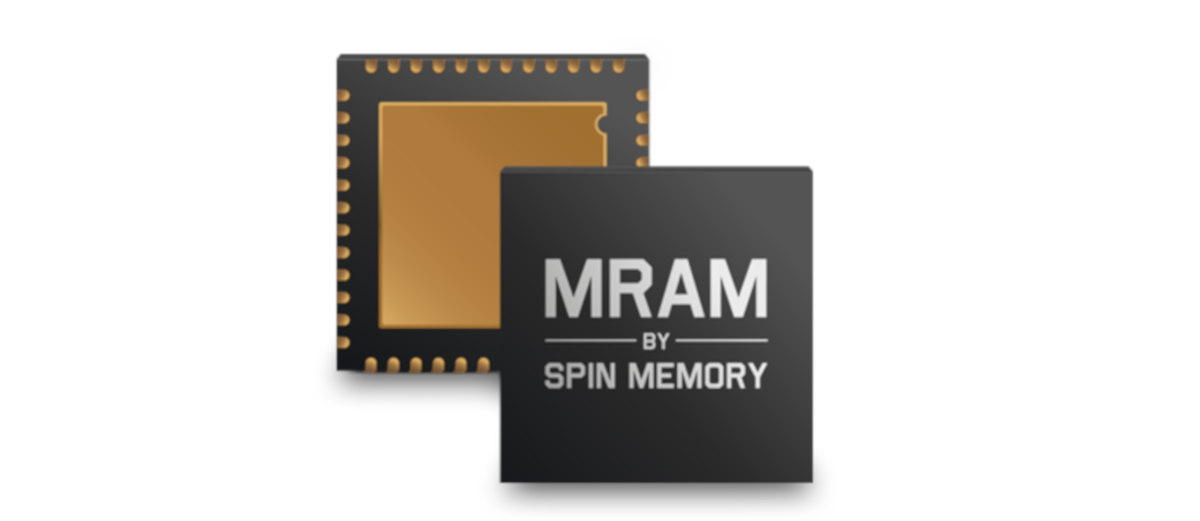
The company’s roots were in Andrew Kent’s NYU laboratory. Allied Minds formed and capitalized Spin Transfer Technologies in 2007, according to its 2014 financing announcement. Orthogonal spin transfer was the original technical proposition. The broader ambition was unusually demanding: combine useful memory speed, endurance and density with non-volatility. Each attribute had to survive the others.

The clever bit around the bit
Spin’s contribution extended beyond magnetic materials. Its Endurance Engine used circuitry and architecture to accommodate memory imperfections. Allied Minds described endurance improvements of up to six orders of magnitude in FPGA emulation alongside test chips in 2018. The qualification matters: an emulated demonstration establishes a different kind of evidence from a customer-qualified production device.
The approach offered a useful engineering insight. Improving a memory cell need not mean demanding perfection from the cell alone. Surrounding circuitry can compensate for its behavior. Spin also developed its Precessional Spin Current structure, called the Spin Polarizer, to improve switching efficiency. Materials and architecture were being developed together.
A sample gives a customer permission to ask harder questions.
THE COMMERCIAL BOTTLENECK
The team was built for this kind of work. Allied Minds reported more than 20 PhDs across engineering, physics, materials science and mathematics in 2018. That describes its technical depth, although degrees alone say little about whether a prospective customer will put a new memory technology into a design.
In August 2020, Spin announced another lever: the Universal Selector, a vertical cell transistor design for MRAM and other memories. The company claimed it could pack up to five times more MRAM into the same area. That was a stated potential benefit, rather than an established fivefold improvement in a mass-market product. Density claims are attractive; production evidence decides their usefulness.
Two partners, two different doors
Spin was selling to organizations that build chips, rather than people shopping for computer upgrades. A designer needs usable memory IP. A foundry needs a process it can manufacture. In November 2018, Arm licensed Endurance Engine technology, while Applied Materials agreed to combine deposition and etch capabilities with Spin’s MRAM process IP. The agreements addressed those different doors.
There was an earlier equipment alliance too. Tokyo Electron’s 2017 announcement paired its deposition tools with Spin’s magnetic-junction design and fabrication expertise. Thin magnetic films, reliable circuits and industrial equipment had to cooperate. The business model reflected that interdependence: licensing, development agreements and partner revenue sharing, rather than relying entirely on a catalogue of finished chips.
The intended applications included AI, connected devices and automotive electronics. For their designers, more persistent on-chip memory could reduce standby energy and make data available after power interruptions. Spin’s alternatives included conventional SRAM and DRAM, alongside other MRAM approaches. Today Everspin sells MRAM products; Avalanche offers Persistent SRAM. Magnetic memory’s usefulness survived this particular supplier.
Money bought experiments. Customers needed evidence.
The funding was substantial. Spin announced $36 million in 2012 and $70 million in 2014. Its $52 million Series B in 2018 included $23 million of converted bridge securities, so the headline should not be mistaken for $52 million of fresh cash arriving at once. A further $8.3 million extension followed in July 2020.
Loss was about 17 times revenue. These are accounting results, not a cash-burn calculation.
The 2019 accounts put the commercial distance into numbers: $2.08 million in revenue and a $35.43 million loss. The firm had expertise, partners and technological progress. Its receipts remained small beside its financial demands. Those numbers explain why another demonstration was consequential.
During 2020, Spin taped out the demonstration chip co-developed with Arm. Tape-out means the design has been sent for fabrication; it does not settle qualification. Allied Minds subsequently reported that COVID-19 had “significantly delayed the required testing of its development chip with ARM.” Its January 2021 update specified a nearly nine-month testing delay, with testing beginning in early Q4 2020. An unexpected government-bid loss late that quarter added pressure. Further third-party investment did not arrive.
On June 23, 2021, Spin’s board decided to liquidate. Allied Minds, which had invested $50.5 million over the company’s lifetime, declined to commit more. Its 2021 report describes liquidity problems and ceased operations. The documented failure was a commercial and financing bottleneck; it does not establish that the underlying physics failed.
Put the test schedule beside the cash forecast
The practical lesson is to budget customer validation as carefully as research. Copy Spin’s effort to connect materials, circuits and manufacturing partners. Then insist that each demonstration has a route to a purchasing decision, with money available for delays. This approach needs customers willing to qualify unfamiliar memory and manufacturing partners able to deliver it. Where either condition is absent, a convincing laboratory result can remain an expensive invitation.