An email address looks suspiciously like progress. It sits there in a spreadsheet, neat and specific, wearing the little costume of a lead. Then reality arrives. Is the address valid? Will the message land? Who sends the follow-up? Did the prospect reply on LinkedIn? Which deal stage owns the answer? Snov.io built its business by noticing that every satisfying contact search opens a trapdoor into five less satisfying jobs.
The company began in Chernihiv, Ukraine, with Email Finder in 2017. A small team led by founder and CEO Oleksii Kratko got its first paying customer on May 17, shortly after attending the Collision conference. Kratko later remembered the plan as roughly $49. The date became the company birthday, which is charming proof that SaaS founders can turn even a Stripe notification into a holiday.
The useful part came next. In a 2018 interview, Kratko described email lookup as an on-demand business. A customer gathers people, puts the tool on hold and goes elsewhere to sell to them. His bet on drip campaigns was refreshingly plain: he expected customers to pay longer, not necessarily pay more. Snov.io had found the weakness in its first success.
“I just expect the client to pay longer, rather than pay more.”Oleksii Kratko, discussing drip campaigns and retention in 2018
The first thing to fail was the handoff
Nothing dramatic had exploded. The finder worked. The problem was that the product stopped precisely where the customer's real work began. Snov.io added Drip Campaigns in 2018, then Email Tracker in 2019. In 2020 the company made the shift explicit: it would stop behaving like a collection of utilities and become one sales ecosystem. Sales CRM arrived in 2021, email warm-up in 2022, then mailbox rotation, deliverability checks, AI writing and LinkedIn automation.
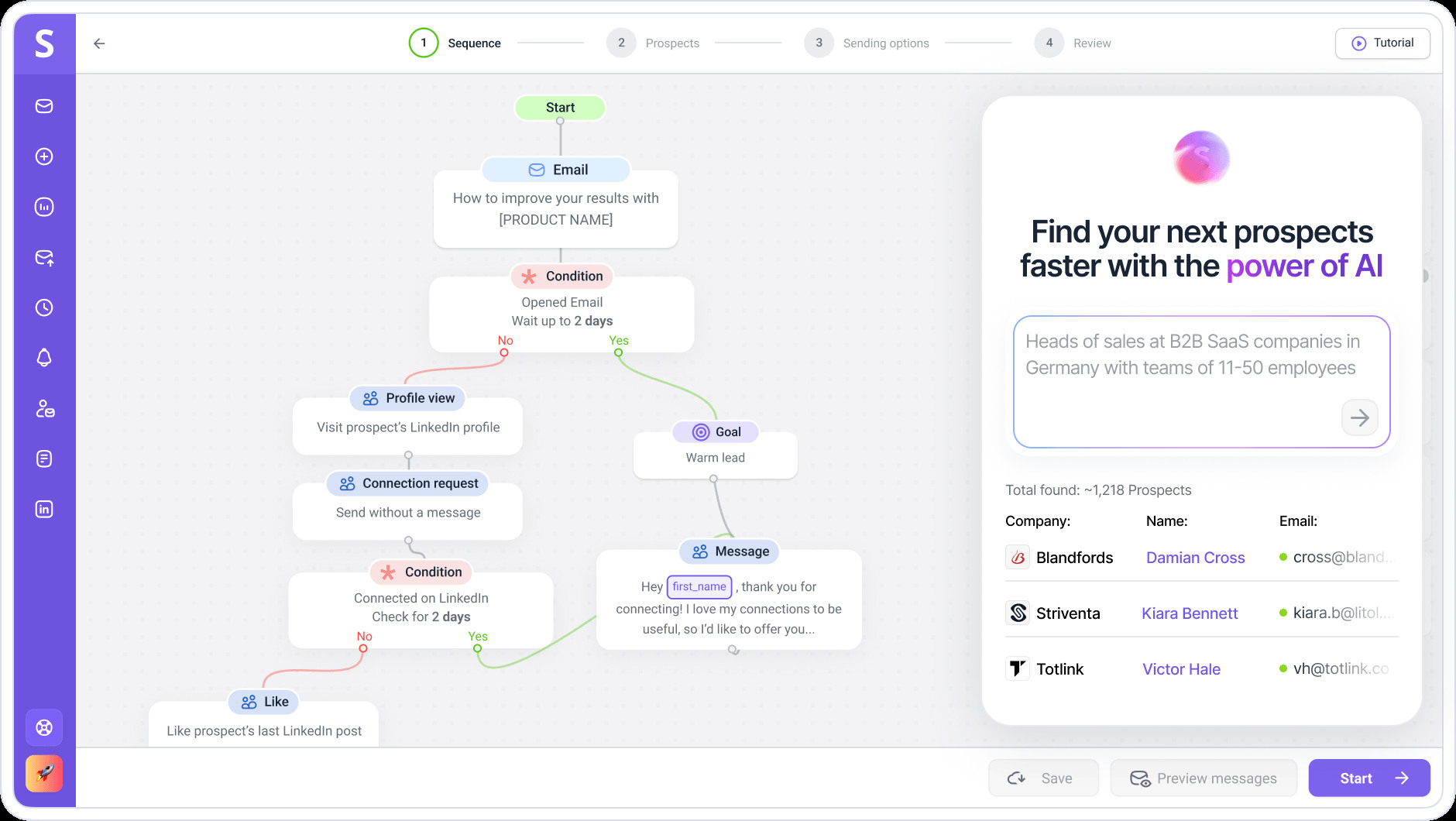
That sequence is the product. Snov.io searches its database and public sources for likely B2B contacts, verifies addresses, helps configure and warm sending accounts, runs email and LinkedIn steps, collects replies and moves prospects into a pipeline. APIs, webhooks and integrations with HubSpot, Pipedrive, Clay, Zapier and n8n let customers keep a larger stack if they prefer. A new MCP connection also lets compatible assistants such as ChatGPT and Claude act on approved Snov.io data and workflows.
A bundle for people with too many tabs
Snov.io sits between narrow tools and expensive data platforms. Hunter can find emails. Lemlist and Instantly specialize in campaigns and deliverability. Apollo.io and ZoomInfo sell broader data and prospecting systems. HubSpot and Pipedrive anchor pipelines. Snov.io's pitch is less about winning every feature contest than removing the glue work between those categories.
That is most attractive to founders, SDRs, agencies, recruiters and small sales teams that do not want to become part-time systems integrators. Snov.io says more than 3 million people have used its tools. Its public pages cite anywhere from 185,000 to 300,000 companies, a range wide enough to deserve caution, but the customer list plainly spans one-person operators, agencies and recognizable brands. The company shows Google, Salesforce, Dropbox, Payoneer, DocuSign, Zendesk and Canva among customer logos.
Customer-reported outcomes featured by Snov.io. They are examples, not promises, and depend heavily on list quality, offer, targeting and execution.
Those stories explain what customers are really buying. A lead-generation agency wants more verified records without assigning a human to hunt down every address. A small software company wants the right employee at a large account, not a generic inbox. A marketing team wants to replace manual follow-up with a sequence that stops the moment someone answers. The common purchase is saved coordination, with contact data serving as the opening ingredient.
Snov.io's own case library makes the trade visible. Agencies report generating tens of thousands of emails, while smaller teams emphasize faster research and lower bounce rates. One consultancy says it cut manual lead-generation effort by 25 to 30 percent and reached reply rates of 10 to 12 percent. Another agency credits a carefully prepared campaign with unusually high response. The word “prepared” matters. Snov.io supplies machinery, not an exemption from writing something worth reading.
For a user, the practical loop is compact. Define a buyer by title, company size, industry and geography. Save and verify the results. Connect a mailbox whose domain records and warm-up status have been checked. Write a short sequence with a human review point. Add a LinkedIn touch only where it makes sense. Route replies into Unibox and turn genuine interest into a deal. Then inspect which segment answered instead of treating a giant open-rate number as applause.
The economics are designed to be legible. A renewable free trial offers 50 credits, 100 recipients and one warm-up slot. The current Starter plan is $39 a month for 1,000 search-and-verification credits and 5,000 recipients. Pro begins at $99 for larger quotas. LinkedIn Automation is separate at $69 per connected account slot, with bundle and annual discounts. Phone and company enrichment use tokens, while preconfigured domains and Google mailboxes add infrastructure revenue.
100 recipients
1,000 credits
per account slot
The meter has two main dials. Finding or verifying a prospect consumes a credit. Contacting a new recipient consumes recipient quota, while follow-ups to that person during the billing period are unlimited. It is an unusually literal expression of the product strategy: charge for putting a real person into motion, then encourage the customer to finish the conversation.
Built in Ukraine, sold everywhere
Snov.io's company identity has two pins on the map. LinkedIn lists New York as the primary headquarters. The operating story, and much of the team, is Ukrainian. Chernihiv appears in both its origin and its present office list, alongside Lviv, Shenzhen and Florianopolis. The team expanded into China in 2020 and Brazil soon after, using country leadership rather than pretending a translated landing page equals a market.

Russia's full-scale invasion made that geography consequential. In February 2022, Snov.io said its core team of nearly 90 people was spread across Ukrainian cities, with some employees sheltering, relocating or serving on the front line. The company kept the service running on AWS infrastructure outside Ukraine. It later stopped serving and accepting payments from Russia and Belarus, supported Ukrainian military, medical and volunteer organizations, and offered free plans to qualifying Ukrainian charities and nonprofits.
Its cultural motto, coined by Kratko, is “Flowing water is harder to freeze.” Corporate mottos tend to wilt under inspection. This one at least matches the operating record: a distributed team kept shipping, grew past 100 people, and continued pushing into new markets. Snov.io now describes a roughly 150-person organization, while LinkedIn recently associated 194 profiles with the company.
The platform keeps eating the chores
Recent releases show the same old instinct wearing newer clothes. In 2025 Snov.io added 50 million company profiles, integrated with Clay and refreshed millions of records. By mid-2026 it had added phone-number enrichment, public LinkedIn context, campaign APIs, an official n8n node and an MCP server. The latter moves routine actions into an AI conversation: search for a particular buyer profile, verify emails, create CRM deals or schedule tasks without touring the dashboard.
There is a risk in this appetite. All-in-one software can become a garage where every tool is technically present and nothing is where you left it. Mature companies may already trust a dedicated data vendor, a deeply customized CRM and a sending system tuned by specialists. Teams that rely on inbound demand, sell to a tiny named account list or face strict limits on cold contact may not need Snov.io's machine at all. LinkedIn automation also carries platform-policy and account-safety risk regardless of built-in limits and proxies.
Data accuracy is another hard boundary. Verification reduces bounces; it cannot make an irrelevant pitch welcome. Warm-up can protect sender reputation; it cannot repair a careless offer. The bundle works best when a team has a defined ideal customer, a lawful basis for outreach, modest operational complexity and the discipline to review results. Without those conditions, automation simply helps bad judgment arrive on schedule.
What another founder can copy
- Watch what customers do immediately after your product finishes its job.
- Build the next recurring chore before inventing an unrelated feature.
- Price the workflow in units customers understand, then make follow-through cheap.
- Use integrations as pressure valves so the bundle does not become a prison.
- Treat international expansion as local operations, not translation theater.
Snov.io's best idea is not the email finder, the AI writer or the latest enrichment field. It is the humble observation that customers buy outcomes in sequences. Find a contact. Confirm it. Reach out. Follow up. Notice the reply. Move the deal. A point product gets applause when it works. A workflow gets opened again tomorrow.