The app had everything except people willing to use it. Landon Taylor’s team spent eight months and a quarter of a million dollars building an iOS app for sales representatives to manage referrals. They spoke to hundreds of reps. In Taylor’s account, it never took off. The expensive discovery was rather ordinary: the people responsible for selling were already occupied with selling.
That failure explains Snoball better than its name does. The company now manages word of mouth marketing for home service businesses, combining referral outreach, customer reviews, reputation assets and human follow-up. Its wager is that a satisfied customer becomes more valuable when somebody remembers to continue the conversation.
- A $250,000 app exposed an adoption problem.
- Snoball now combines software with managed follow-up.
- The useful test: who answers when a customer replies?
The quarter-million-dollar instruction manual
Taylor, Snoball’s co-founder and CEO, arrived here through customer acquisition. His agency work led to BestCompany.com, a consumer review business that connected prospects with service providers. Best Company for Business launched in 2019; reputation marketing assets followed in 2020. The referrals module arrived in 2023, and the business adopted the Snoball name that October.
The progression matters. Reviews made customers’ experiences visible. Marketing assets carried those experiences into sales materials. Referrals offered a way for the same customers to introduce the next buyer. Snoball brought those activities together, with BestCompany.com remaining its review-site partner.
The failed app exposed a distribution problem inside the product: every additional task required a rep’s cooperation. Taylor described the opening as “The white space here is done for you.” The company shifted the burden onto its own operation. Customers could supply a list or connect a customer relationship management system; the referral process could begin at a chosen point in the customer journey.
“The white space here is done for you.”
Landon Taylor · Co-founder & CEO
The machine starts it. A person keeps it going.
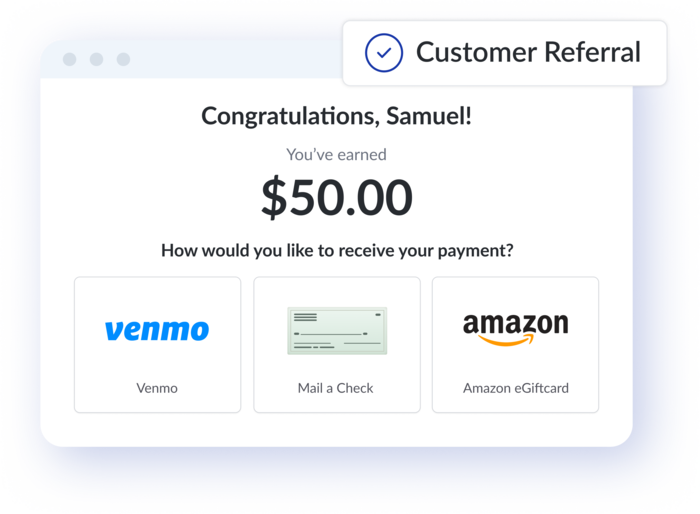
Snoball’s September 2026 explanation of its moving-company workflow is unusually specific. Messages go out on days 1, 8, 21 and 45 after a job. The immediate goal is a response. Once the customer replies, a person takes over and the automated sequence stops. That design makes the system an opening for a conversation rather than a succession of identical requests.
The company says Taylor and one colleague personally answered more than 10,000 conversations for its first 30 clients. Doing the work by hand supplied the knowledge needed to decide which parts could be automated. Scheduling and tracking are repetitive. Remembering that a customer’s son may soon be moving requires attention to what that customer actually said.
The broader product includes referral tracking, automated incentive payouts, review requests, video testimonials and assets such as badges and widgets. Its paid referral package lists a dedicated referral desk and customer-support handoffs. These are connected jobs: a customer who reports a problem needs help before being asked to lend the company their reputation.
A moving customer need not move again
Movers illustrate a useful wrinkle in the business. Buying a service infrequently does not prevent a customer from knowing somebody who needs it. Taylor initially doubted the category, according to Snoball’s account of his thinking. Results from early moving customer JK Moving helped change his mind.
Snoball reports that JK Moving generated more than $200,000 in new revenue within roughly seven months. A separate published summary lists more than 100 referrals and more than 40 sales. Muscular Moving Men generated over 100 referrals and booked 29 moves in two months. Those are company-published customer outcomes, rather than a promise about what another mover will achieve.
The operational problem appears elsewhere too. At solar company Suntria, sales reps struggled to track referrals and homeowners waited for earned payments. Snoball’s case study reports more than 175 new referrals, a 3.4 percent request-to-referral rate and a 75 percent close rate after appointments. Those last two percentages describe different stages; presenting only the larger one would make the story considerably prettier and considerably less useful.
Requests that produced referrals
Appointments that closed
The bill has more than one line
Snoball sells subscriptions with service attached. Its free tier includes a BestCompany.com listing and basic reputation tools. The Pro plan advertises $549 monthly, or $494 per month when billed annually at $5,928. Pro adds review generation and marketing functionality. Pro + Referrals is custom-priced, with the review tools and managed referral operation combined.
A buyer therefore needs to compare the quoted subscription, incentive spending and resulting sales together. Snoball allows reward rules tied to a qualified referral or a completed sale. Rewarding a sale changes the economics of the bounty; it does not make the subscription disappear. Its pricing page also notes that additional usage can increase plan prices.
The company sits between reputation software, referral software and an outsourced marketing operation. Birdeye offers automated referral campaigns; Referral Rock offers tracking, rewards, integrations and advisor-led setup. Snoball’s distinguishing proposition is its staffed customer conversation alongside reviews and reputation assets. Automation alone is hardly a scarce ingredient in this market. Buyers should ask who reads a reply and what happens next.
Four dates worth putting in your calendar
There is a practical lesson here even for a business that never buys Snoball. Choose a completed-job trigger. Schedule the four follow-ups. Assign somebody to read replies. When a customer mentions a future need, make a reminder about that need. Record who referred whom, state the reward terms and pay when the agreed event occurs. Honor requests to stop.
The sequence needs something worth recommending. Snoball’s own guidance says inconsistent service, insufficient volume or an absence of unsolicited referrals are reasons to fix the underlying business first. Its pricing page recommends at least 15 monthly customers and 100 past customers for the referral package. Those are recommended starting conditions, not a guarantee of results.
The company’s September 2026 material reports programs across more than 300 moving companies. That gives its current focus a concrete shape. Its public account of funding emphasizes Taylor reinvesting resources from earlier businesses, while its team story describes retaining much of the BestCompany.com crew. Operational knowledge carries over along with the software.
The $250,000 app was a costly way to discover a small constraint. Customers could recommend a company, and salespeople could ask them. Neither fact meant somebody would consistently do the follow-up. Snoball built a business around taking responsibility for that neglected interval. A recommendation may begin with affection. Getting it into the sales pipeline requires administration.