A ringing phone is an excellent advertisement for a marketing company. For the person standing on a ladder, it can be a rather less welcome event. Someone has to answer, remember the address, arrange the visit, send the estimate and, eventually, collect the money. A lead arrives as a possibility. Turning it into a job requires a small procession of administrative acts.
Townsquare Interactive has built its pitch around that procession. The Charlotte business sells digital marketing, but its software reaches into the inbox, the appointment book and the invoice. The interesting question is how much of an owner’s working day a marketing subscription can reasonably take off their hands.
- For the owner doing several jobs: managed online marketing plus customer-management tools.
- The connected offer: attract enquiries, respond, book, invoice and follow up.
- The buying question: how much work will the subscription actually remove?
The customer who has no marketing department
The company’s origin has an appealing lack of romance. According to its careers site, Townsquare Media’s radio advertisers wanted to reach customers beyond broadcast. Interactive was formed to help them do it. There was already a customer, already a relationship and already a problem. Nobody had to invent a new human appetite.
The business dates its work with local operators to 2012. Its parent’s 2025 annual report describes a particularly specific sales target: privately owned businesses outside America’s top 50 markets, with fewer than 20 employees and less than $5 million in annual revenue. Think of the person who owns the business and still spends much of the day doing its work.
This is a useful distinction. A large company can assign website copy, customer records and campaign reporting to different departments. In a small firm, those departments may all be one person who would also like to eat lunch. Townsquare’s offer is built around that shortage of attention.
Local radio relationships help sell the service, but the business reaches well beyond them. About 60% of subscribers at the end of 2025 were outside the parent’s local media footprint. Interactive has become a national business with a local-business vocabulary.
An enquiry is a relay race
Start with discovery. Townsquare builds and hosts websites, writes business-specific content and manages search visibility and listings. Its current pricing page includes Google Business Profile management and reputation work. Social media management and targeted advertising provide other routes to prospective customers. These are recognizable agency services, bundled into an ongoing relationship.
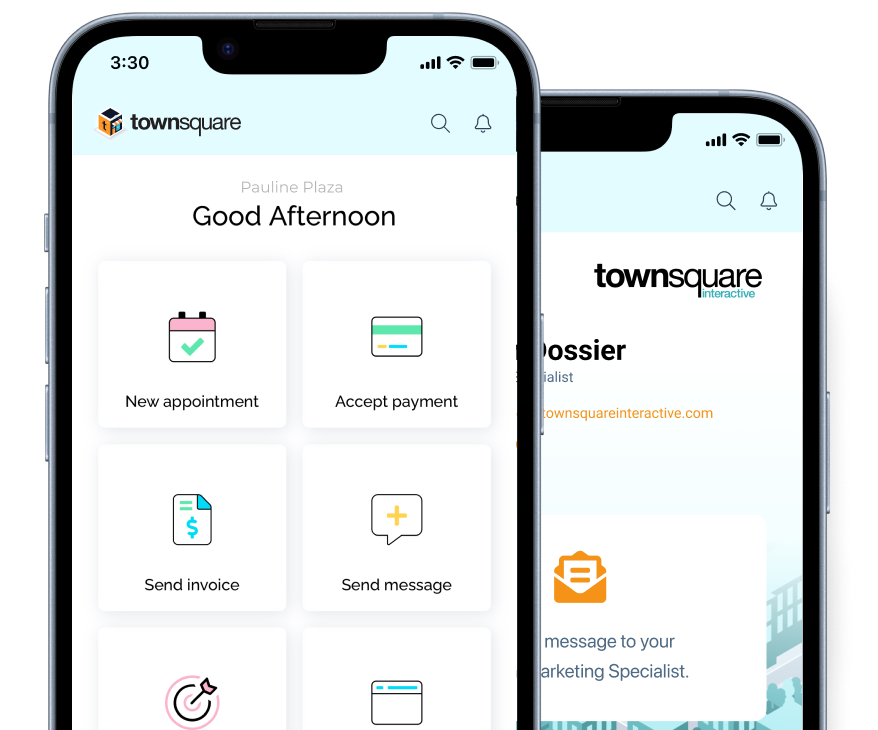
Then comes the baton pass. The cloud-based CRM brings customer details together with conversations, appointments, invoices and payment information. An integrated inbox centralizes communication. The calendar allows website visitors to choose available appointments, including outside business hours, and provides confirmations and reminders.
Estimates and invoices sit further along the same route. An owner can prepare a quote, send an itemized invoice and use payment tools from the platform. Automated email and text campaigns cover follow-up. The appeal is fairly concrete: less copying of customer information from one place to another, and fewer occasions when everyone assumes somebody else replied.
- 01Get foundWebsite · search · listings
- 02RespondInbox · customer record
- 03BookCalendar · estimate
- 04Get paidInvoice · payment
- 05Stay in touchEmail · SMS · reviews
A map of the product’s intended workflow, not a promise of conversion.
The newer sales language is “Search Everywhere Optimization.” Townsquare now frames website content, listings, reviews and Google presence as inputs to visibility in AI-assisted search. That is the company’s positioning. Its own FAQ says it cannot guarantee appearances in AI answers. A business owner can evaluate the actual work without treating the phrase as a secret password.
What the roofer’s number really tells us
Consider Top Roofing and Contracting. In a company-published example from May 2024, an owner identified as Peyton had signed up in October 2020 without an existing web presence or marketing strategy. The account describes local SEO alongside scheduling, invoicing and payment features, and reports more than $1.4 million in customer payments processed since signing.
The number is interesting because it places the product near the end of a transaction. It is also easy to misuse. Processed payments are not the same as sales caused by marketing. The example does not establish how much work would have arrived anyway, or how much profit remained after the roofer’s costs. It shows a reported use of the tools, rather than a universal return on investment.
For another owner, the copyable idea is the sequence. Keep the enquiry, appointment, estimate and invoice connected. An advertising report may celebrate the moment someone contacts you; the customer’s story continues for several more chapters. A useful system should be able to follow them.
The subscription bill buys people, too
Townsquare sells monthly subscriptions. A May 2024 platform guide advertised packages starting at $199 a month, with prices subject to change. That is a historical starting point, not a current quote for the complete marketing package. The current pricing page asks businesses to request a quote.
The important comparison is the labor included. Townsquare advertises US-based support, a dedicated relationship manager and monthly reporting. Its About Us page puts the coordination argument neatly: “Nobody Should Need Five Vendors to Be Findable.” There is a little extravagance in the capital letters, but the complaint is familiar.
“Nobody Should Need Five Vendors to Be Findable”
Townsquare Interactive · About Us
A self-service website builder such as Wix or Squarespace offers a different bargain: the owner assembles more of the operation. A local agency offers another possible relationship. Separate customer-management, booking and payment tools provide still more combinations. These are alternative buying routes; which costs less depends on the services selected and the owner’s time.
Interactive occupies the space between a marketing service and business software. Its expertise has to cross both: content and search on one side, customer workflows and support on the other. The software becomes more valuable if people actually use it. The human service becomes more valuable if it removes work instead of adding meetings.

The careers site’s stated values include simplicity, transparency and learning quickly from failure. Those are company aspirations, rather than a verdict on working life. They do fit a product whose customers are unlikely to enjoy being assigned homework by their marketing vendor.
The year the subscriptions went backwards
A subscription model provides recurring revenue. It also provides recurring opportunities for a customer to reconsider the bill. Townsquare’s 2024 shareholder letter called 2023 its first real growth challenge for Interactive and reported the loss of more than 6,500 subscribers that year.
The letter described changes to customer service that produced cost efficiencies. The parent subsequently dated the introduction of the Business Management Platform to 2024. Together, these developments show an operation adjusting both its service economics and its product. They do not prove that one new feature solved the subscriber problem.
Nearly 38% segment profit margin. Segment profit is the parent’s reported segment measure, not company-wide net income.
The August 2026 results make that distinction matter. Interactive’s second-quarter revenue fell 8.5% year over year while segment profit increased 3.4%; the parent reported a margin of nearly 38%. It attributed reduced sales velocity to lower sales headcount. A profitable quarter and a shrinking revenue line can share the same page.
For customers, that is a reminder to judge the service at account level. A healthy provider margin does not establish a healthy return for a particular plumbing company. For observers, it makes Townsquare a more interesting business than a frictionless growth story: selling to small operators means living with their willingness to keep paying.
Copy the handoffs
A practical evaluation starts with one real enquiry. Ask where it enters, who gets notified, where the conversation lives, how the appointment is booked and how the invoice gets sent. Then ask which of those steps the provider handles, which the software handles and which still belong to you.
This arrangement is likely to appeal when customer information is scattered and the owner wants help maintaining an online presence. It is a less obvious fit when a company already has well-used systems, needs specialized workflows or enjoys doing its own marketing. Adding another dashboard to an orderly business can be a remarkably expensive way to acquire another password.
Track appointments, accepted estimates, paid jobs and repeat customers alongside visibility. None of those measures needs a fashionable name. Townsquare’s most useful proposition is that the distance between being found and being paid deserves attention. A phone can ring beautifully. Someone still has to finish the conversation.
Take a closer look
Explore the company website, Business Management Platform, packages and company blog. Watch the platform video on YouTube, or read the parent’s August 2026 business update.