At Naval Station Guantanamo Bay, electricity has nowhere else to come from. The installation generates its own power and desalinated water. An unreliable generator therefore threatens more than the lights. It reaches into the water supply, maintenance schedules and the ordinary business of keeping a base running. Here, an electrical diagram begins to look like a map of everything.
- SGT brings Siemens energy systems, industrial software and building controls to U.S. federal agencies.
- Its work ranges from naval-base power to digital rehearsals of shipyard operations.
- Engineering, procurement, security and long-term maintenance all belong in the same purchasing decision.
That is a useful introduction to Siemens Government Technologies, or SGT. The separate, cleared subsidiary of Siemens Corporation works where physical infrastructure and digital systems meet federal requirements. Its customers include military services and civilian agencies. The interesting part is how frequently a problem that sounds like one discipline turns out to require several.
An island with no extension cord
Guantanamo's aging energy infrastructure was costly to operate and vulnerable to outages. The Navy selected a modernization approach that brought together liquefied natural gas generation, solar power, batteries and microgrid controls. Existing diesel generators remained available for backup and surges. A single replacement machine would have left much of the problem untouched.
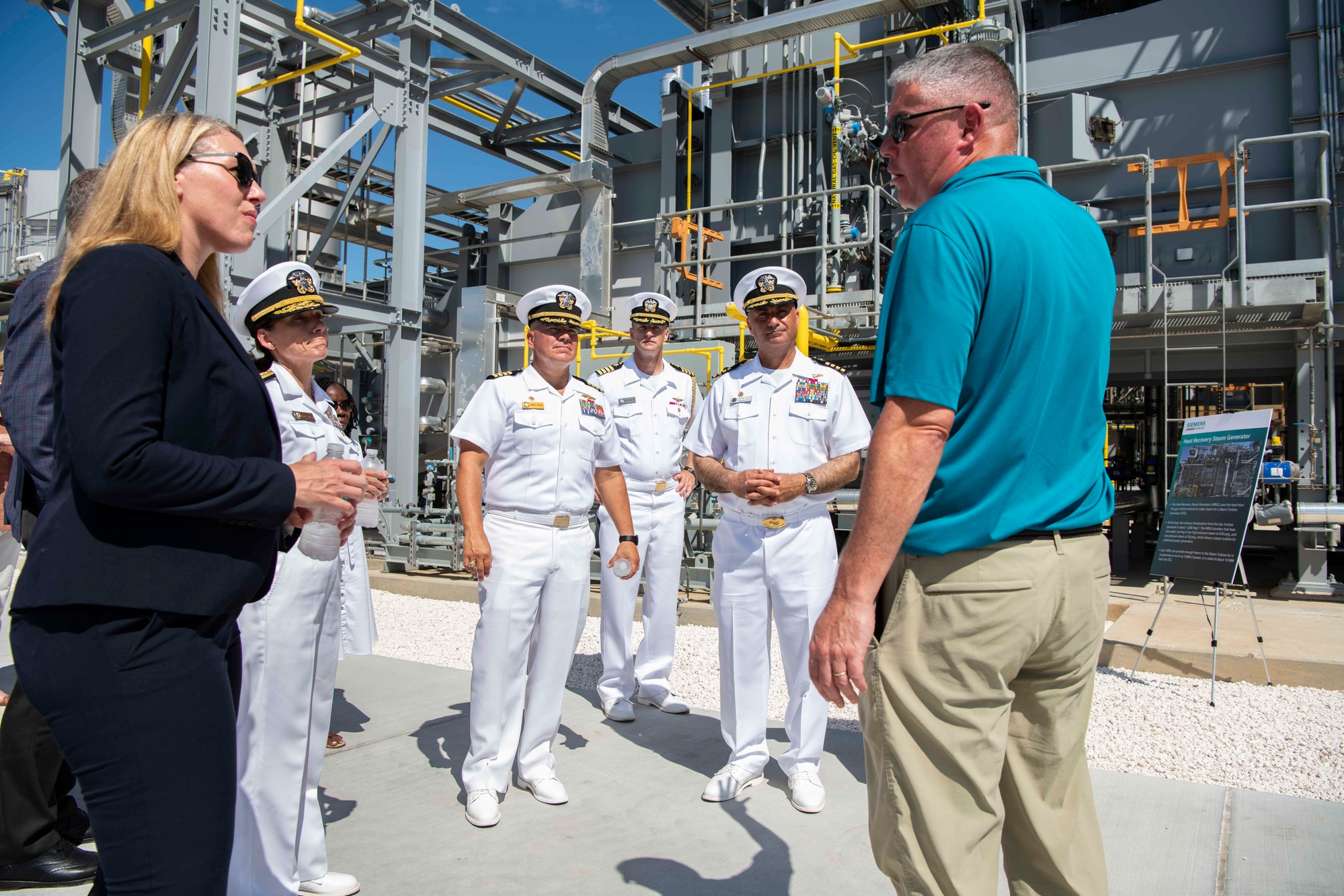
The new LNG power plant opened in September 2023. The Navy described a 20-megawatt facility and projected approximately $10 million in annual fuel savings. Those are different kinds of numbers: one describes installed capacity; the other depends on future operation and fuel economics. Neither, by itself, measures the value of having water and electricity available when required.
The price depends on what you count
The Navy put the construction project at $368.8 million when the plant opened. The broader energy savings performance contract covers a longer relationship. A July 2024 Defense Department notice reported a modification bringing its cumulative face value to approximately $936.3 million, with work expected to finish in April 2043. Reading those figures as competing estimates would miss their different scope.
Different scopes and reporting dates. These are not annual revenue figures.
Performance contracting changes the buying conversation. Project financing and guaranteed savings help an agency undertake improvements while committing to a measured economic outcome over time. Financing, maintenance and verification become part of the engineering proposition. The buyer must examine the baseline and contractual guarantees as carefully as the equipment. A handsome savings forecast still needs an enforceable method of measurement.
This helps explain SGT's position in the market. It earns work through federal project contracts, software delivery and continuing support. Its contract vehicles provide established routes for agencies to procure those services. A vehicle's ceiling is permission to place orders up to a limit; it is not money already earned.
Rehearse the shipyard
At a shipyard, the scarce resource may be time. A submarine awaiting maintenance occupies a place in a larger sequence of workers, equipment and facilities. Buying another machine will help only if that machine addresses the actual constraint. Otherwise, the queue simply moves.
SGT's Navy work uses digital twins to make those relationships testable. The effort covers the four public shipyards, beginning with a model of Pearl Harbor's facilities, equipment, personnel and maintenance processes. Siemens Tecnomatix Plant Simulation supports the process-modeling work. Planners can investigate changes in a virtual environment while the physical shipyard continues operating.
Move the process in software before moving the equipment on the ground.The practical logic of shipyard simulation
The distinction matters. A detailed picture shows where things are. A process model helps investigate what happens when something changes. The useful output is a decision: which layout, investment or workflow deserves the disruption of implementation? The practical caveat follows directly. A model built on unrepresentative inputs can lend precision to the wrong answer. Teams still need operational knowledge and disciplined validation.
The factory meets the cloud
In August 2026, SGT announced an $80 million Army award to create digital and physical manufacturing capabilities at Anniston Army Depot. The assignment targets electric motor stator assemblies for unmanned aircraft systems inside a World War II era facility. The announced performance period is 12 months. SGT calls the approach “born digital”: simulate production before commissioning the line.
The factory assignment draws the company's capabilities together. Production equipment needs power, safety systems and a usable engineering record. SGT also supplies Siemens Federal Cloud, featuring Teamcenter product lifecycle management, and manages Mendix Cloud for Government, a low-code application platform. These tools address different jobs: maintaining product information and building applications around organizational needs.
An editorial map of the capabilities, not a prescribed delivery sequence.
In July 2026, SGT announced enterprise CMMC Level 2 certification and FedRAMP High certification for Siemens Federal Cloud. Mendix's government platform had received its own authorization in January 2025. The distinctions matter to buyers: approval attaches to a defined offering and security context. It does not automatically cover every Siemens product or authorize classified workloads.
Start with the dependencies
SGT's competitive argument rests on combining a broad industrial portfolio with federal delivery expertise. An agency might otherwise assemble energy contractors, building-control specialists, software vendors and integrators. One accountable integration partner can simplify coordination. The buyer must still assess compatibility, lifecycle costs and how easily future changes can be made.
Even its portable power offering follows this logic. The Deployable Power Module coordinates generation, batteries and optional solar in a containerized microgrid. SGT reports fuel reductions of up to 50 percent in hybrid mode, a configuration-dependent claim rather than a universal promise. Load, operating conditions and available generation determine the result.
The lesson travels beyond defense. Before funding the visible upgrade, trace what it depends on. Establish the baseline. Rehearse consequential changes. Assign responsibility for the years after installation. At Guantanamo, that chain ends with electricity and fresh water. At a shipyard, it ends with a vessel returning to service. The equipment matters because something else is waiting for it.