The company that turned FedRAMP from a multi-year, seven-figure ordeal into a 90-day path - by running a pre-authorized, AI-managed federal cloud vendors can inherit.
Selling software to the U.S. federal government requires FedRAMP - a security authorization so slow and expensive that, by the government's own reckoning, fewer than 500 of the more than 30,000 commercially available SaaS applications have earned it. Knox Systems exists to change that ratio.
Rather than helping each vendor build compliance from scratch, Knox operates a pre-authorized cloud boundary - a "landing zone" running across AWS, Azure, and Google Cloud at FedRAMP Moderate, High, and DISA IL4. A customer that deploys onto Knox inherits between 60% and 80% of the required security controls on day one, already implemented, documented, and assessed. The remaining work - the parts genuinely specific to each application - is what the vendor and Knox finish together.
The result the company advertises is blunt: FedRAMP in roughly 90 days for about 90% less than the traditional route. It is the difference between a two-year construction project and turning on a utility.
Knox's founder and CEO, Irina Denisenko, did not read about the FedRAMP problem in a market report. She hit it. As COO of Class Technologies, she took a product through federal authorization herself - slow, opaque, expensive enough that she eventually acquired an already-authorized company just to jump the queue.
"FedRAMP compliance isn't just a requirement - it's a major bottleneck."Irina Denisenko, Founder & CEO, Knox Systems
That lived frustration is the seed of the company. The U.S. government spends roughly $100 billion a year on software, yet the authorization barrier keeps most of the best commercial tools out. Knox's wager is that lowering the barrier does not just help individual vendors - it widens the entire pool of software the government can safely buy.
A pre-configured, pre-authorized landing zone on AWS, Azure, or GCP supporting FedRAMP Moderate, High, and DISA IL4 - the shared boundary customers inherit from.
Proprietary monitoring and remediation software trained on roughly ten years of federal audit data, catching compliance and security issues in real time and automating fixes.
Interprets dense regulatory language and maps each requirement to a customer's specific infrastructure configuration.
Continuous visibility into security posture and audit readiness, with artifact coverage the company puts near 99%.
Pre-configured secure cloud images that ship compliant by default, so teams start from a locked-down baseline.
Purpose-built acceleration paths for large orgs and emerging companies, including fast-tracking subcontractors for prime government contractors.
Plenty of tools automate compliance documentation - Vanta and Drata, for instance, help teams track and evidence controls. Knox's difference is that it does not only help you write the documents; it owns the authorized environment underneath them. Because the boundary itself is already assessed and carries 15+ agency authorizations, customers inherit trust rather than re-earning it from zero.
Security by inheritance: the controls are already implemented, documented, and assessed before your app arrives.
Against the do-it-yourself path or a traditional 3PAO consulting engagement, that flips the model - from a bespoke, years-long project to shared infrastructure a vendor switches on. It is the same instinct that turned private data centers into cloud regions, aimed at the specific problem of government trust.
Knox's customers are commercial AI and SaaS providers that want to sell into federal civilian and defense agencies without building a compliance organization first. The roster spans household enterprise names and fast-moving startups alike.
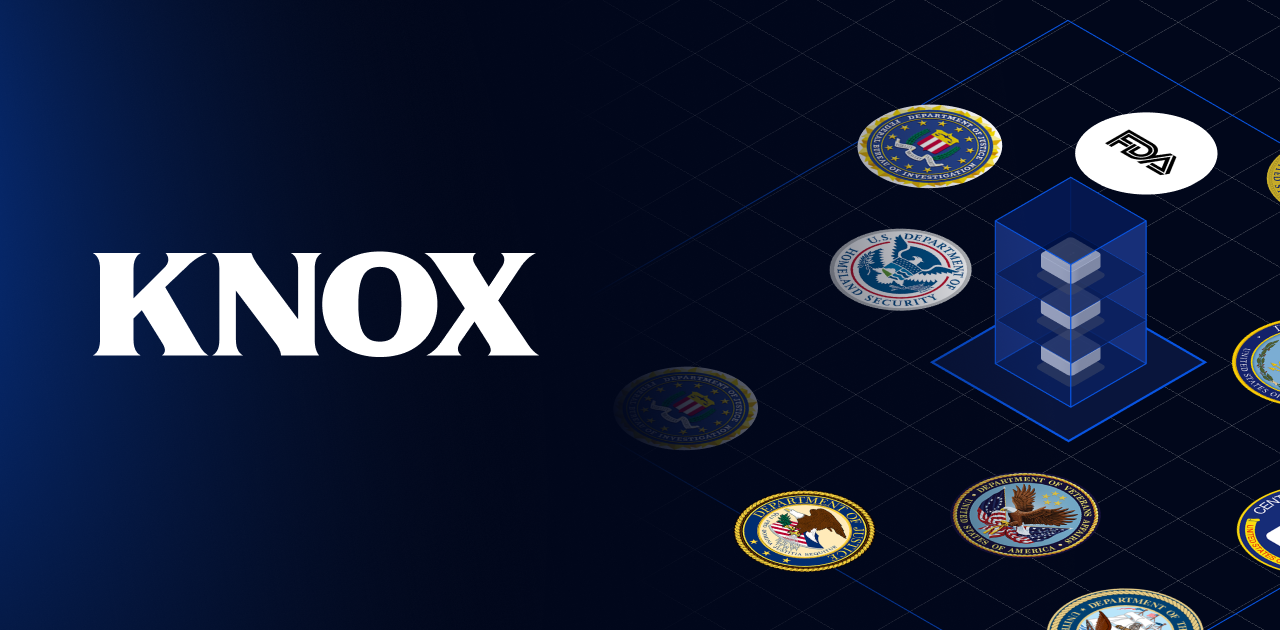
On the other side of the boundary sit the agencies whose authorizations customers inherit - among them the Department of Health and Human Services, the Department of Homeland Security, the Department of Commerce, and the Food and Drug Administration.
Knox is a B2B managed service. Vendors pay to deploy onto the pre-authorized boundary and to run continuous, automated compliance - roughly $500,000 per application, set against a traditional cost that can run several million up front and over $1 million a year to maintain. The pitch is not a discount; it is a change in who can afford to serve the government at all.
Irina Denisenko starts the company in Austin, aimed squarely at the FedRAMP bottleneck she had lived through.
Felicis leads the seed, with Ridgeline and FirsthandVC, funding the managed federal cloud build-out.
Knox appears on the FedRAMP Marketplace at High, opening secure AI and cloud to government agencies.
B Capital leads, joined by M12, Okta Ventures, MongoDB Ventures, Hearst Ventures, and Benchstrength.
The inherited boundary reaches 15+ agencies as customers like Adobe, Celonis, and OutSystems come aboard.
Before Knox, Denisenko co-founded and ran Class Technologies as COO, growing it to $50M in annual recurring revenue, 200 employees, and more than $350M raised. Earlier, she helped build the U.S. drone-technology company PrecisionHawk into an industry leader before its acquisition. A Wharton graduate, she has spent a decade on systems that have to work for the people who depend on them - drone operations, digital classrooms, and now federal software supply.
That track record shows up in the company's stance: the hardest customer on earth - the federal government - is treated as the wedge, not the obstacle. The complexity that scares most founders away is precisely what makes the moat deep once crossed.
Searches for founder interviews and product walkthroughs. Direct video links were not confirmed at publication, so these open relevant results.
Profile compiled from public sources including Knox Systems' website, the FedRAMP Marketplace, PR Newswire, Washington Technology, WashingtonExec, Okta, Finsmes, and Crunchbase. Figures such as timelines, cost reductions, and control-inheritance percentages are approximate and as stated publicly by the company. Last updated July 2026.