YesPress Profile - Company
GovDash
The AI-native platform that finds, wins, and runs government contracts - so contractors can stop fighting their own paperwork.
The AI-native platform that finds, wins, and runs government contracts - so contractors can stop fighting their own paperwork.
It is 2 a.m. somewhere in Northern Virginia, and a proposal manager is not awake. That is the part worth noticing. A federal solicitation dropped at close of business, the response is due in days, and the work that used to swallow a weekend is being drafted, checked for compliance, and outlined while the team sleeps. The thing doing the work is GovDash, and the company behind it has built a business out of the hours other people used to lose.
GovDash sells software to government contractors - the firms that build, supply, and service the U.S. government. In 2025, the company says, its customers won more than $5 billion in contracts using the platform. Nearly 200 companies now run their pipeline on it. In January 2026 the company closed a $30 million Series B. For a four-year-old startup in one of the least glamorous corners of enterprise software, that is a loud year delivered in a quiet voice.
Winning federal work is less a competition of ideas than a test of endurance. A single opportunity demands sourcing, capture planning, a CRM nobody likes, a proposal that satisfies hundreds of compliance requirements to the comma, and then - if you win - a contract to actually deliver. Each step lives in a different tool. The connective tissue is a human, usually exhausted, usually pasting text between five tabs at midnight.
"Companies are not just reacting to temporary disruptions. They're rethinking how they run their government business and leaning into technology to become more resilient."Sean Doherty, Co-founder & CEO
The incumbents had digitized pieces of this - an opportunity database here, a proposal repository there. None of them had asked the more annoying question: what if the whole lifecycle was one system, and what if the tedious parts were handled by something that never got tired? Government procurement is slow by design. The contractors chasing it did not have to be.
GovDash was founded in 2022 by Sean Doherty, Tim Goltser, and Curtis Mason. Goltser and Mason had been building things together since high school, where they co-captained the robotics team. In college they teamed up with Doherty - whom Mason met at Boston University - to build Hang, an app for scheduling time with friends. The hangout app was not the company. The lesson was: this group could ship.
Their bet was unfashionable. While much of their YC W22 cohort chased consumer apps and developer tooling, the GovDash founders pointed at federal procurement - a market famous for its acronyms, its compliance manuals, and its allergy to anything new. Goltser dropped out of college to work on it full-time. The wager: the AI wave would matter most not where it was loudest, but where the paperwork was heaviest.
"Goltser and Mason have been building things together since high school. The hangout app was practice. Federal contracting was the real game."From the GovDash origin story
Doherty, Goltser, and Mason found GovDash and join Y Combinator's Winter 2022 batch, aiming the AI wave at federal procurement.
Northzone leads a $10M round, with Y Combinator returning. Total funding reaches roughly $12M.
Customers win more than $5B in government contracts on the platform, pursuing 3x more opportunities than before.
An oversubscribed round led by Mucker Capital and BCI, with Northzone and Y Combinator joining. Revenue up 16x, customers up 18x to nearly 200.
The platform reaches FedRAMP Moderate Equivalency, clearing it to serve defense contractors handling Controlled Unclassified Information.
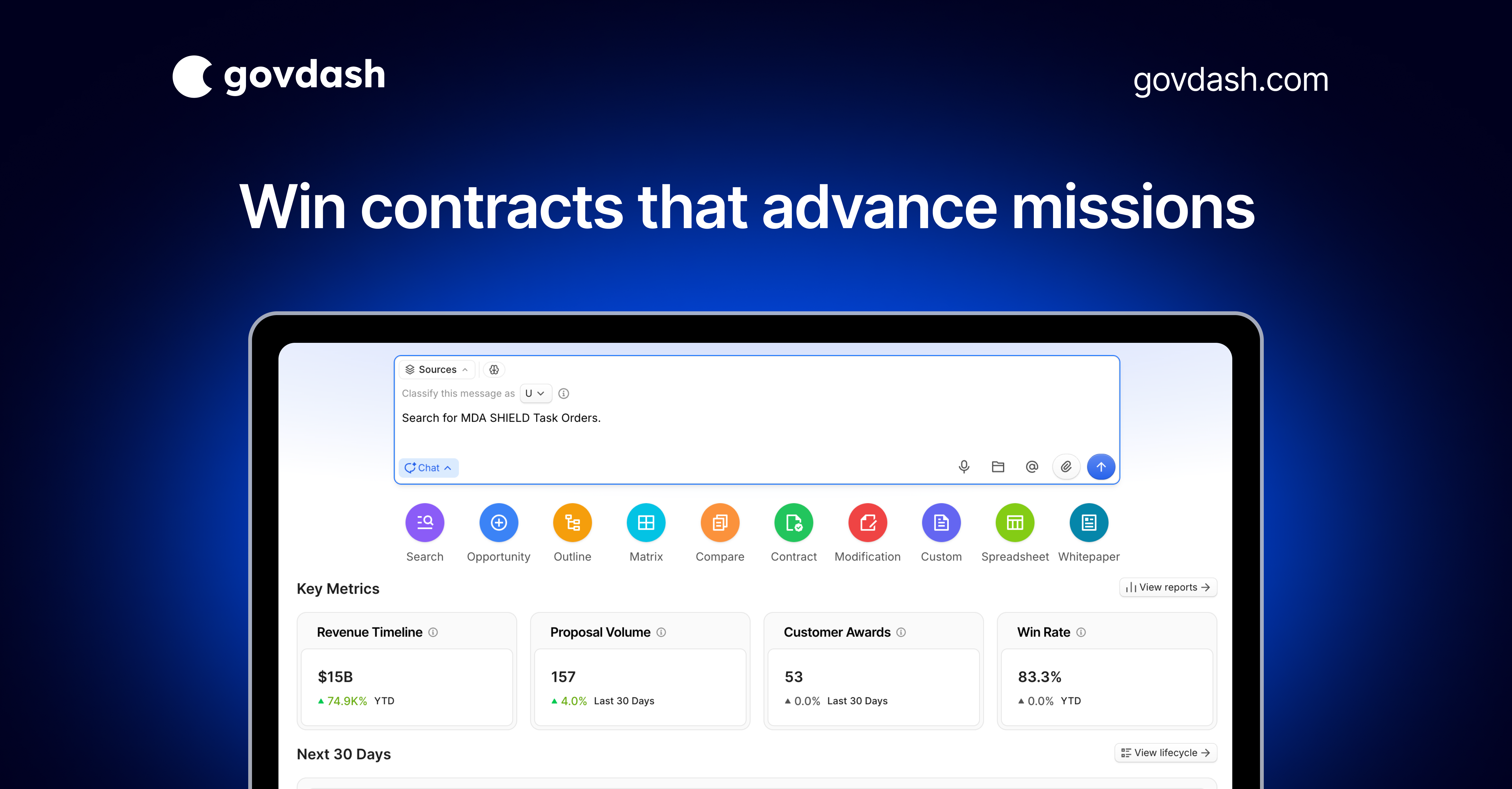
GovDash describes itself as the first end-to-end system of record for government contractors. Instead of stitching point solutions together, it runs the full lifecycle in one place - and puts an AI agent, Dash, at the center of the tedious parts.
Surfaces the right opportunities to pursue out of the firehose of federal solicitations.
A capture cloud for building and managing a pipeline - the CRM contractors will actually keep updated.
AI-assisted drafting, outlining, and compliance checks against requirements down to the comma.
Full lifecycle management for the work after the win, so delivery does not start from scratch.
The AI agent that reads the RFP, drafts, and automates the workflows nobody enjoys.
"The platform reads the solicitation so the proposal team does not have to. The team gets to do the thinking."How customers describe GovDash
What can you actually do with it? Find a bid worth chasing, build the capture plan, draft and compliance-check the proposal, and - if the award lands - manage the contract, without leaving the system or losing the thread between steps. Customers report 80% faster RFI responses, pink-team drafts in half the time, and roughly 4x more RFP output from the same team.
Bars are scaled for the eye, not the calculator. The point is the direction: the same proposal team, doing several times the work, without the all-nighter tax.
Behind the numbers are real firms - Endurion, Aurex, GAP Solutions, OneZero Solutions, Sumaria Systems, SPATHE Systems, and more than 150 prime contractors. The Series B was led by Mucker Capital and British Columbia Investment Management Corporation, with Northzone and Y Combinator returning. Integrations with Microsoft SharePoint, Microsoft 365, and Salesforce mean the platform meets contractors inside the tools they already live in.
Caption: Investors do not usually return for a second helping unless the first one worked. Northzone and YC came back.
GovDash states its mission plainly: to help businesses win and deliver government contracts that advance American interests. The team is entirely U.S.-based, and 54% of it has prior government-contracting experience. That last number is the tell. This is not a group of outsiders guessing at the pain - more than half of them lived it before they tried to automate it.
"54% of the team has done govcon before. They are not guessing at the pain. They are automating something they survived."On the GovDash team
It is a tidy bit of irony that a company built to remove drudgery from government work is staffed by people who chose, twice, to spend their careers near it. The difference is what they are pointing the tools at: not the mission of contracting, but the misery of it.
The Series B money is going where the founders' bet always pointed: more engineering across Discover, Capture, Proposal, Contract, and Dash, more customer success, and a growing footprint in New York and Arlington, Virginia. FedRAMP Moderate Equivalency opens the door to defense work involving sensitive data. The roadmap is less a pivot than a deepening of the same wager - that the heaviest paperwork is where AI earns its keep.
For an informed, skeptical reader, the right posture is curiosity with a raised eyebrow. The growth figures are the company's own, the $5 billion is what customers won and not what GovDash banked, and federal software is a graveyard of promising startups. But the direction is hard to argue with: contractors want to chase more work with fewer all-nighters, and GovDash has built a credible way to let them.
Back to that 2 a.m. in Virginia. The proposal manager is still asleep. The solicitation that dropped at five o'clock has an outline, a compliance matrix, and a first draft waiting in the morning. The weekend that used to disappear is still there. That is the change GovDash is selling - not a louder government, just a less exhausted one chasing it.