A job interview has an awkward little trick. Two people can spend an hour discussing a career, make a decision that changes both their lives, and leave behind a handful of notes. Siadhal Magos has spent years worrying about the distance between the conversation and what survives it. His company, Metaview, began with that gap. The person explaining his work deserves attention. The person listening also needs a record. A keyboard makes a demanding third guest.
Magos encountered the problem while working in product at Uber. Hiring occupied a substantial part of his working life, yet the evidence from interviews remained difficult to inspect. The contrast bothered him: a technology company could measure so much of its business while relying on a rather fragile account of the people it was about to invite inside.
A history student joins the hiring machine
He grew up in London with an Irish mother and a Hungarian father. His name reflects that combination, a detail he volunteered when explaining his background. He studied history at University College London. His enthusiasm for startups and technology developed after university, eventually taking him into product leadership.
At Osper, where he became Head of Product, hiring felt personal. The company was small enough for each arrival to change the group noticeably. Working closely with the CEO, he came to see recruitment as a decision about the character of the whole business. There was little room to imagine a disappointing hire as someone else’s problem.
Then came Uber and Amsterdam. He joined in March 2016, entering a company recruiting at a very different scale. The product work interested him; so did the machinery required to bring people into the organization. Hiring had become an operating discipline, complete with interview panels, training and expectations about feedback.
In his writing about that period, Magos returns to consistency, transparency and uncertainty. Different interviewers could produce different experiences. A panel could have plenty of opinions without a clear view of the conversation behind them. Even a thoughtful process still had to decide what to do with incomplete evidence. The polished scorecard was carrying more weight than its few lines suggested.
How much of a hiring decision can a team trace back to the conversation itself?
Two colleagues, one missing record
Magos’s eventual co-founder, Shahriar Tajbakhsh, had worked with him at Osper. Tajbakhsh went on to Palantir, while Magos experienced Uber’s approach to hiring. They were looking at similar problems from different companies. When they compared notes, the interviews themselves stood out as a source of valuable information that organizations were failing to retain.
They founded Metaview in 2018. Magos became CEO; Tajbakhsh brought the engineering background and became CTO. Their proposition joined speech processing and language technology to a practical recruiting problem: capture the discussion, make its contents usable, and let hiring teams work with something more dependable than recollection.
The early ambition included helping interviewers improve, helping decision makers revisit evidence, and giving talent leaders a view across many interviews. That matters to the founder’s story because the note-taking product can make the idea sound smaller than it was. A usable record could help one person finish an administrative task. Records across a company could help a team understand how it was making decisions.
Ask what actually happened
To see how Magos thinks about people, look at the interview he has described conducting himself. In Metaview’s engineering hiring process, he ran an examination of a candidate’s impact. The candidate selected a recent piece of work they were proud of. Magos then tried to understand the decisions behind it.
He wanted the objective, the customer, the reason the project mattered and the candidate’s own contribution. He warned people that the discussion would get detailed. “I want to feel like I was there with you and know exactly how you operated.” The request is almost disarmingly plain. It gives the candidate a story to tell and the interviewer a job to do.
His method leaves room for discovery. A prepared interviewer knows what they need to learn, then follows the answer. The impressive question is less useful than the patient one that uncovers how a decision was made. Ask about the meeting. Ask what happened afterward. A résumé can accommodate a remarkably large cast of heroes; details help establish who did the work.
That interest extends to the interviewer’s behaviour. In his writing on inexperienced interviewers, Magos identifies three recurring errors: failing to explain the purpose of the conversation, staying too polite to ask for concrete examples, and letting assumptions shape the questions. Each can leave both parties feeling they had a pleasant meeting while producing surprisingly little to assess.
He has also allowed the interviewer to become part of the experiment. After an early-2022 conversation with Recruiting Brainfood’s Hung Lee, Metaview analysed the exchange and compared it with Magos’s captured interviews. Lee’s open questions and willingness to let his guest speak matched the team’s initial impression. One question about leadership produced nearly four minutes of response.
There is a gentle comedy in feeding a founder interview back through the founder’s software. It also makes the larger point unusually tangible. A conversation has a shape. Someone makes space; someone fills it. Good intentions alone tell you little about which person did which.
The long middle of a short founder story
Metaview took four years to find product-market fit, Magos later explained in a conversation with GV. That stretch complicates the convenient version of entrepreneurship in which a founder spots an obvious problem and customers obligingly form a queue. Understanding a problem from experience does not settle how people will buy a solution.
By May 2023, his explanation of the product was sharply practical. Recruiting teams could use AI to write interview notes, freeing the interviewer to listen, ask questions and build a relationship. The benefit was easy to picture because the distraction was easy to recognize. Anyone who has tried to remember a thoughtful answer while typing the previous one already knows the difficulty.
In a 2024 discussion recorded at Transform in Las Vegas, he addressed another part of that work: making summaries relevant and accurate enough to earn trust. The product also supported audio-only calls. Those are modest-sounding details with consequences. A recruiting tool has to fit the conversations people actually have, including the ones without a camera.
“You don’t do it to buy time. You do it to buy speed.”
Siadhal Magos, on fundraising
His observation about capital followed the experience of finding demand and then needing to move faster. He said Metaview should have hired ahead of its growth. A company selling better hiring had acquired its own lesson in timing. The irony is useful: the founder was living with the same consequential decisions he wanted to help customers make.
Sixty countries, and a preference for Python
The public version of Magos has room for a joke. Asked in a 2023 podcast interview whether Benny Hill or Monty Python was funnier, he chose Python, while pointing out that both were a little before his time. An answer can be polite and still deliver a small injury to the people asking it.
He also offered a glimpse of life beyond software. His wife wanted to visit one hundred countries. At the time, their tally stood at sixty. He described himself as travelling along with the mission. His own geography already included London, time on the American West Coast and a spell living in Amsterdam.
These details give the product executive a less corporate outline. There is a person with a family itinerary behind the talks about recruiting systems. The country count belongs to that moment in 2023, an unfinished undertaking with a clear target and plenty of distance left.
A recruiting company learns to recruit
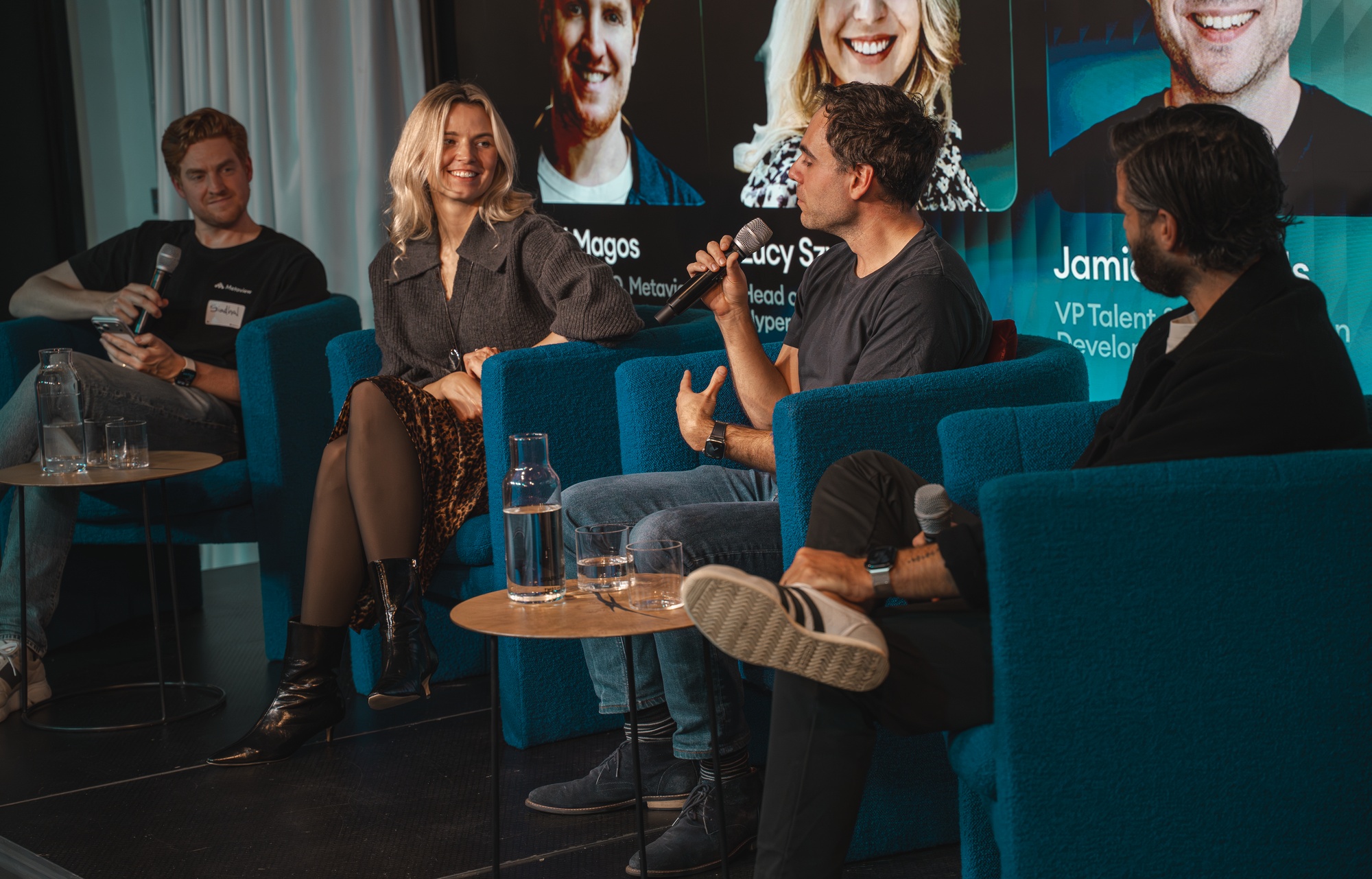
As Metaview grew, Magos’s conversations widened from interview technique to how recruiting teams should work with AI. The company’s 10x Recruiting community brought him together with talent leaders from businesses including Miro, Deliveroo and hyperexponential. Their discussions considered the work people should keep, the systems they could redesign and the meaning of a good hire.
By September 2026, he was discussing agents that could perform parts of recruiting, including sourcing, outreach and scheduling. In a RecTalk conversation, he argued that relationships, influence and human judgment would remain valuable as more operational work moved to software. The proposal asks recruiters to change their work while continuing to take responsibility for the people involved.
Metaview had acquired Reval, an AI recruiting business founded by Seth Tilliss and Aditya Gupta, that August. The acquisition supported fillmore, its recruiting coworker designed to find candidates and arrange screening calls. The company that began by capturing what people said was moving further into the work that gets them into a conversation.
On September 30, Magos announced a $60 million Series C led by Insight Partners. Metaview reported more than 7,000 customer companies and $110 million in total funding. He also laid out plans to open in New York and expand the team from 80 people to 250 by the end of 2027. Those are announced ambitions, with the hiring still ahead.
Next on Magos’s agenda: more recruiting agents, a New York office and a larger team.
For Magos, that makes the original question personal again. Before the expansion becomes an organization, it will be a series of discussions with people considering whether to join. Someone will explain a project. Someone will ask what happened next. His own company will have to listen carefully, remember accurately and decide whom it wants in the room.