There is a specific feeling attached to a CAA truck coming into view. It arrives before the mechanic steps out, before the battery turns over, before the tow begins. A problem that had been yours alone is now shared. Shoshana Fruitman's work at CAA Club Group can be read as an effort to carry that feeling farther than the shoulder of a highway.
Fruitman is the organization's Chief Marketing Officer, a role that puts her across a Canadian business with an unusually broad front door: roadside assistance, insurance, travel, rewards, safety advocacy and community programs. Those services do different jobs. The marketing challenge is to make them feel like expressions of the same relationship.
Her answer has not been to erase CAA's history. It has been to locate the useful emotion inside it. For many Canadians, the name already signals rescue, membership and a familiar maple-leaf badge. The opportunity is to translate that accumulated trust into categories where the brand has been quieter, particularly insurance.
A nearly 50-year-old blank page
In 2023, CAA Insurance faced a strange condition for an established company. It had been operating for almost five decades, yet it had never gone to market with a large consumer-facing brand campaign and positioning of its own. Awareness existed, but the story had room to become clearer.
Fruitman, then vice-president of marketing operations, described the goal in direct terms: “We've been in business a long time and we really want CAA Insurance to be top of mind for people.” The campaign was less a strategic turn than a public introduction. It asked consumers to connect what they already knew about CAA with what the insurer wanted to stand for.
“We've been in business a long time and we really want CAA Insurance to be top of mind for people.”Shoshana Fruitman, 2023
The resulting platform, “Making Things Better,” sounds modest on purpose. Instead of opening with risk tables or policy features, the creative work noticed small upgrades in ordinary life. One spot found an onion ring hiding among the fries. Another captured the narrow relief of avoiding out-of-date sushi. The moments were comic, recognizable and brief. Together, they offered a vocabulary for a company whose real product often matters most on a bad day.
There is discipline in choosing that scale. Insurance advertising can easily drift toward catastrophe or fine print. These spots stayed with the manageable and familiar. The point was not that every problem disappears. It was that a company can be judged by whether it improves the next few minutes. That idea gave CAA Insurance a way to speak in the same emotional register as roadside assistance without pretending the products were identical.
The media plan matched the observation behind the ads. People do not move through television, radio, social and online video one at a time. They stack channels, often using several at once. CAA ran ten television spots, five radio spots and a substantial set of online videos. The repetition was not merely about reach. It made a single brand idea recognizable wherever the audience happened to be looking.
The loyalty apprenticeship
Fruitman's route to that campaign began well before insurance. She spent more than a decade in progressive retail-marketing roles, with earlier professional profiles listing Loblaw Companies Limited, Indigo and CIBC Wood Gundy. Her experience included the launch and operation of Canada's largest loyalty program. The public record does not turn that work into a tidy memoir, but its relevance to CAA is easy to see in the work itself.
Loyalty is frequently reduced to points, redemptions and a plastic card. A member organization has to work on a longer clock. Roadside help may be dramatic, but it is intermittent. Travel planning, discounts, insurance and community programs fill the space between emergencies. Each service becomes another chance to prove that a membership is useful before renewal arrives.
Fruitman's education points in the same direction. She attended Ivey Business School at Western University from 2000 to 2002, focusing on corporate strategy, behavioural science and marketing. She graduated with Distinction, made the Dean's Honour List and finished in the top ten percent of her class. Those subjects meet neatly in loyalty: how people make choices, how a company organizes around those choices and how a message becomes memorable.
A former colleague's public recommendation adds a view from inside the work. Jason Jilek wrote that he worked with Fruitman ahead of what he called the largest loyalty integration in Canadian history. He credited her vision, drive and instincts, and noted that her teams were consistently strong performers. It is an unusually specific endorsement because it connects market judgment with the ability to attract people to a team.
Collaboration as a growth system
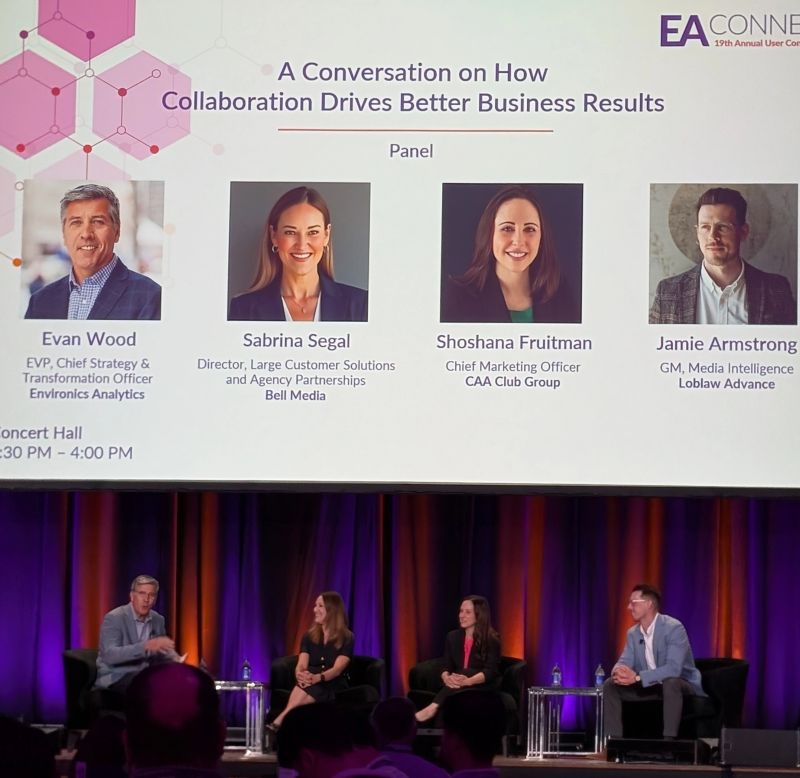
By 2025, Fruitman's public conversations had widened from campaign craft to collaboration and data. At the EA Connect conference, she joined leaders from Environics Analytics, Bell Media and Loblaw Advance for a panel about how collaboration drives better business results. The photograph is corporate, almost diagrammatic: four sectors on one stage, each holding a different piece of the customer picture.
That matters because CAA's marketing surface is larger than an ad plan. A member may encounter the organization through a tow, a quote, an app, a discount, a travel booking or a road-safety campaign. None of those interactions alone describes the whole relationship. Collaboration is how a distributed business develops a coherent memory of the member without making the member learn its internal structure.
Fruitman has also appeared in industry discussions about loyalty value beyond transactions. The phrase is useful. A discount can close a sale, while a well-timed service can change whether a person stays. The marketer's work shifts from manufacturing attention to arranging usefulness. Data can help identify the moment, but the benefit still has to feel human when it arrives.
A national badge, used locally
The same logic shows up far from an analytics conference. In 2024, CAA South Central Ontario renewed a partnership with the Brampton Honey Badgers. The arrangement created game-day experiences for members and donated tickets through nonprofit groups to youth and families in Brampton. Fruitman's explanation emphasized the city's growth, diversity and large population of young families.
“At CAA, we always look for meaningful ways to give back to our members and the community,” she said. The partnership was a small example of a broad brand operating locally: access for members, support for a team and seats for families who might not otherwise attend. It also made the membership visible somewhere other than a roadside or an inbox.
CAA's public mission is to help Canadians stay safe, mobile and protected. Its programs range from school safety patrols and road advocacy to travel and insurance. In November 2024, Fruitman was part of a CAA delegation introduced at Ontario's legislature during a visit connected with auto-theft advocacy. Marketing in this setting sits close to public affairs and service delivery. The promise has to survive beyond the campaign.
The strongest extension of a legacy brand is not a new slogan. It is a new occasion for an old promise to become useful.
The moment after the message
Fruitman's career now connects three systems that are often treated separately: brand, loyalty and operations. Brand gives the relationship a memorable meaning. Loyalty gives it a rhythm. Operations determine whether the promise is true when the customer tests it.
That is why the 2023 insurance work is more interesting than a collection of commercials. The campaign took an existing association, relief when CAA arrives, and gave it a broader job. It made insurance legible through a feeling rather than an abstraction. It also gave a multi-business organization a sentence that each part could try to prove.
The phrase “making things better” is intentionally smaller than transformation. It leaves room for an onion ring, a basketball ticket, a useful discount or a tow truck. Those are not equivalent services, but they can accumulate into the same conclusion: membership helped today.
For Fruitman, the next marketing problem is embedded in that accumulation. CAA already owns recognition. Insurance already has history. The work is to be remembered at the point of consideration, then to justify that memory through every channel and encounter that follows. The campaign gets attention. The relationship earns the renewal.