Sherif Foda once told a room of students that he had spent 78 days offshore. He remembered it as an achievement. The students wanted to know why anyone would do that. It is a small, funny collision between two ideas of a successful working life. Foda, who started in the Red Sea and went on to run businesses across continents, has had to learn that endurance does not explain itself to the next generation.
His larger experiment asks a similar question about ambition. What should a company from the Middle East be expected to do? Stay small? Supply local knowledge while someone else supplies the technology? Foda founded National Energy Services Reunited, or NESR, in 2017 to give a more expansive answer. The company would bring regional businesses together and connect them to international investment.
Today, the Egyptian executive is based in Houston, with a business concentrated across the Middle East and North Africa. The geography is central to his argument. Capital can travel. Technical knowledge can travel. The benefits of building an enterprise should also take root where its people work.
A second career, without the golf
Foda graduated from Ain Shams University in Cairo in 1991, studying electronics and automatic control. Before oilfields came computers: he spent two years in the information technology and computer industry. He joined Schlumberger in 1993, beginning on offshore fields in the Red Sea, then moving to Germany and Eastern Europe. His eventual senior roles included responsibility for the Arabian market, worldwide well intervention, Europe and Africa, and the Production Group.
That progression gave him experience of an industry whose customers may operate within national borders while its equipment, specialists and investment move around the world. He also served as senior adviser to Schlumberger’s chairman. By the time he started his own company, he had seen the business from the working end of a well and from the executive offices where resources are allocated.
The invitation to try something else arrived through an unexpected example. At an energy conference, Foda met a 74-year-old former chief executive who had found retirement unsatisfactory and was starting a special purpose acquisition company. Golf had failed to keep him occupied. Foda’s reaction was to ask why he, being younger, could not attempt a fresh start too. A retirement story became a founding story.
Two businesses become an argument
A SPAC raises money before acquiring an operating business. NESR completed its initial public offering in May 2017. The operating combination followed on June 6, 2018, when Gulf Energy SAOC and National Petroleum Services came together under its roof. This distinction matters: the capital-market vehicle existed before the combined service business. The company’s origin involved joining established operations, customers and teams.
The shareholders behind the combination included SCF Partners, Viburnum Funds, the Olayan Group and Waha Capital. Former shareholders of the acquired businesses retained a substantial interest. Foda was assembling a company with people who already knew the region, while giving international investors a way to participate through a US-listed enterprise.
His promise at the time included jobs and local manufacturing. Those are practical ambitions in an industry that requires equipment, maintenance, transport and skilled crews. They also establish a demanding test. Calling a company regional is easy; deciding where its expertise, purchasing and employment will accumulate takes years of choices.
Foda has been explicit about the identity he wants that enterprise to carry: “proudly, we’re from the Middle East, listed in America.” The two locations serve different purposes. One describes the roots of the business. The other describes a route to investors, and the obligations that come with their money.
The unglamorous test of being public
Those obligations became a serious problem. In March 2022, NESR identified potentially significant accounting errors. Its annual financial statements for 2018, 2019 and 2020 could no longer be relied upon. Restatements increased accrued liabilities and service costs and substantially reduced previously reported net income. The problems reached into finance, accounting and the supply chain.
In August 2024, the company settled SEC charges concerning financial reporting, accounting and controls. Without admitting or denying the findings, NESR agreed to pay a $400,000 civil penalty and undertake corrective work. The settlement required remediation of material weaknesses within a year and provided for an additional penalty if the undertakings were not satisfied.
NESR re-established its Nasdaq Capital Market listing on October 22, 2024. A subsequent company filing reported that, during the third quarter of 2025, its chief executive certified completion of the settlement’s non-monetary undertakings. These events belong in the same account as the acquisitions and laboratories. A business asking investors to trust its growth must also make its accounts dependable.
Foda has described the difficulty of getting local teams accustomed to US reporting requirements. His response included strengthening compliance knowledge and implementing SAP across the business. It is the kind of work that rarely produces an arresting photograph. It does, however, determine whether a company can manage the complexity that its expansion creates.
Put the laboratory near the problem
In Dhahran Techno Valley, Saudi Arabia, NESR’s Oilfield Research and Innovation Center, NORI, gives the localization idea a physical address. Its grand opening took place on February 22, 2023. Research is organized around reservoir development, chemistry, decarbonization and operational intelligence. The aim is to turn scientific work into applications that customers can use in the region.
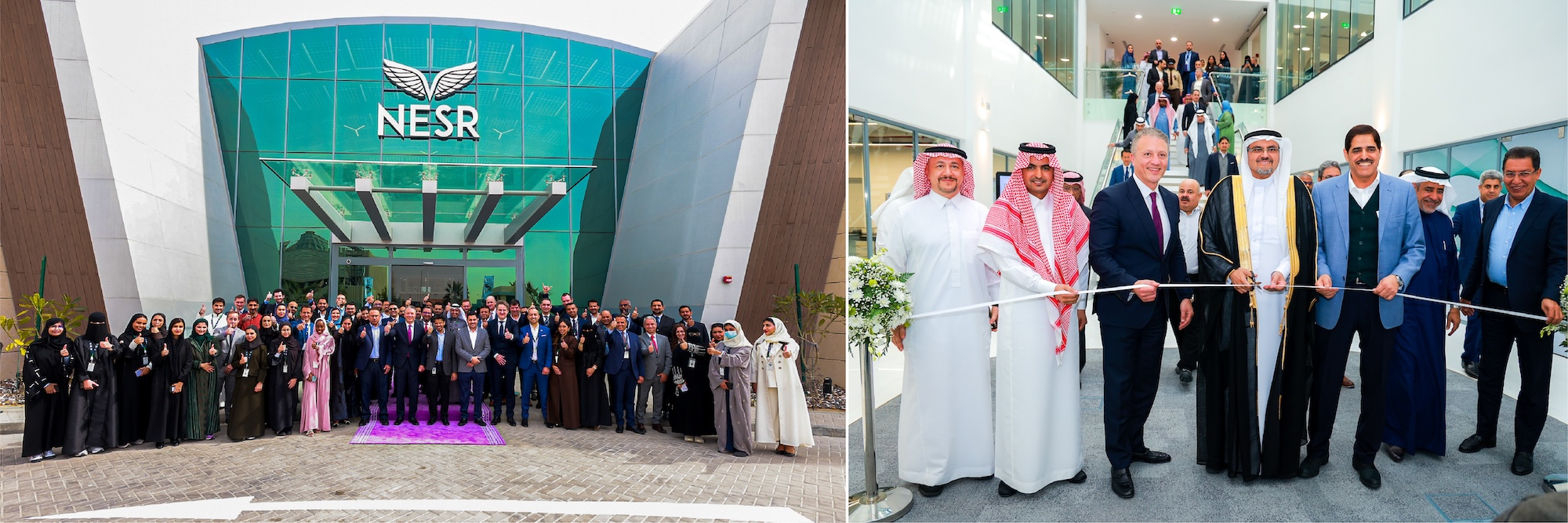
The center is designed as an open platform. Local and international innovators, universities and energy customers can work together there. A chemistry laboratory addresses problems including water control, cementing and stimulation fluids. An operational intelligence laboratory works on real-time data and applications. The common purpose is to bring the development of solutions closer to the conditions in which they will be used.
Training supplies another part of that infrastructure. NESR’s Global Wireline School was inaugurated in Saudi Arabia in October 2024. In February 2025, the company announced a Global Advanced Hydraulic Fracturing School developed with Saudi Aramco. Its intensive three-week program brought participants from multiple countries into reservoir engineering, formation evaluation and practical operations.
A school is a useful measure of what a company means by local talent. Equipment can arrive on a truck. The judgment to operate it, interpret results and solve an unfamiliar problem takes longer to develop. Foda’s regional enterprise needs people who can carry that knowledge between projects, and eventually teach it to others.
“The region has the talent and the human capital.”Sherif Foda
Water gets another job
Foda’s environmental work starts with the existing oilfield. NESR Environmental & Decarbonization Applications, NEDA, covers projects such as water treatment, methane detection and flare capture. In a November 2024 interview, he described a Saudi project treating highly saline produced water into freshwater. In Iraq, the company used reservoir water to make workover fluid, reducing the need to consume freshwater for that task.
These projects connect the environmental agenda to the materials an operator already handles. Water comes up with hydrocarbons. Gas can be wasted. Heat can escape. Each presents a technical problem, and potentially another service to sell. Foda is pursuing commercial applications within the industry that built his career.
water→Treatment &
separation→Reusable water /
mineral recovery
Two areas of NESR’s technology work. Outcomes depend on the project and the process.
The next proposal reaches into batteries. In October 2026, Foda discussed an agreement with Saudi Aramco for a direct lithium extraction demonstration project using oilfield water. The project is valued at approximately $200 million over a potential five-year period. It targets 2,000 tonnes of battery-grade lithium carbonate annually, with production scheduled to begin in late 2027.
Those figures describe a planned project. They are useful precisely because they give the ambition a scale and a timetable. For Foda, the connection to his original idea is clear: bring in technical expertise, establish manufacturing capabilities locally, and retain more of the value created from the region’s resources.
Local knowledge, measured in delivery
In August 2026, Foda described how NESR prepared for disruption by examining supply routes and making 30-, 60- and 90-day contingency plans. The company stocked essential materials, arranged alternative routes through Saudi Arabia’s west coast and used chartered flights for important supplies. Regional knowledge had become a question of keeping work moving.
He also described searching with Aramco for Saudi sand that met the specifications needed for hydraulic fracturing. Importing sand into the Middle East has a certain comic extravagance. Finding the correct grain size, shape and purity is a less amusing engineering problem. His point was that local sourcing has to satisfy the technical requirements before it can deliver the commercial benefit.
NESR reported $520.8 million in revenue for the second quarter of 2026, up 59.1 percent from the same quarter a year earlier, and $44 million in net income. Its August release described more than 7,000 employees, over 60 nationalities and operations in 16 countries. This is now an organization whose ambitions require daily coordination across a substantial footprint.
Company-reported footprint, August 2026.
Foda’s responsibilities extend beyond NESR. He serves on the board of Alfanar, a venture philanthropy organization, and chairs WDVG Engineering in Houston and GLC Energy in London. These connections place him among businesses and institutions concerned with technical capability, investment and the development of enterprises.
The early offshore worker has become a builder of systems: financial controls, research partnerships, training programs and supply arrangements. Each is less dramatic than a long stint at sea. Together, they offer a more useful answer to those skeptical students. Endurance may get someone through a difficult assignment. Building something that other people can develop, question and improve is a different ambition, and a much longer job.