The awkward thing about an oil well is that the valuable part is underground. On the surface, you see machinery, hoses, people waiting for other people, and a clock. Halliburton has spent more than a century working on that gap: the distance between knowing where the resource is and getting a well to produce it.
- The job: equipment, chemistry, crews, and software for the life of a well.
- The buyer: oil and gas operators, from independents to national companies.
- The wager: connecting the operation can save more time than improving one machine.
A pump is only the beginning
In 1919, Erle P. Halliburton started a cementing business in Duncan, Oklahoma, with a wooden mixing box, a borrowed wagon, mules, and a pump. Cementing sounds like an unglamorous place to begin. It is also essential: the cement around a well’s casing helps establish barriers between the well and surrounding formations. A hole without dependable barriers is a problem.
The company expanded from that task into the work around it. Today, Halliburton helps operators interpret rocks, steer drill bits, manage drilling fluids, cement wells, install completion equipment, fracture formations, and maintain production. Its expertise combines subsurface interpretation with chemistry, mechanical engineering, and field execution. The customer buys a way to turn a geological proposition into an operating asset.
That makes Halliburton a supplier to the companies producing hydrocarbons. Petrobras, Coterra, Hess, and Eni appear in its public customer announcements. These buyers have different reservoirs and procurement rules, but a shared concern: mistakes and idle equipment consume money before the next barrel arrives.
The 17% that earned another job
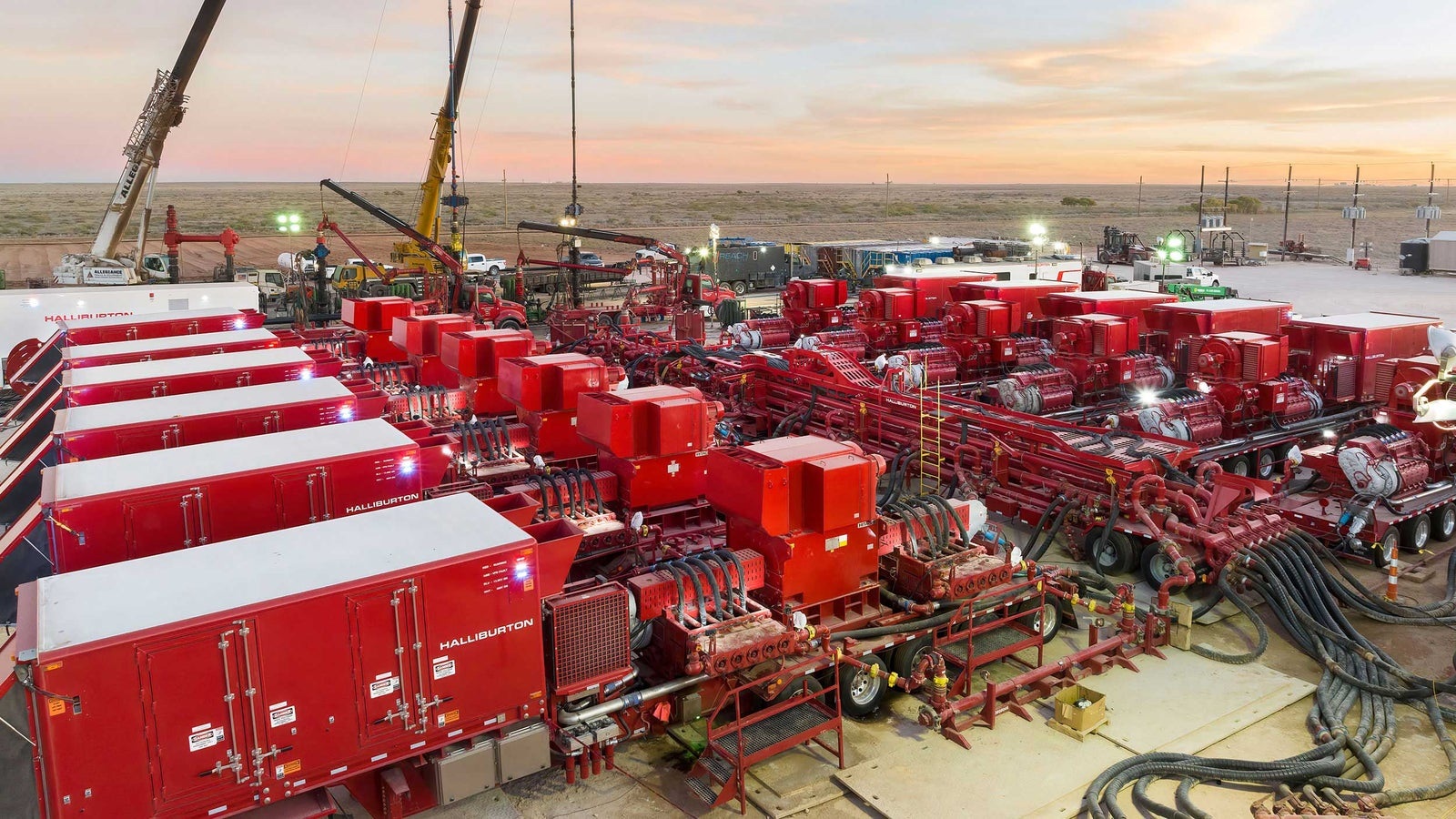
Consider hydraulic fracturing. Operators pump fluid into rock to create pathways through which hydrocarbons can flow. A well is treated in stages. Each stage brings decisions, equipment settings, and transitions. Speed matters, but so does delivering the treatment the operator intended.
Halliburton’s Octiv Auto Frac automates stage execution against customer specifications. Before its introduction, the companies said, pumping decisions were managed manually. In January 2025, Halliburton and Coterra reported a 17% improvement in stage efficiency during the initial rollout. Coterra then extended the service to its remaining Halliburton-operated completion programs in the Permian Basin.
“The deployment of intelligent automation for hydraulic fracturing helps us execute stages consistently”
Tom Jorden, Coterra CEO · January 2025
The sequence matters. A measured result preceded the expanded deployment. That is a useful industrial buying lesson: choose a repeatable task, establish a baseline, and ask whether the whole workflow improves. The reported 17% concerns stage efficiency. It does not establish a corresponding increase in oil production or a universal reduction in well cost.
The road rules still apply
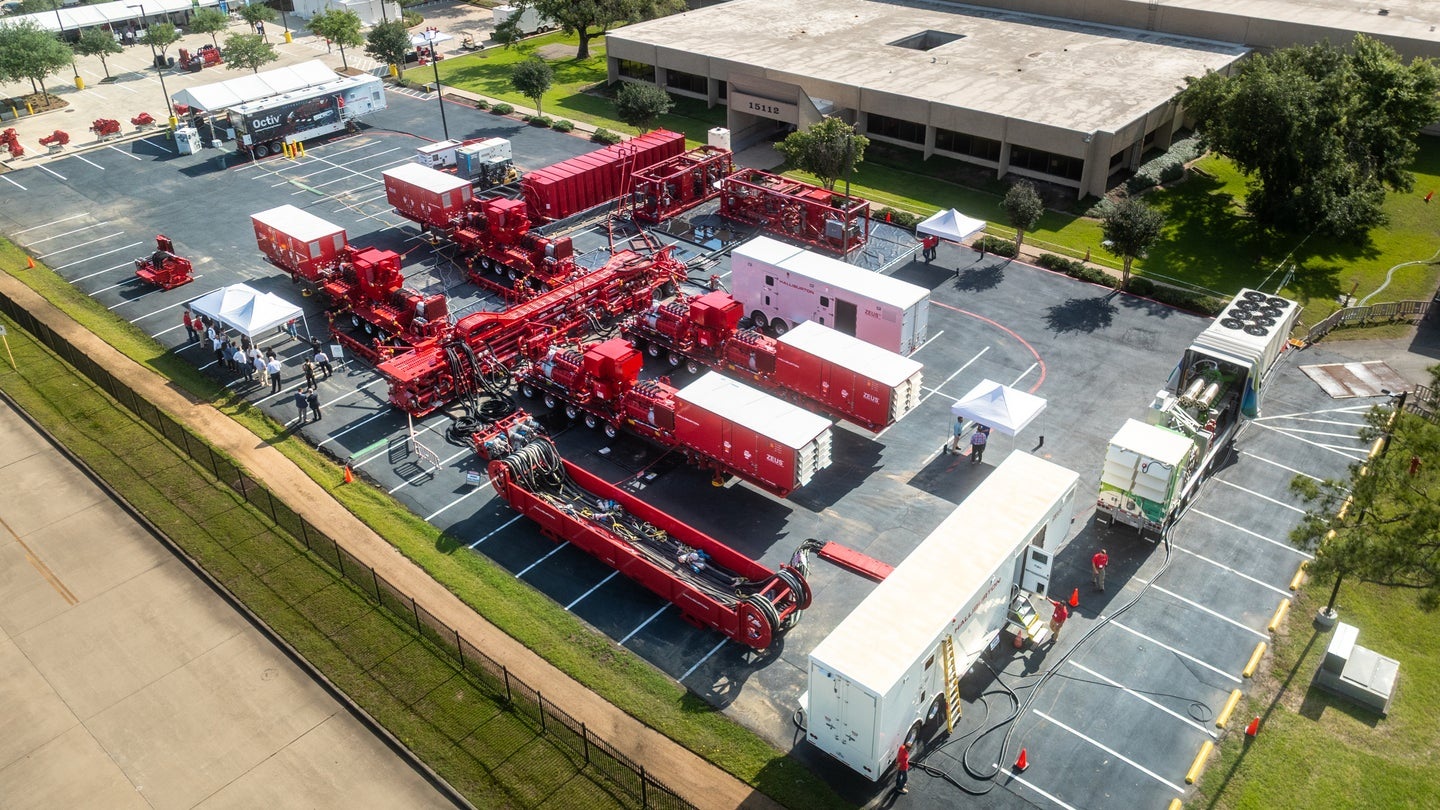
Electric equipment adds another layer. Halliburton rates its ZEUS pumping unit for sustained operation at 5,000 hydraulic horsepower. Electric motors offer precise rate changes and remove some machinery associated with diesel powertrains. The change, however, reaches well beyond replacing an engine.
Hess’s Bakken conversion makes this plain. Its June 2024 account described 18 months of preparation: restructuring contracts, cross-training crews, adding automated valves, and replacing equipment. Halliburton redesigned the system into separately transportable modules to meet North Dakota road weight restrictions. A promising machine still had to get to work legally.
Hess also needed a fuel chain. Compressed natural gas came from its Tioga plant; VoltaGrid supplied generators. Hess projected a 35% reduction in fracturing CO₂ emissions and 30% faster stage transitions. Those were expectations for that project, not evidence of emissions-free extraction. Power availability, fuel logistics, and operating conditions determine what electric pumping can deliver.
The software effort has its own infrastructure. In 2020, Halliburton announced a five-year agreement with Microsoft and Accenture to move digital capabilities to Azure, expand remote operations, and improve analytics. That supports the same practical ambition as the redesigned fleet: put information and equipment where a decision can use them. The distinction matters when evaluating an industrial technology company. A cloud platform can make data available across locations; a trained crew, a working sensor, and a suitable operating procedure still determine what happens at the well.
The invoice behind the experiment
Halliburton earns money through field services, product sales, integrated contracts, and software. Landmark’s DecisionSpace 365 brings subsurface and well workflows into its digital portfolio. In 2025, the company reported $15.729 billion in services revenue and $6.455 billion in product sales. This remains a business with substantial physical work behind the screen.
Those figures also explain the competitive pitch. SLB and Baker Hughes offer broad alternatives; specialist suppliers compete in individual services. Halliburton can combine tools and execution under one scope. Petrobras’s three-year offshore drilling award, announced in January 2025, bundled iCruise steering, LOGIX automation, EarthStar reservoir measurements, and other services. Buying the connections is part of buying the equipment.
For a buyer, the useful comparison is total job economics: downtime, treatment consistency, transport, power, crew requirements, and the risk of coordinating suppliers. A faster pump can be an expensive improvement if another part of the operation cannot keep up.
Some lessons came with billion-dollar bills
Scale has also disappointed Halliburton. Its proposed Baker Hughes acquisition ended in 2016 after regulatory obstacles and worsening industry conditions. The Justice Department had sued, alleging harm to competition in at least 23 markets. Halliburton paid a $3.5 billion termination fee. The deal’s premise could not overcome the conditions required to complete it.
Operational failure carries a different weight. In 2014, Halliburton announced an approximately $1.1 billion settlement covering a substantial majority of plaintiffs’ class claims arising from the Macondo disaster. Any account of well engineering that discusses efficiency while ignoring barriers and consequences misses the central responsibility of the work.
The clock keeps running
The latest figures show the dependence on customer activity. Third-quarter 2026 revenue was $5.703 billion. International revenue rose 3% sequentially; North America fell 5%, with lower U.S. land pressure pumping activity. Better technology does not remove the spending cycle.
Yet the workflow argument keeps finding buyers. Eni’s September 2026 Cronos award in Cyprus bundled drilling, well construction, automation, and completions. The practical idea is fewer interfaces across a complicated development. Halliburton began by making one vital step repeatable. Its current ambition is to connect enough steps that the customer spends less time waiting between them.
Go a little deeper
Explore Halliburton’s website, ZEUS equipment, Coterra’s automation rollout, Hess’s field account, and company news and results.
Watch the 2025 Frac Technology Showcase or visit the video channel. Follow on LinkedIn, X, Instagram, and Facebook.