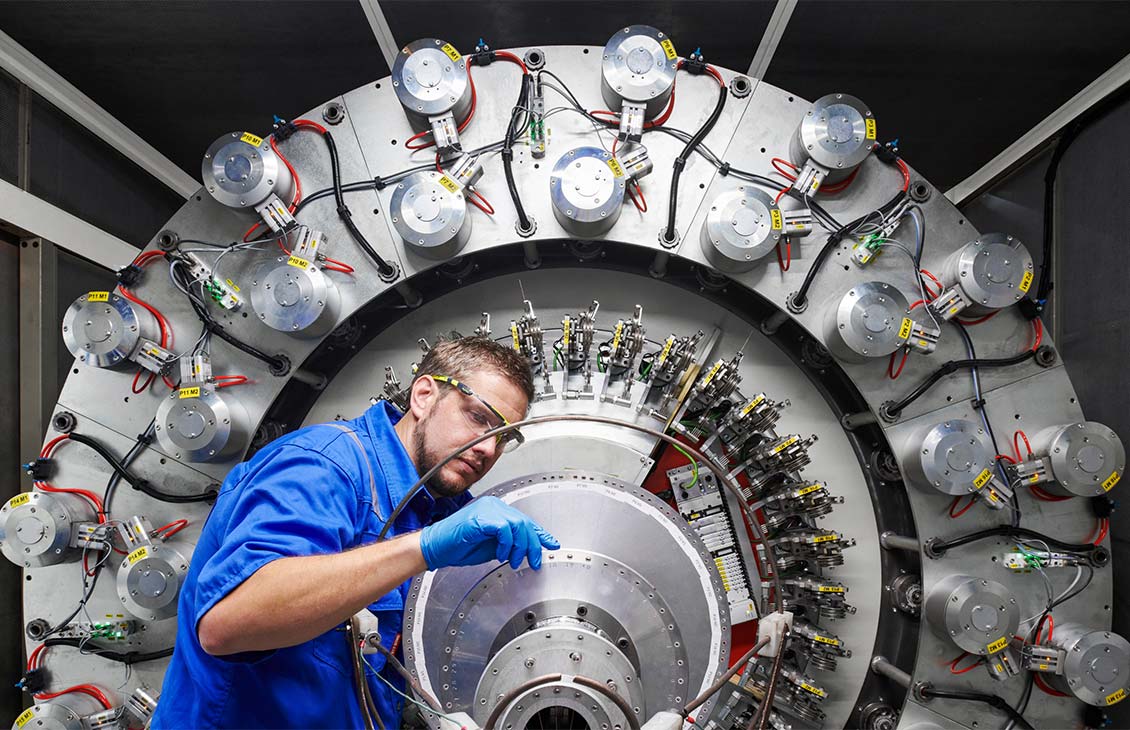
The drill bit looks like something a dentist might order after a particularly bad week. Steel blades. Round cutters. An industrial appetite for rock. In SLB’s Retina system, the bit also carries imaging technology. It can reveal details of the formation at roughly two-millimeter resolution while drilling. The useful part is the timing: engineers get information while they can still change what happens next.
- SLB sells measurements, software, equipment, and services to energy operators.
- Its advantage is connecting knowledge of the reservoir to work in the field.
- Customer budgets still set the pace. Better information cannot approve a drilling project.
A camera where the decision happens
In October 2026, SLB reported Retina deployments in more than 50 wells across 18 locations. Images taken at the bit capture the formation before drilling changes it. Fractures and thin beds become information for well placement and completion design. The instrument earns its place by shortening the distance between seeing a problem and acting on it.

That idea is older than the company’s three-letter name. Conrad and Marcel Schlumberger formed their electrical prospecting business in 1926. A year later, a team led by physicist Henri Doll lowered an electrical probe into a 500-meter well in Pechelbronn, France. Doll was also Conrad’s son-in-law. This was a family business with an unusually ambitious basement.
Previously, engineers relied on rock samples and cuttings that could miss promising zones. The first electrical resistivity well log offered another way to identify formations around a borehole. The output was a hand-plotted graph. The commercial proposition was already recognizable: measure something expensive to misunderstand, then give the operator a better basis for deciding.
The handoff is part of the product
Today, SLB works across the well’s life. It characterizes reservoirs, steers drilling, supplies fluids and cementing services, equips wells for production, and helps maintain them. National oil companies, international majors, and independent producers buy those capabilities. Its market sits between the owner of an energy resource and the work required to develop it.
The software follows the same chain. Petrel helps geoscientists and engineers interpret and model the subsurface. DrillPlan connects that knowledge to well design. Delfi provides the digital environment linking applications and workflows; Lumi supplies data and AI infrastructure. These names describe different jobs. Their value depends on whether information travels usefully between them.
- 01MeasureFormation data
- 02ModelPetrel
- 03PlanDrillPlan
- 04OperateField feedback
New measurements return to the model. The next decision starts with more evidence.
Consider TotalEnergies’ 15-year DrillPlan agreement, announced in October 2026. It brings offset well data, trajectories, casing inputs, and planning assumptions into a common planning environment. A geologist’s interpretation and a drilling engineer’s design need to agree about the same well. Shared assumptions are a practical product when a disagreement can become steel in the wrong place.
SLB earns money through equipment sales, field services, chemicals, software licenses and subscriptions, and integrated contracts. Halliburton, Baker Hughes, and specialist suppliers offer alternatives across that portfolio. SLB’s distinction is the combination: subsurface expertise, digital tools, and equipment that performs the physical task. Buyers must judge that combination against their own workflows, integration costs, and local service needs.
The $5.2 billion wrong turn
Technical knowledge does not travel equally well into every market. In 2001, Schlumberger bought the IT consultancy Sema for about $5.2 billion. By late 2002, the telecommunications slump and depressed IT company valuations had helped force a reassessment. Its accounts recorded a $2.638 billion goodwill impairment as part of a wider package of charges.
The sale of most SchlumbergerSema businesses was announced in 2003 at approximately $1.5 billion and closed in 2004. That was a different bundle of assets from the original purchase, so subtracting the two prices would produce a misleading loss figure. The sequence still makes the strategic reversal plain: broad IT expansion gave way to a tighter oilfield focus.
“information technologies that enable real-time reservoir description, monitoring and management”
Andrew Gould / explaining the oilfield opportunity, 2003
Gould’s explanation located the opportunity inside the customer’s reservoir. SLB acquired Petrel Workflow Tools in that same year. The interpretation is straightforward: software has a stronger claim on this company’s attention when it connects to a technical problem its engineers understand.
The budget gets a vote
The economics remain stubbornly physical. SLB’s 2025 revenue was $35.708 billion, down 2%. Excluding acquired ChampionX revenue, the decline was 6%. Growth in digital and data center solutions could not outweigh activity reductions in Saudi Arabia, Mexico, and offshore Sub-Saharan Africa. Customers can like a tool and still cut the work that requires it.
2025 includes ChampionX after acquisition. The reported decline was 2%; excluding that acquisition, 6%.
ChampionX joined in July 2025, adding production chemicals and complementary artificial lift technologies. Management described production and recovery as a less cyclical market. The logic is practical: producing wells need attention after the drilling campaign ends. The all-stock deal exchanged 0.735 SLB shares for each ChampionX share; expected savings and growth benefits remain execution targets.
Follow the heat
SLB also applies subsurface and engineering skills to geothermal energy and carbon capture and storage. The overlap makes sense: understanding rock matters when extracting heat or assessing where carbon dioxide can be stored. It does not make every project economical. A suitable reservoir, project financing, permits, and a buyer still have to come together before technical capability becomes a business.
The next extension reaches beyond the well. In August 2026, SLB agreed to acquire thermal management specialist Kelvion for about $3.4 billion in cash plus $0.7 billion of assumed debt. Closing is expected in the first half of 2027. Cooling equipment would expand SLB’s existing modular data center infrastructure business as AI increases the physical demands on computing facilities.
The transferable lesson is specific: find the decision that becomes expensive when information arrives late. Improve the measurement, then connect it to whoever can act. That approach needs trustworthy data, usable workflows, and customers with money to deploy it. It loses force when budgets disappear or integration costs swallow the benefit. A century later, the graph still has to earn its keep.