Andy Hendricks wanted a job that would let him go outside. The oil business obliged, although its idea of fresh air involved a jack-up rig in the Gulf of Mexico. He had a petroleum engineering degree from Texas A&M. His first employer, Ocean Drilling & Exploration Company, put him to work as a roustabout and roughneck. A university education had brought him to the rig; the rig would provide an education of its own.
That beginning gives his later career a pleasing complication. Hendricks now runs Patterson-UTI Energy, where software, automation and data occupy an increasing share of the conversation. Yet the person making that case began with the physical work those systems are meant to improve. His career spans the distance between handling equipment offshore and deciding which pieces of a drilling operation should be connected, measured and automated.
A degree, then the deck
Born and raised in the Dallas area, Hendricks graduated from Texas A&M in 1987. It was an awkward moment to choose petroleum engineering as a profession. He stayed with the subject through the industry's downturn, having already tried mechanical engineering and discovered that he preferred a different course. His explanation was agreeably free of grandeur: “I wanted something that was going to let me go outside from time to time.”
The early offshore stint was brief. In 1988, he joined Schlumberger, beginning a 24-year career with the oilfield services company. The move put him inside a business where engineering knowledge had to travel: across countries, across geological conditions, and between people who designed tools and people who used them.
His eventual return to Texas came with an international working life behind it. He had worked offshore and onshore and conducted business in Spanish and French. There is something usefully corrective about that career path for anyone imagining an oil executive's education ends at graduation. Different locations ask different questions of the same equipment. Managing across them adds another subject to the syllabus: how to make technical knowledge intelligible to the next person.
Texas A&M
NexTier merger
A Senate hearing, with company
By May 2010, Hendricks was president of Schlumberger Drilling & Measurements. The following May, he appeared before the US Senate Committee on Energy and Natural Resources to explain developments in upstream oil and gas technology. He introduced a small personal detail before the engineering: he had brought his son, Drew, so he could see government at work.
The testimony offers a compact picture of Hendricks as a technical translator. He described a division concerned with directing wells, improving drilling performance and keeping the wellbore in contact with the reservoir. To explain the punishment downhole electronics endure, he invited senators to imagine putting a smartphone in an oven, driving over it, and expecting it to work afterward. Consumer electronics had rarely been offered a less attractive field trip.
The point underneath the joke was serious. Drilling involved sophisticated instruments and the skilled people operating them. He was explaining why an industry associated with heavy machinery also belonged in a discussion about information, precision and engineering. Years before his current company's digital investments, he was already making that argument in public.
Six months to the chief executive's chair
Patterson-UTI announced his recruitment in March 2012. He would join as chief operating officer on April 2, with a planned succession to Doug Wall, who intended to retire. Chairman Mark Siegel pointed to Hendricks's experience managing businesses with technological and geographical complexity. The attraction was specific: this was an executive who had run a global drilling business, with responsibility for thousands of employees.
Hendricks had also completed executive finance training at IMD in Switzerland in 2008. The combination matters. A drilling contractor must understand what an upgrade can do in the field and what it will cost before it earns a dollar. Engineers and financial managers meet at precisely that uncomfortable point.
On October 1, 2012, he became chief executive. He has served on the company's board since June 2017. His tenure has concentrated on people, technology and acquisitions, with recruiting, leadership development and sustainability among the stated priorities. These are broad responsibilities, but the chronology gives them substance: a field worker became a global division leader, then took charge of the contractor purchasing and deploying the equipment.
“No amount of financial success is more important than doing what is right.”
Andy Hendricks, Patterson-UTI Code of Business Conduct and Ethics
The award between two chairmanships
Hendricks chaired the International Association of Drilling Contractors in 2017 and again in 2023. Between those terms, he received its 2021 Contractor of the Year award. Clay Williams of NOV presented it at the association's annual meeting in Dallas on November 5. The award recognizes lifetime achievement in technical innovation, safety and economic efficiency; fellow drilling contractors nominate and select the recipient.
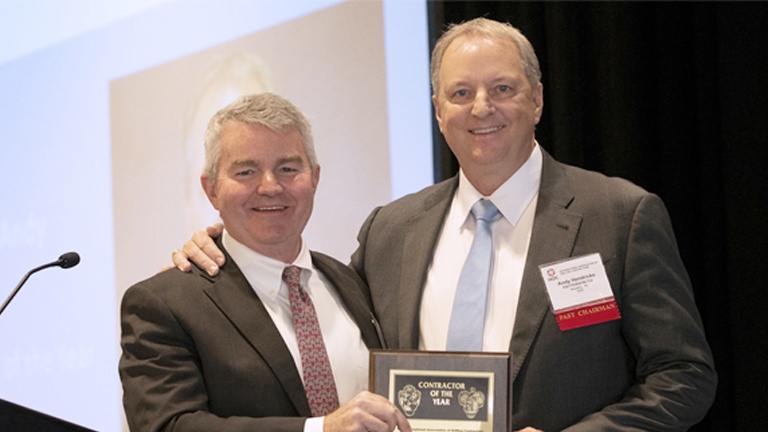
That combination of criteria is revealing. Better equipment has to work safely and make economic sense. Recognition by other contractors also places him inside a professional community whose members compete for business while sharing some operational concerns. A rival can still have something useful to teach you about keeping a crew safe.
His public instructions to employees carry a related expectation. In the company's code of conduct, he urges people to raise concerns through managers, Human Resources, the legal department or the company's reporting hotline. An issue must be identified before it can be resolved. It is a practical management demand: information needs a route upward, including when the information is inconvenient.
Two deals, one longer view of the well
In August 2023, Patterson-UTI completed its acquisition of Ulterra Drilling Technologies. The announced consideration included $370 million in cash and 34.9 million shares. Ulterra brought specialized drill bits, an expanding Middle East presence, and its BitHub data platform. Hendricks emphasized how that information could complement Patterson-UTI's own PTEN+ platform.
The following month, on September 1, Patterson-UTI completed its merger with NexTier Oilfield Solutions, adding a business focused on well completion and production services. Together, the transactions widened the company's participation in the work required to turn a drilling plan into a producing well.
Hendricks's explanation of Ulterra makes the intellectual ambition behind the acquisition unusually clear. He wanted the combined drilling and completion data to support better analytics and better well economics. Owning another business could bring more than equipment and revenue. It could bring observations about what happened before and after a particular operation, giving engineers more context for their decisions.
Drilling products
Drilling services
Completion services
What the software actually does
Automation can become a pleasantly vague word in an executive presentation. Patterson-UTI's CORTEX applications give it something concrete to do. The platform monitors, optimizes and automates equipment functions on APEX rigs. Its Connect application automates steps around drill-pipe connections. Its Downlink tool automates sequences used to send instructions to downhole tools. Ream automates the process of conditioning the wellbore.
These are particular tasks with particular consequences. Repeatable procedures can reduce variation between operations. Bringing rig controls and operational data together also makes it possible to examine what happened, rather than relying solely on recollection after a shift. The engineering attraction is understandable: a repeated action offers repeated opportunities to learn.
The company's technology portfolio also extends to power. Its annual reporting describes GenAssist engine-management logic, designed to start and stop engines as demand changes, and EcoCell lithium battery storage. Both address fuel use and emissions. Hendricks's sustainability message places these investments alongside employee development, local community engagement and capital stewardship. The aspiration is expressed through the operation itself: perform the work while reducing its impact.
The cycle still gets a vote
Hendricks has repeatedly argued for a more durable business cycle. As IADC chairman in 2023, he welcomed producers' greater attention to returning cash to shareholders and growing with moderation. Rapid expansion followed by retrenchment makes financial recovery harder and disrupts the workforce. His preference for stability has a human dimension as well as an accounting one.
That preference does not remove the market's ability to surprise. In July 2026, Patterson-UTI reported second-quarter revenue of $1.2 billion and a $20 million net loss attributable to common stockholders. Hendricks described improving activity and expected additional drilling and completion work in the third quarter. Those expectations were a view of the future, accompanied by the familiar uncertainty of commodity markets.
By September, its average US operating rig count was 103, with an average of 101 for the third quarter, as announced on October 9. Those figures count rigs earning contract revenue; they are a measure of activity rather than profit.
September 2026
His LinkedIn updates provide a less formal glimpse of the job. He discusses digital and AI deployment, praises colleagues' technical work, and thanks the people behind an annual energy analyst dinner in New York. In that setting, an executive's calendar includes both drilling performance and making sure the people who organized the evening receive credit.
He also serves on the HAY Center Foundation board in Houston, and his public profile lists service on the Texas A&M College of Engineering advisory council. Creative Destruction Lab lists him with its Texas energy program. These affiliations place an experienced operator in contact with education, community work and new ventures. They add a quieter dimension to a biography otherwise marked by rigs and transactions: places where industry experience can be useful without another acquisition announcement.
It is a long journey from the Gulf rig to that dinner table. The connection is work: learning it, explaining it, financing it and deciding how it should change. Hendricks entered the business wanting some time outdoors. He now helps determine what happens there, one equipment decision, software application and crew at a time.
Continue the conversation
Interviews, working life and the organizations around him.