The first useful thing to know about Sheri Chin is that she once quit a job that other people wanted. Fresh out of school, she had landed a coveted seat in investment banking. The prestige was real. So was the mismatch. On the subway ride home after resigning, relief arrived with such force that she later compared the trip to Aladdin's magic carpet carrying her toward another world. It is an unusually cheerful image for a career correction, and a revealing one. Chin did not throw away the discipline she had acquired. She took the numbers with her.
Those numbers became the spine of a marketing career across financial services: American Express, Official Payments, ACI Worldwide, BFS Capital and, eventually, Galileo Financial Technologies. In an industry fond of abstract nouns, Chin kept one concrete noun close at hand: revenue. She learned the language of the spreadsheet before choosing the work of the story. The combination explains much of what followed.
At Galileo, Chin was asked to build. The company supplies the technology beneath card issuing, digital banking and payment programs, which means its best work can be nearly invisible to the person tapping a card or opening an app. Marketing such infrastructure requires translation. The product is technical; the promise is human. The buyer wants scale, control and speed. The buyer's customer merely wants the money to move.
A marketer with a banker's scorecard
Chin's answer was to construct what the trade politely calls a marketing center of excellence. The phrase can sound like an office where excellent memos go to reproduce. In her telling, it was far more physical: hire the team, build the funnel, establish the measures, create the content, align with sales and product, relaunch the brand, then integrate two businesses beneath the Galileo name. All while the market was changing its mind about growth.
For much of the fintech boom, growth had been treated as a universal solvent. It could dissolve awkward questions about profitability, retention and the cost of acquiring a customer. Chin argued for a sterner bargain. Marketing and sales had to balance expansion with margin. The campaign could not merely attract applause; it had to support a durable commercial outcome. Her preferred indicator was revenue, a measure that is wonderfully immune to adjectives.
That choice also gave her a firmer position inside the business. A marketer who accepts the same scoreboard as sales can argue about the play rather than the existence of the game. Chin's compact challenge to peers was to “lean into that fear and face the numbers.” The line is half pep talk, half audit instruction.
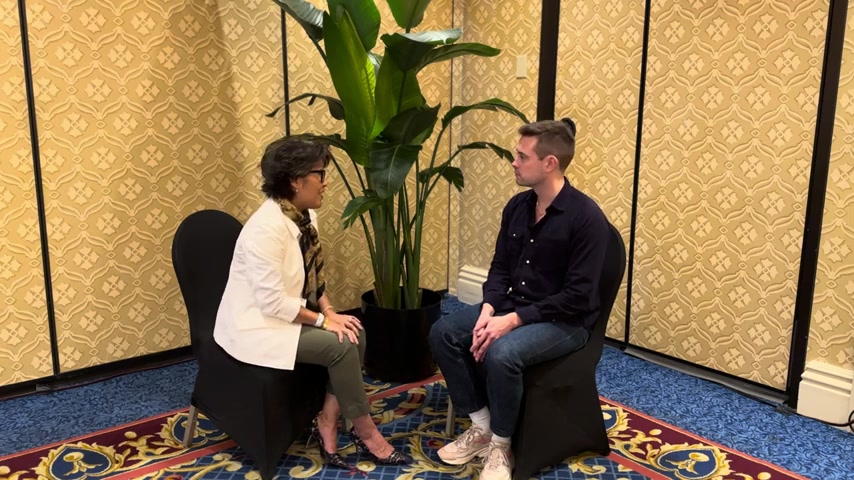
The little bit of magic hiding in lost deals
The strongest part of Chin's operating system begins with an admission: a company does not automatically know why people buy from it. When she joined Galileo, useful knowledge certainly existed, but much of it lived as anecdote. Salespeople knew fragments. Executives had impressions. Marketing needed a method.
The early team was tiny. Rather than declare self-sufficiency and drown nobly in tabs, Chin and demand-generation leader Sarah Spagnola worked with an outside research specialist. They began structured interviews with buyers after wins and losses. The third party mattered because candor changes when the company that won or lost the deal is not holding the microphone.
“There's a little bit of magic in these interviews.”Sheri Chin, on hearing what a survey score misses
The magic was practical. Interview transcripts sharpened Galileo's brand pillars. They revealed advisers and consulting groups that influenced buying decisions. They prepared sales teams for objections, helped new hires absorb the competitive landscape and showed where prospects went looking for trustworthy answers. A loss was no longer a sad row in the CRM. It was field research with bruised feelings.
There is a tidy paradox here. Fintech runs on quantitative data, yet Chin found an edge in conversation. A dashboard shows the direction of travel. An interview explains why the passenger changed trains. She saw the two forms of evidence as companions, especially when planning for a market moving too quickly for last year's categories.
Experiment quickly; keep the brand sober
Chin is not allergic to novelty. Her Galileo team formed an AI task force and used the tools in daily work, looking for time and financial savings while learning what the systems did badly. But she attached conditions. Test cheaply. Fail quickly. Evaluate the business need, available expertise and risk. Run the experiment through the brand before releasing it into polite society.
That caution has special weight in financial services. A consumer may forgive a grocery app for an eccentric recommendation. Money is less whimsical. Privacy and security, in Chin's formulation, are the basis of trust. The useful question is therefore not whether a trend is exciting, but whether it improves the work without making the company sound careless, unrecognizable or unsafe.
Chin's public playbook repeatedly pairs forces that are easy to separate: growth with profit, automation with judgment, quantitative data with qualitative evidence, and a strong brand with the freedom to test.
She applies the same discipline to her own education. Conferences, a peer community of B2B marketing leaders and C-suite networks are appointments, not indulgences. A busy executive can always cancel learning in favor of output. Chin's view is that output deteriorates when the intellectual account is never replenished. Even the chief marketer must remain marketable to new ideas.
The same pragmatism appeared when Galileo began looking upmarket. Selling to an enterprise is not simply selling to a small company in a larger font. More people enter the decision, proof takes longer, risk acquires extra chairs and the message has to survive a relay across departments. In a 2024 conversation with other marketing chiefs, Chin discussed the internal work behind that shift: closer sales alignment, account-based programs, tailored content and partnerships that can open an otherwise guarded door.
The interesting part is what did not disappear. Enterprise ambition did not cancel the need to serve smaller fintech customers, just as a new brand did not erase the equity of belonging to the SoFi family of companies. Chin's métier is integration: old rigor with new work, product complexity with plain promises, ambition with proof. A less patient operator might call these contradictions. She turns them into a to-do list.
The people behind the acquired value
Her most instructive leadership lesson arrived through acquisitions. Chin went through several and worked to keep her marketing teams employed after each transaction. Eventually, she recognized the leverage hiding inside the story: the team's revenue growth had helped make the company worth buying. Retention was not charity from the acquirer. It preserved some of the machinery that had created the value.
She also concluded that she could have advocated earlier and more forcefully - for retention awards for the team, and for the CMO title for herself. The lesson now travels through her mentorship: do excellent work, certainly, but also make its value legible. Build relationships before a negotiation. Ask for what the evidence says you have earned.
Chin credits investment-marketing executive Kelly Ford Buckley with trusting her with a first CMO opportunity. Sponsorship altered the arc of her career, so she treats it as something to pass along rather than frame on the wall. She has spoken particularly about connecting and elevating women and minority leaders in fintech. At Money20/20, that concern moved from private mentorship to public conversation about the industry's leadership gap.
The aim connects back to Galileo's broader promise of financial access. Products built for underserved customers are better served by leadership that understands more than one kind of customer. Chin's argument is commercial as well as moral: women make a large share of household financial decisions while remaining underrepresented in the rooms where financial technology is directed. An industry that claims to know its customer should notice who is missing from its own table.
Keep the rigor, choose the ride
A straight line would have taken Chin from economics at Stanford and an MBA at Wharton deeper into finance. Her actual career bent toward marketing without abandoning finance's demands. She kept analytical acuity, added customer curiosity and turned revenue accountability into an argument for marketing's place at the table.
The subway anecdote survives because it contains the whole method in miniature. Notice the signal. Admit the mismatch. Move. Keep what the experience taught you. Chin has spent the years since building systems that help companies do much the same thing: hear what the market is saying, correct course before vanity becomes strategy and make the new direction measurable.
Marketing, in this version, is neither glitter nor clairvoyance. It is a practiced loop between people and numbers. The numbers keep the story honest. The people tell you which story is worth measuring. And if the work can occasionally feel like a magic-carpet ride beneath the fluorescent lights, so much the better.