Shannon Miller was studying chemistry when a recommendation from her freshman residence assistant sent her into a thermodynamics class. The subject offered an explanation for things she could already see: refrigerators, car engines, the machinery of ordinary life. She changed her major. Years later, the professor who taught that class would help draw her back toward a research idea that became a company.
It is a pleasingly small beginning for a career now occupied with the size of the electricity supply. Before the financing rounds, the generators, and the utility agreements, there was a student discovering that understanding a refrigerator could be more compelling than the course of study she had chosen. A kitchen appliance seldom gets proper credit in a founder story.
Today Miller is president and co-founder of Mainspring Energy. She led the company as its founding CEO until June 2026, when she brought in former Cummins chief Tom Linebarger to take that job. Sixteen years after the founding, her work has acquired a new scale and a different title. The original question about how to turn fuel into useful power remains.
The refrigerator that changed the subject
The professor was Christopher Edwards. He became Miller’s doctoral adviser at Stanford, and she has described him as a mentor whose influence extended well beyond the classroom. Her account of that relationship is unusually warm for a story involving compression ratios. She credits him with helping form her interest in energy and her respect for reasoning from first principles.
That approach begins by asking what the physics permits. An existing machine may be familiar, convenient, and thoroughly understood; familiarity alone does not settle whether it is the right design. Miller’s education gave her a way to ask the question carefully. She earned bachelor’s, master’s, and doctoral degrees in mechanical engineering at Stanford and was a National Science Foundation Fellow.
Research funding from Stanford’s Global Climate Energy Project supported her work on improving the conversion of fuel into electricity. With Matt Svrcek, she worked on an early prototype that helped establish the foundation for Mainspring’s technology. The academic problem had a practical destination: power that people and businesses could afford to use and depend on.
A machine with a different grammar
The research group’s problem was easy to state and difficult to build around: find an efficient, practical way to turn the energy in chemical bonds into useful work. An early experimental apparatus could perform a single compression-and-expansion cycle. It measured the reaction’s efficiency without producing electricity. There was encouraging physics, followed by a formidable engineering assignment.
The eventual generator uses a flameless reaction to push moving assemblies through copper coils. Magnets moving through those coils generate electricity directly. Air springs help return the assemblies toward the center. The motion runs along a line, dispensing with the crankshaft that makes a conventional engine’s movements so familiar. A diagram is considerably more helpful here than the word “generator,” which invites everyone to picture something they have already seen.
Precise control matters because different fuels and operating conditions require different compression. Mainspring uses power electronics and software to govern the process. Its current product is built around 250-kilowatt generators, with ten forming a standard 2.5-megawatt configuration. That modular arrangement lets customers assemble capacity in increments rather than begin with a single large machine.
For Miller, the attraction reaches beyond the mechanism. Electricity has to be available when people need it. Solar and wind supply vary, and customers’ requirements change. A generator that can respond to demand and operate on different gaseous fuels gives planners another tool. The energy transition contains enough moving parts already; Miller’s company has made a business of controlling a few of them.
Ten years to the loading dock
Miller, Svrcek, and Adam Simpson founded the company in 2010. Khosla Ventures supplied early backing. They were taking a laboratory concept into a market where a customer’s confidence must survive long after the presentation ends. A power machine needs to work repeatedly, economically, and under conditions that a research demonstration does not have to encounter.
Commercial shipments began in 2020. The ten-year interval is central to Miller’s story. It gives the word “founder” some weight: a decade of carrying a technical proposition toward a product somebody would purchase. She led the company through that development and launch, building a business around the research she had helped pursue.
- 2010Miller, Simpson, and Svrcek found the company.
- 2020Commercial generator shipments begin.
- 2026Miller becomes president; Linebarger becomes CEO.
The business collected financial support as it grew. In September 2022, Mainspring announced the final close of a $290 million Series E led by Lightrock. The funding was intended to expand operations and manufacturing for commercial, industrial, and grid customers. The progression from experiment to production had brought an accompanying progression in the kinds of resources required.
Recognition arrived along the way. MIT Technology Review included Miller in its 2012 Innovators Under 35. She received the C3E Entrepreneurship Award in 2022 and was named an Energy Central Champion in Innovation in 2023. Those dates span much of the distance between promising research and commercial equipment. The work continued between ceremonies.
Optimism, with a workshop attached
Miller’s language about work leaves room for ideas that sound odd at first. She encourages people to “keep your mind open to sometimes wacky ideas.” It is useful advice from someone whose product asks customers to reconsider what a generator can look like inside. Permission to be unconventional helps, provided someone eventually does the calculations.
At Mainspring, three stated values give that attitude a working form: pragmatic optimism, excellence without ego, and proactive collaboration. Optimism comes with an obligation to acknowledge obstacles. Technical confidence comes with an obligation to accept feedback. Collaboration calls for people with different skills to work through a problem together. None of those habits makes a difficult machine easy to build. They describe how a team might remain useful to one another while trying.
“I spent fifteen years proving this works. Now we get to prove how big it can get.”
Shannon Miller, June 2026
The mix is consistent with the problem she chose. Her motivation includes reducing carbon emissions while expanding access to affordable electricity. Cost and availability are part of the objective. A technology must fit into the lives and budgets of the people expected to use it. Engineering ingenuity has to answer commercial questions as well as technical ones.
That has required a second education. Founding Mainspring meant learning to raise money, recruit colleagues, manage a product, and sell it. A doctoral degree provides a formidable start on the physics; a company adds people who need to understand the plan, investors who need to believe it, and customers who need the result. Miller’s career sits at that intersection.
The founder recruits her next boss
In April 2025, Mainspring announced a $258 million Series F led by General Catalyst. Its board also gained Linebarger and Bethany Mayer, the former Ixia CEO. Linebarger brought decades of experience at Cummins, a manufacturer whose business had required exactly the sort of industrial operations and energy-market knowledge a growing generator company could use.
Miller worked with him on the board and then initiated the effort to recruit him into the CEO role. The June 2026 appointment put him in charge of the company while she became president. Her current responsibilities include operational development and commercial sales. She remains involved in turning the technical proposition into work delivered for customers.
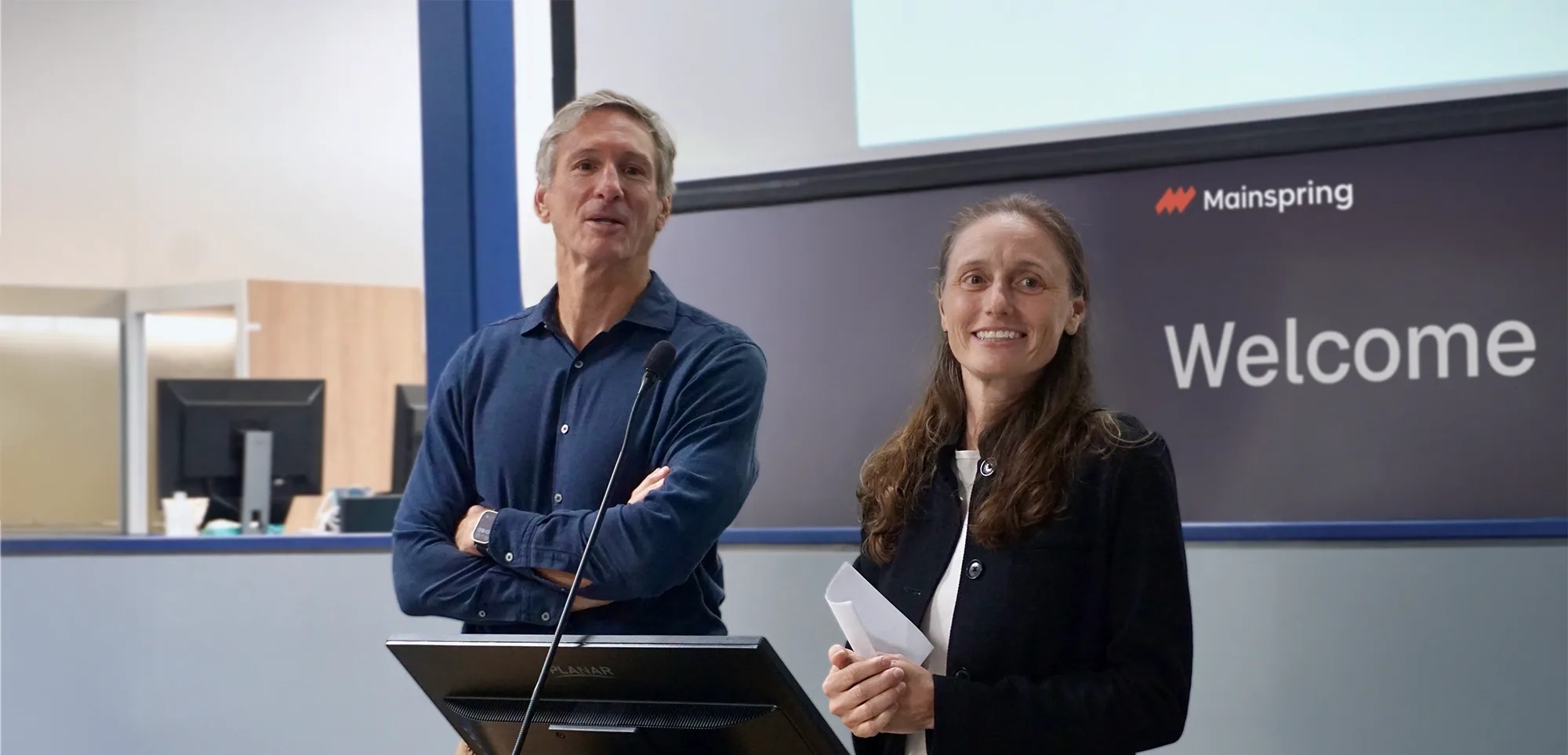
Her explanation is practical. Linebarger had experience taking energy technology into large markets. Bringing him in allowed her to concentrate more directly on the product and customer execution. It is a revealing choice for a founder who includes humility among her company’s values. The organization was being redesigned around the work ahead, much as the original machine had been designed around the job it needed to perform.
The market has supplied some surprises. Utilities were an anticipated destination for the technology. Miller has said the strength of data-center demand was less expected. Customers are seeking capacity on shorter schedules, and factory-built local generation has acquired a particular appeal. The founder who spent years preparing a machine now has to help meet a market in a hurry.
A larger order of difficulty
On October 13, 2026, Mainspring announced an agreement with American Electric Power for up to 1.6 gigawatts of generators through 2034. AEP’s initial purchase was 190 megawatts, with deliveries scheduled to begin in 2027. The distinction matters: the larger number describes the agreement’s potential, while the first purchase establishes a nearer delivery commitment.
Initial purchase
Deliveries begin in 2027
Up to this total
Agreement through 2034
Initial purchase ≈ 12% of the potential total. Capacity figures describe procurement, not electricity already in operation.
The relationship has a history. In July 2022, Mainspring announced a memorandum of understanding with AEP for an Oklahoma pilot. Potential uses included placing generation near pockets of demand and supporting electrification. Four years later, a much larger procurement framework gives the collaboration a different scale. The laboratory question has traveled into utility planning.
For Miller, the work ahead is concrete: help a company that proved it could make a generator deliver more of them. Manufacturing, sales, and execution occupy the space between an agreement and a customer receiving power. Her title has changed, and the size of the orders has changed. There are still machines to build, people to work with, and an engineering question worth staying curious about.
Keep following the current
Conversations, engineering, and the next chapter.