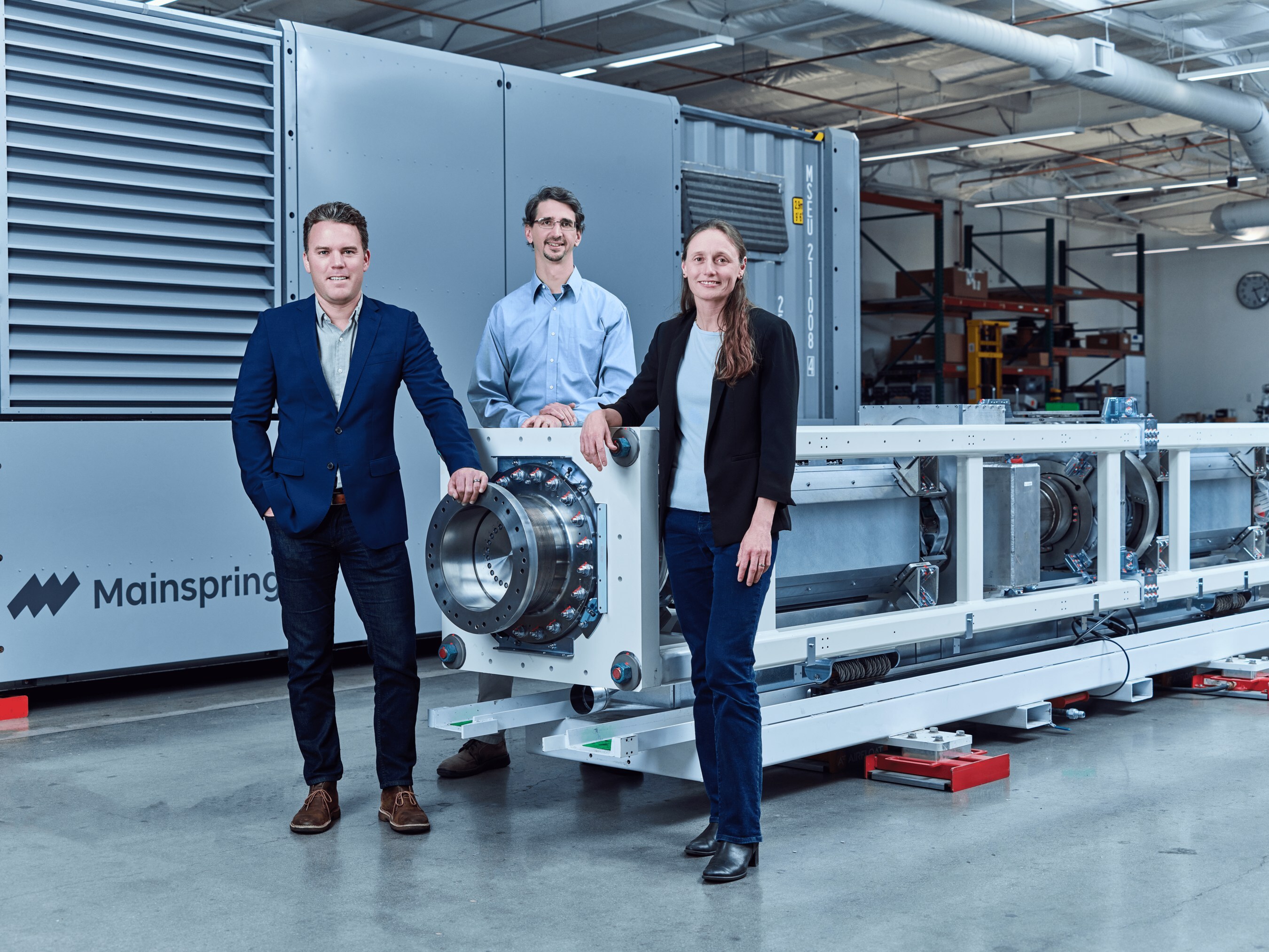
The machine makes a peculiar argument with the eye. Two cylinders slide back and forth through copper coils, twelve times each second. There is fuel but no flame, motion but no crankshaft, an engine-like rhythm from something that is not an engine. In its commercial casing, the whole affair becomes a gray box roughly the size of a parking space. For Adam Simpson, the box created a problem no laboratory instrument could solve: before customers could buy one, they first had to understand what one was.
Simpson is a mechanical engineer and one of three founders of Mainspring Energy. Today he is its chief commercial officer, leading sales along with product, public affairs, marketing and project delivery. The reach of that job is a clue to the nature of the product. A new class of electrical equipment does not travel neatly from drawing board to loading dock. It passes through reliability tests, air rules, financing committees, utility plans and the suspicious mind of anyone responsible for keeping a facility alive during an outage.
His career has become an extended act of translation between those rooms. The first language was combustion. The later ones included thermodynamics, economics, regulation and, finally, the plain prose of customer need: How soon can it arrive? What will it cost? What happens when the grid fails?
Chapter oneA laboratory assembled from whatever was available
At Lafayette College, Simpson studied mechanical engineering. His senior honors work examined how particular fuels affected elements of internal combustion. A college report from 2004 noted that he used the department's equipment to set up a laboratory for the yearlong project. The summer before, he had worked in computational-flow research at the University of Michigan and acquired a taste of automotive research.
There is a tidy irony here. The undergraduate studied what happens inside combustion; the company he later built would emphasize a reaction in which nothing burns. But the more important continuity is method. Fuel is never merely fuel. Its chemistry changes a machine's efficiency, emissions and useful life. Simpson kept following those consequences.
He arrived at Stanford in 2004 and left six years later with master's and doctoral degrees in mechanical engineering. His dissertation bore the unflashy, ambitious title Decision Making in Energy: Advancing Technical, Environmental, and Economic Perspectives. The work combined thermodynamic analysis with established technical and economic methods, aiming to help make investment and policy choices in a complicated energy system. He also received support from Stanford's Global Climate and Energy Project and consulted for Sandia National Laboratories and energy-focused venture firms.
“The linear generator has the efficiency and emissions benefits of fuel cells, but the robustness and dispatch ability of engines and turbines.”Adam Simpson
The dissertation's three-part lens proved almost suspiciously useful. Technical performance alone does not put generation on a customer's property. Neither do noble environmental intentions or an attractive spreadsheet. Infrastructure survives only where all three agree to tolerate one another.
A fourth categoryThe useful difficulty of having no familiar name
At Stanford's Advanced Energy Systems Laboratory, doctoral students worked on a question posed by professor Christopher Edwards: what was the most efficient and practical way to turn chemical-bond energy into useful work? Early experiments used a one-shot device. It could measure the efficiency of a high-compression reaction, but it did not yet harvest electricity. The results encouraged a larger wager.
In 2010, Simpson, Shannon Miller and Matt Svrcek incorporated the company then known as EtaGen. Their proposed generator used a flameless reaction to drive oscillators through copper coils, converting linear motion directly into electricity. Control was the trick. The reaction had to happen at the right place and moment, repeatedly, while a system outside the laboratory delivered power customers could count on.
What moves inside the gray box
under compression
move through copper coils
becomes electricity
No crankshaft. A controlled, flameless reaction drives the back-and-forth motion directly.
The new machine borrowed recognizable virtues without fitting a recognizable shelf. It could be dispatched up and down, like conventional generators, while pursuing fuel-cell-like efficiency and low emissions. Its controls could adjust compression for fuels with different chemistry. Simpson has described a modular 250-kilowatt unit that can be combined in whatever count a site needs. To an engineer, those are elegant properties. To a buyer, they invite a thicket of follow-up questions.
The team spent a decade answering them. Mainspring began commercial shipments in 2020 and publicly launched its first product in 2021, along with a $150 million agreement with NextEra Energy Resources. There is no garage-to-glory montage that can make ten years of hardware development feel brief. Steel must endure. Controls must behave. Maintenance must become ordinary. Regulators must decide which rules apply to a machine created after the categories were written.
The second inventionTurning an object into an option
Simpson remained actively involved in design through commercial launch. Then his remit widened. As chief product officer, he often found himself explaining a generator few prospects had heard of. Later, as chief commercial officer, he became responsible for sales and the supporting work that makes a sale real. The title change is less a departure from engineering than an expansion of its boundaries.
His pitch is built around optionality. A customer can install modules at the capacity needed now and add more later. The same system can operate independently or alongside the grid. It can ramp power up and down, pair with solar and batteries, and work with several gaseous fuels. The precise environmental result depends on which fuel is used, a distinction more useful than pretending every electron comes with the same biography.
This flexibility has taken Mainspring beyond the original commercial and industrial customers. Data centers need large blocks of power while grid interconnections can take years. Municipal utilities want local capacity they can dispatch. Wastewater plants can have biogas available at the site. Each market hears a different part of the same mechanical sentence.
By 2025, the company had secured a $258 million Series F round to expand manufacturing and customer sales. That year Simpson also announced a strategic advisory board drawing on utility, data-center and financial experience. In early 2026, Utah Municipal Power Agency selected Mainspring for a 48-megawatt project planned to begin operation in 2027. Hundreds of small modules will be asked to act like a power plant while retaining the redundancy of many separate machines.
“You can right-size the number of units for any power needs... We can turn off and on, ramp our power up and down.”Adam Simpson
The Utah project is the company story written at utility scale. The awkward little category must now satisfy an institution formed to keep electricity reliable and affordable for six cities. Simpson called it a model for public power companies facing rising demand and seeking greater independence. The language is notably practical. Nobody at a municipal utility receives applause because a generator is conceptually interesting.
Sixteen years onThe market catches up with the machine
In June 2026, Mainspring appointed former Cummins chairman and chief executive Tom Linebarger as its chief executive, while founding CEO Shannon Miller became president. Simpson welcomed the addition by looking back: when he, Miller and Svrcek started the company sixteen years earlier, they could not have imagined the opportunity now in front of them. He called power infrastructure an “historic inflection point.”
It is tempting to read that as the familiar founder's claim that history has finally booked an appointment. In this case, the calendar supplies some evidence. AI data centers, electrification and new manufacturing loads are colliding with congested grids and long equipment queues. Customers who once required an introduction to onsite generation are now looking for megawatts on deadlines.
Completes combustion research and a mechanical engineering degree at Lafayette.
Finishes a Stanford doctorate on energy decisions and co-founds the company that becomes Mainspring.
The linear generator reaches commercial shipment after a decade of development.
Mainspring raises $258 million as manufacturing and customer demand expand.
Simpson helps take the argument to utility scale with a planned 48 MW Utah project.
That change also sharpens the risk. Speed can flatter mediocre decisions. Power assets remain in place for years after the urgent meeting in which they were approved. Simpson's old doctoral question - how to weigh technical, environmental and economic consequences together - has therefore grown more relevant, not less. The machine has left the laboratory, but the decision framework came with it.
There is an agreeable symmetry in the work. A linear generator makes useful electricity from repeated motion along one axis. Simpson's own path has repeatedly crossed the boundaries around the machine: from fuel chemistry to system design, from product to policy, from selling a unit to planning a utility-scale array. The mechanism moves back and forth. The career keeps moving outward.