Imagine a cancer researcher with a promising question and an unpromising download bar. The data exists. Other scientists have collected it, public money has paid for it, and somewhere a server is holding it. Before the researcher can begin, however, the files must arrive, the software must behave, and a computer must be persuaded to do rather more than it was bought to do. Discovery has acquired a waiting room.
Seven Bridges built its business around shortening that wait. Its answer was to put genomic datasets, analysis tools and computing power together in a shared environment. Researchers could come to the data. A laptop could become the entrance to an experiment far larger than the laptop itself.
- The job: organize and analyze genomic and other biomedical data in the cloud.
- The buyers: research agencies, academic labs, biopharma companies and diagnostic laboratories.
- The distinction: workflows, collaboration and a record of how results were produced, above the rented infrastructure.
- The present: Seven Bridges became part of Velsera in 2023; its platform name survives.
The download before the discovery
The Cancer Genome Atlas offers a particularly good illustration. The Cancer Genomics Cloud’s history describes a resource spanning 33 tumor types or subtypes and more than 2.5 petabytes of information. Collecting such a resource is one achievement. Making it usable by a laboratory without a matching computer installation is another.
In 2014, the National Cancer Institute selected three groups to build cloud pilots: Seven Bridges, the Broad Institute and the Institute for Systems Biology. Seven Bridges announced a $5.8 million contract. The pilots launched in 2016. Their premise was practical: keep large datasets near elastic computing and give researchers a way to bring their own questions and tools.
That arrangement changes the price of admission to research. The Cancer Genomics Cloud lets teams analyze private cohorts alongside public data, use prepared pipelines, build custom workflows and collaborate across institutions. Access is still governed by the dataset’s rules. A convenient interface does not give anyone permission to inspect controlled patient information.
The living room and the borrowed horsepower
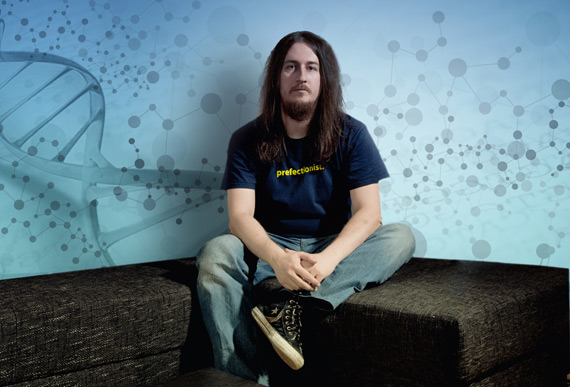
The company’s beginning was considerably smaller than a petabyte. In a public retrospective, early co-founder Doug Colton recalled starting Seven Bridges in his Washington, D.C., family room in 2009 with Deniz Kural and John Sheffield. Igor Bogicevic and the Belgrade office followed. Colton remembered being slow to find a market and credited James Sietstra with helping the business survive.
“Our HQ was in Cambridge, but our heart was in Belgrade.”
Doug Colton, early co-founder, recalling the company’s beginnings
It is a useful corrective to the tidy startup legend. The biology required insight; the software required engineering; the company required somebody to keep it solvent. Later public accounts identify Kural, Bogicevic and Sietstra as co-founders. The recollections reveal a wider early cast, rather than a single genius alone with a revelation.
By 2013, the platform was called IGOR. An AWS case study explained the awkward rhythm of its customers’ work: an analysis might require 100 servers for a few days, followed by almost none while scientists examined the results. Buying enough equipment for the peak leaves a laboratory owning a great deal of expensive silence.
Seven Bridges used rented infrastructure to accommodate that rhythm. Its software let researchers connect open-source and proprietary tools through a graphical interface. The commercial insight was as much about intermittent demand as it was about DNA.
An experiment with a receipt
What does a user actually do? Create a project, select or upload files, choose an analysis workflow, set its parameters and run a task. Public apps can be copied into a project and modified. A workflow strings tools together so that an output from one step becomes an input to the next.
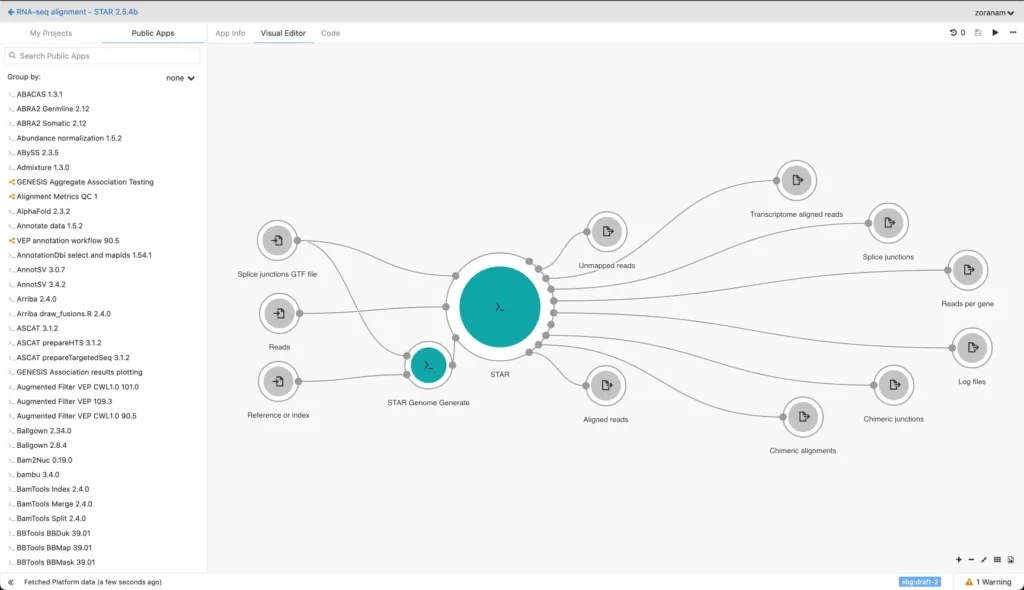
The workflow editor makes that wiring visible. Researchers who prefer code can use the API to automate uploads, metadata queries and executions. Interactive environments support closer inspection of results. The product serves people who want to operate a prepared analysis and people who want to build the next one.
The more consequential feature may be its memory. Seven Bridges records the data, tool versions and parameter settings used in an analysis. A colleague can inspect what produced an output instead of trying to reconstruct it from somebody else’s recollection. In a research group, “I think I used the newer version” is an expensive sentence.
That expertise extends beyond an interface. Seven Bridges combines software engineering with bioinformatics and scientific support. Pfizer’s 2021 engagement, for example, concerned centralizing and managing terabytes of raw and processed single-cell RNA-sequencing data. Before researchers could extract more meaning from individual cells, the organization needed a better way to find and work with its files.
The reference has a point of view
Storage is only half the problem. Analysis also depends on the model against which a genome is compared. A conventional linear reference provides a sequence for that comparison. But people vary, and a reference that represents some ancestries better than others can make variation harder to recognize.
Seven Bridges’ GRAF tools use graph references, allowing alternative sequence paths. The distinction matters because a graph can represent genetic variation that a single linear path cannot conveniently carry. It also makes the choice of reference a scientific decision, rather than a background setting to forget.
In 2022, Seven Bridges announced a collaboration with the University of São Paulo, Google Cloud and the Brazil Genome Association on DNA do Brasil. The project planned to sequence 15,000 Brazilians and use GRAF to build a reference reflecting the population’s mixed ancestry. The announcement said an initial 3,000 genomes had been processed and stored.
The lesson is specific: match the analytical model to the people being studied. A graph is not automatically the right graph. Its construction and the population represented still matter.
A subscription, a meter, a scientist
Seven Bridges occupies the managed bioinformatics layer above cloud infrastructure. Its business includes software subscriptions and enterprise engagements, public research contracts and professional services. Compute and storage have their own economics: platform documentation says those costs are passed along.
That is why “in the cloud” deserves to be followed by “at what scale?” The company’s guidance on compute optimization describes both traps. Too much allocated capacity means paying for resources an analysis does not use. Too little means jobs waiting when they could run in parallel. Archived storage can cost less, but retrieval has its own charges.
A research contract is not an equity round. These are documented historical amounts, not a funding total or a price list.
Commercial demand did grow. Seven Bridges reported 260% annual contract value growth and a 95% renewal rate for 2018. Those are company-reported measures for that year, not current revenue. They suggest that managing biomedical analysis had become a recurring customer need, rather than a one-off cloud experiment.
The alternatives include DNAnexus in commercial cloud genomics, and Broad FireCloud/Terra and ISB-CGC among NCI’s cloud resources. Seven Bridges’ particular proposition combines shared research environments, recorded execution, graph-reference tools and expert services. The sensible comparison starts with the data and workflows a team already has.
Three companies, one longer journey
In January 2023, Summa Equity brought Seven Bridges together with Pierian and UgenTec to form Velsera. Research infrastructure joined clinical genomics interpretation and laboratory software. The combination aimed to connect work that often happens in separate organizations and systems.
The Seven Bridges name continues as a platform within Velsera. ARIA addresses data harmonization and sharing; RHEO automates steps around an analysis. A July 2025 RHEO account describes integrating a clinical laboratory’s sequencer and cloud storage, using sample metadata to direct tasks, monitoring execution and returning results to the client’s infrastructure.
The parent company’s leadership changed in 2026: Jamie Coffin’s CEO appointment took effect in February, and Kareem Saad was announced as president and chief business officer in May. These are Velsera developments. Seven Bridges’ role remains identifiable within the larger portfolio.
Try one question before a thousand genomes
The practical starting point is modest. The Cancer Genomics Cloud offers new users a way to request $300 in NCI-supported cloud credits. Its tutorials begin with creating a project, selecting data and running an analysis. A small public dataset and a documented workflow let a researcher learn the machinery before committing a large cohort.
Keep the execution record, check collaborator permissions and inspect the bill. Confirm support for the chosen workflow language on the specific environment: a 2022 expansion announced Nextflow and WDL alongside CWL, while the CGC’s own FAQ describes native CWL support and limited Nextflow support.
A shared platform cannot fix an unsuitable reference, missing access permission or a weak experiment. What it can do is make a well-designed analysis easier to run, inspect and share. Seven Bridges’ useful lesson travels beyond genomics: when the files become enormous, reconsider which part of the work needs to move.