Imagine a scientist opening a laptop to study half a million people. The computer on the desk is ordinary. The data behind the screen are anything but: genetic sequences, health records, imaging and years of observation. The interesting question is where the laboratory begins. In the processor? In the dataset? Or in the rules that let a stranger ask a question of it?
DNAnexus has made a business out of that last, sprawling arrangement. It supplies cloud software through which organizations manage biomedical data, run analysis and collaborate. Its work sits between the machines that produce biological information and the people trying to extract an answer. A genome can be sequenced beautifully and still spend its working life waiting for someone to make it usable.
- The job: put biomedical data, analysis tools and collaborators in governed cloud workspaces.
- The buyers: drug developers, diagnostic labs, biobanks, health systems and research institutions.
- The attraction: less infrastructure to assemble before science can begin.
- The catch: compute costs, scientific quality and export permissions still require adult supervision.
The sequencer outran the server
The company began in 2009, founded by Andreas Sundquist, Arend Sidow and Serafim Batzoglou out of Stanford. Its timing supplied the problem: sequencing costs were falling while the volume of sequence data was expanding. Reading biology was becoming more accessible. Organizing the output was acquiring a rather different temperament.
That imbalance matters. Producing a file and producing an interpretable result are separate operations. A laboratory needs storage, compute, analytical tools and a record of what happened. Add collaborators at another institution and it needs agreement about access, versions and responsibility. The overhead grows even when the experiment looks unchanged.
DNAnexus chose to sell the environment around the analysis. Its stated vision is short enough to fit on a lab notebook: “To make precision health a reality for all.” The business underneath is more specific. It aims to make large, sensitive datasets workable for organizations developing, reviewing and delivering personalized treatments.
Company-reported figures, August 2026. Reach and data volume describe the platform’s scale; they do not measure discoveries or patient outcomes.
A project is a laboratory with permissions
Start with something almost comically mundane: a project. In the platform’s quickstart, a user creates one, selects a billing account and cloud region, sets access levels, adds data and invites members. These are the first steps before running a workflow. The scientific question arrives with a small administrative entourage.
Inside that workspace, users can organize files, execute bioinformatics pipelines, inspect cohorts and work in notebooks. The platform supports workflow languages including Nextflow and WDL, containerized tools through Docker, and JupyterLab. A researcher can bring analysis code into a shared environment rather than arrange another local installation for every collaborator.
The useful consequence is reproducibility with fewer handoffs. Data, tools and analysis can live together, subject to access controls. That does not guarantee a good experiment. It does make the experiment easier to repeat, inspect and share without reconstructing an entire computing setup from someone else’s instructions.
clinical records
permissions
notebooks
permitted outputs
A conceptual path through the platform. The controls and tools depend on the deployment.
The customer is rarely just one scientist
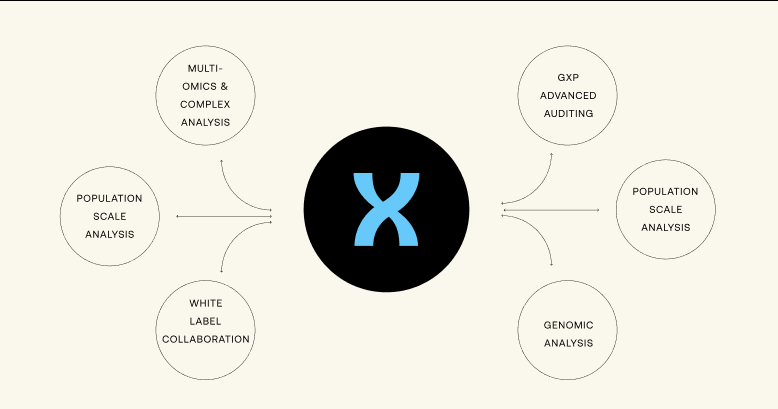
A diagnostic laboratory needs a different rhythm from an exploratory research group. Pipelines must fit ongoing operations; collaborators and results cannot be managed as an endless series of special favors. Natera is a named DNAnexus customer. Regeneron Genetics Center uses the company’s genomic computing expertise, and Regeneron also invested in the 2020 financing. Sometimes a customer becomes sufficiently interested in the plumbing to buy a stake in the plumber.
At City of Hope, the relationship takes the form of POSEIDON, a cloud environment for exploring de-identified clinical and genomic information. It supports questions around cohorts, drug development and clinical trial matching. The acronym expands to Precision Oncology Software Environment Interoperable Data Ontologies Network. Naming a research system evidently remains a computational problem of its own.
The FDA supplies another variation. It launched precisionFDA in 2015 so scientists, industry and academics could work with shared data and analytical methods. The project’s public code identifies DNAnexus as its cloud provider. Here the value lies in comparing and benchmarking approaches, helping a community examine whether its methods produce dependable results.
These examples explain the company’s market position better than “cloud software” does. DNAnexus combines biomedical workflows, collaboration and governance with scientific implementation support. Its FedRAMP record dates to October 2018; the marketplace now lists the platform as certified at Class C, formerly described as Moderate. Certifications apply to defined offerings and controls. They are inputs to a customer’s compliance work.
The bill has more than one line
The business model combines enterprise contracts, cloud consumption and professional services. One public AWS Marketplace listing shows a $450,000 annual platform subscription, with additional usage charges and possible infrastructure costs. Private offers are available. That is a published enterprise offer, not the price every researcher pays to open a workspace.
UK Biobank illustrates the distinction. Its published three-year access fees are £3,000, £6,000 and £9,000 across three data tiers, excluding VAT. Eligible student researchers and those in lower-income countries have a £500 route. Those fees belong to the biobank. Analysis adds compute, storage for uploaded or generated data, and data-transfer costs; AWS sponsors storage of the biobank data dispensed to projects.
In April 2026, UK Biobank said around 90% of platform projects came in under £1,000 in its discussion of cloud analysis costs. That figure should not swallow the separate access fee or become a promise for an unusually demanding study. Machine type, memory, runtime and data movement change the bill. The practical move is to estimate the workload, test a small batch and expand after the pipeline behaves.
Investment helped DNAnexus build the machinery. It announced $100 million in financing in June 2020 and another $200 million in March 2022, the latter led by Blackstone Growth. The money supported platform development, international expansion and AI integration. Capital raised is a measure of financing, however elegant the press release; it is not a revenue figure.
The exit became the hard part
UK Biobank’s 2026 oversight report exposed a difficult boundary. Its platform restricted direct downloads of participant-level data, but researchers could export their analyses and results. An output-checking airlock was missing: a technical way to check that a purported result did not contain participant-level information. Policy and training were doing work that needed additional technical controls.
After data misuse came to light, access was suspended. The report described plans for output checking. UK Biobank’s July 2026 application page still said new applications were paused, with an intended return in late 2026. This is a documented problem with export governance, not a finding here that somebody broke into the cloud.
The biobank had already outlined procurement for output checking, future cloud infrastructure and a replacement analysis platform or platforms. Its December 2025 plan included extending DNAnexus’s current contract to support the transition. For a supplier, a major customer is both proof of usefulness and a continuing examination. Keeping the data in one place makes collaboration possible; controlling what leaves that place is part of the same job.
A shared laboratory needs a front door. It also needs someone to mind the exit.
YesPress analysis
AI arrives after the filing cabinet
In May 2026, DNAnexus announced an Omics Data Agent for conversational dataset exploration and cohort creation, an AutoML Assistant for model development, and an Omics Data Catalog for governed metadata. The names advertise intelligence. The underlying task remains recognizable: find the relevant data, describe them properly and connect them to an analysis.
These tools extend the platform’s role from hosting work toward helping users formulate and execute it. Natural language may lower the effort of constructing a cohort. A catalog may make an existing dataset reusable. Neither removes the need to check the biological meaning of variables, the suitability of the model or the permissions attached to the information.
Borrow the method before buying the machinery
There are alternatives. Terra supports biomedical analysis and collaboration; Seven Bridges supplies bioinformatics workflows and tools. Organizations can also assemble their own environment. The cloud architecture is not an exclusive invention. DNAnexus competes through the particular combination of scientific workflows, managed infrastructure, governance and implementation expertise it sells.
The comparison should begin with the work. A small, stable analysis on an adequate existing system may offer little reason to migrate. A distributed organization coordinating sensitive data, changing pipelines and repeated production workloads has more to gain from a managed platform. Cloud migration also requires training and a budget; the browser is not an exemption from either.
The portable lesson is useful even without a purchase: keep data and analysis close, record versions, assign permissions deliberately, test before scaling and budget for the outputs as well as the inputs. A shared laboratory works when its responsibilities are as legible as its tools. DNAnexus’s proposition rests on making that arrangement easier to operate. The laptop gets to stay modest. The work behind it does not.
Open another window
Explore the company, platform, new AI products, documentation and blog. Read the latest news, review the enterprise marketplace offer, or check UK Biobank access and its 2026 oversight report.
Find DNAnexus on LinkedIn, X, GitHub and YouTube. Watch the company’s linked videos on workflow capabilities and platform tools.