A bell is a satisfying way to measure a beginning. It makes a noise, produces a photograph, and leaves very little room for argument about whether something has happened. Seth Blackley helped start Evolent in 2011. In June 2015, the company completed its public offering. The bell supplied an ending for the startup story. Blackley still had years of work ahead of him as president.
That stretch of time is the interesting part. He became chief executive in October 2020, nine years after becoming president. His career has involved founding a company, staying inside it as it changed, and eventually taking responsibility for the whole operation. The familiar entrepreneurial milestones are there. So is a slower story about colleagues, shared authority, and the difficulty of building an organization that can keep changing its cast.
An analyst learns to build
Blackley began his professional career in 2001 in McKinsey & Company’s Washington, D.C., office. He was an analyst. Before the founder title came the work of examining other people’s businesses, an occupation in which a well-constructed explanation is valuable and the person receiving it still has to decide what to do.
His education took him through the University of North Carolina at Chapel Hill and Harvard Business School. At Chapel Hill, he studied business and graduated with highest honors. He earned his MBA at Harvard. The geography of his professional life then settled around Washington, where consulting, corporate development, and eventually Evolent would form successive chapters.
From June 2007 to August 2011, he was executive director of corporate development and strategic planning at The Advisory Board Company. Those job titles put expansion and choices about the future inside the same remit. They also place him in the organization where he worked with Frank Williams and Tom Peterson, the colleagues with whom he would found Evolent.
The move into entrepreneurship therefore came with an existing working relationship. This was a company assembled by people who had already encountered one another in business. Their shared professional history is a more useful starting point than the customary imaginary garage. A garage has excellent publicity instincts. It rarely explains who can work with whom.
- 2001Analyst at McKinsey
- 2011Evolent co-founder and president
- 2015Evolent lists on the NYSE
- 2020Becomes chief executive
Four years to a ticker, nine to a new title
Evolent’s early pace gave the founders a compact story to tell: an idea became a listed business in less than four years. In 2017, Blackley and Williams appeared together on the podcast A Healthy Dose to revisit that passage. Even the joint appearance is a useful detail. The founding story had more than one narrator.
Blackley’s job as president continued after the public listing. The transition to CEO arrived in 2020, when Williams described his co-founder’s work building the national partner network, developing the company’s approach to the market, and using acquisitions to extend its capabilities. These were responsibilities accumulated inside the business before the top title changed.
On that handover call, Blackley thanked Williams and spoke about continuing their partnership. He also emphasized the culture Williams had helped establish. Succession here meant a change of responsibilities within a relationship that predated the company. It was a continuation with a different person answering the chief executive’s questions.
There is a particular challenge in that kind of promotion. A new title arrives in an organization that already knows you. Colleagues have a history of your decisions, your habits, and the jobs you used to do. Authority has to function amid all that familiarity. Blackley’s chronology makes this a central feature of his story: he helped create the institution he would later be asked to lead.
The door that opens twice
One of Blackley’s more revealing public remarks came attached to an alumni reunion. After catching up with former Evolent colleagues around JPM, he posted his appreciation for the group and added a cheerful recruitment footnote: “boomerang hires always welcome!”
The joke contains a practical policy preference. Someone who has left can still be a person worth hiring. An alumni network can remain a professional relationship rather than becoming a list of departures. Blackley’s invitation gives that relationship somewhere to go.
“boomerang hires always welcome!”
Seth Blackley, on an Evolent alumni gathering
In 2024, the idea acquired a name and a face when he welcomed Katie DiPerna Cook back to Evolent. The company shared a conversation between the two, describing her return as chief people officer. Returning employees, it said at the time, accounted for about 2 percent of its population. Blackley’s own accompanying note expressed pleasure at having her back.
A return hire has a different kind of knowledge from a first-time recruit. There is history on both sides, along with whatever experience the person acquired elsewhere. The welcome is especially interesting in a company that has itself changed since the employee left. Coming back means meeting an organization again, with some familiar people and a different assignment.
A useful person to disagree with
Blackley has also written about the colleague who makes an ambitious plan less comfortable. In a 2022 essay about inclusion, he singled out Jessica Somers for grounding decisions in the resources available. He credited her willingness to challenge the leadership with helping Evolent concentrate its efforts.
His point went beyond representation statistics. A leadership group can become attached to an agreeable explanation of its own business. Somers, in his account, brought a different working style and the readiness to question whether the company was taking on too much. He acknowledged that receiving difficult feedback takes work.
That is a concrete test for a founder. An opportunity can be appealing and still require people, time, or money that are already committed elsewhere. The useful colleague is sometimes the one who asks where those resources will come from. By naming that contribution publicly, Blackley made disagreement part of his account of how decisions improved.
The same operating concern appeared in a 2023 earnings discussion. Asked how Evolent was preparing for growth, he described moving people between parts of the company, retaining strong performers, and giving them new responsibilities. Expansion and integration had to happen together. His answer put staffing and internal movement near the center of the work.
A chart can show a larger business. Someone still has to decide which experienced colleague should take on the next difficult job. That decision connects the personnel file to the growth plan, with rather less ceremony than an opening bell.
Who gets the next invitation?
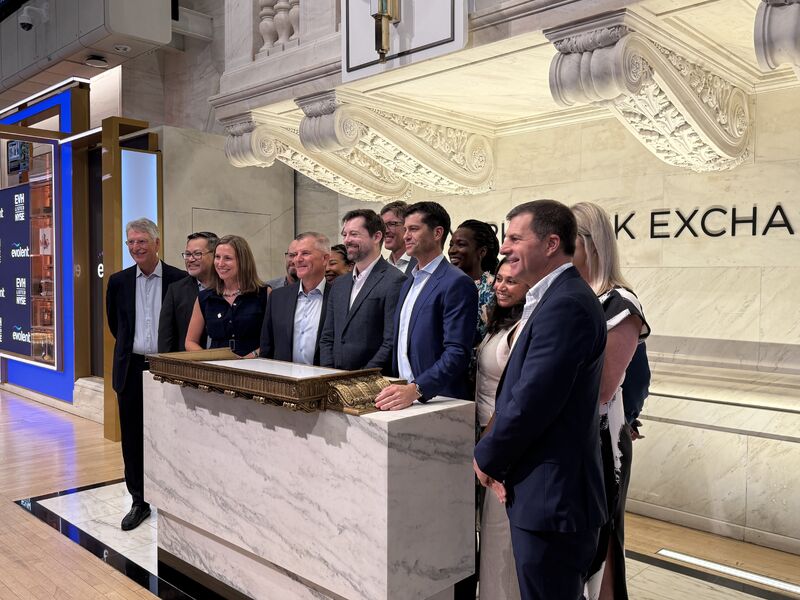
In 2025, Evolent returned to the New York Stock Exchange to mark ten years since its listing. Blackley used the occasion to highlight emerging leaders who had joined the visit. They were the first participants in new talent development programs, with opportunities to meet founding leaders and board members and take part in strategic discussions.
That choice of emphasis made an anniversary do two jobs. It commemorated an earlier achievement and brought people with future responsibilities into the room. A founder can look around at a company he helped start and see colleagues whose main contribution still lies ahead.
At a leadership gathering that year, Blackley also described borrowing a hiring idea from Netflix: recruit people whose work and leadership give other colleagues something to learn from. It puts a second question alongside whether someone can perform a role. What happens to the people working around them?
His public career has other, smaller glimpses. He serves on the Capital Area Food Bank’s board. In 2023, he posted about his first fully driverless Waymo ride. At an investor event that year, he teased visitors with the suggestion that a mild, humidity-free day represented a normal Washington summer. Anyone who has met August in Washington can supply the rebuttal.

The work on Monday morning
The current chapter remains an operating job, with results that require more than anniversary language. In August 2026, Evolent reported quarterly revenue of $652.5 million and a net loss attributable to common shareholders of $28.4 million. Blackley expressed confidence in an emerging operating model built around AI and emphasized discipline in the cost structure. Those are management’s expectations; the reported loss belongs beside the reported revenue.
The distinction matters to the portrait. Founding a company gives a chief executive history, relationships, and a reason to care about what happens next. It also leaves him responsible for decisions in the present. Revenue, costs, people, and execution keep demanding attention after the photograph has been filed.
Blackley’s story is now long enough to contain an analyst’s beginning, a founding partnership, nine years as president, and a different assignment as CEO. Around those dates sit the details that give the chronology a person: the alumni invitation, the returning colleague, the public credit for a difficult challenge, the younger leaders brought along to New York.
The bell remains a fine way to announce a beginning. Blackley’s more revealing work has accumulated in the intervals between its appearances, when there is no podium and a colleague is waiting for a decision.
Keep reading, listening, watching
- Evolent: company profile
- Official biography
- Seth Blackley on LinkedIn
- His essay on candor and inclusion
- The 2025 anniversary reflections
- A conversation with returning colleague Katie DiPerna Cook
- Watch: Evolent’s NYSE anniversary bell ceremony
- The founders revisit the early years
- Capital Area Food Bank board
- August 2026 company results