Ty Wang knew his future co-founder years before Angle Health existed. His acquaintance with Anirban Gangopadhyay began while both were still in school. The two met as high-school students through the U.S. government’s Stokes Educational Scholarship program. Later came government work. Then, by Wang’s account, they joined Palantir about two weeks apart and ran into each other at the office. Some partnerships begin with a pitch. This one had already accumulated a past.
The accidental reunion is a pleasing detail in a career now described in financing rounds. Before anyone could attach a valuation to their company, these were two engineers who had worked inside large organizations and knew each other across more than one setting. A co-founder search can become an elaborate exercise in predicting how a stranger will behave. Wang and Gangopadhyay had the advantage of actual encounters.
In 2019, they founded Angle. Wang became chief executive; Gangopadhyay became chief technology officer. By September 2026, the company was announcing a financing package at a $2.7 billion valuation. The distance between those moments is large. The older relationship is a useful place to begin measuring it: two people carrying a shared history into work neither could have completed with a clever introduction alone.
Colorado, before the pitch deck
Wang grew up in Colorado, the child of immigrant parents. He has described a low-income upbringing and parents who worked multiple jobs. Their entrepreneurship came out of necessity. In that household, running a business belonged to the business of keeping a family going. It preceded the vocabulary of venture capital, with its rounds, partners and carefully rehearsed descriptions of opportunity.
That distinction gives his later career some texture. The word “entrepreneur” can describe a parent making ends meet and a founder meeting investors, while disguising how different their circumstances are. Wang’s story contains both versions. His own route would bring access to a funded education, engineering work and the technology industry. His parents’ experience remained part of the background against which he understood those opportunities.
He was interested in computers and how things were built. At Washington University in St. Louis, he studied electrical and systems engineering. The scholarship offered a concrete arrangement: funding and work experience connected to a future in government service. Long before the startup accelerator, there was another institution shaping the route, complete with obligations as well as an opening.
An education in large organizations
Wang’s early career took him into U.S. government work, including assignments in the Middle East and South Asia. He later moved to Palantir. At Palantir, he led product and engineering teams on major deployments. These were jobs inside organizations whose moving parts extended well beyond a single piece of software.
A deployment is a particularly useful word here. It asks whether something works in the place where people will use it. A demonstration can be arranged around the product; a deployment must accommodate the organization. There are people to coordinate, existing processes to understand and decisions that require more than an engineer’s permission. Wang’s career had put him close to that distinction before he became a chief executive.
His explanation of Angle repeatedly returns to systems and first principles. Begin with what an organization is trying to accomplish. Examine the steps, the participants and the information between them. Ask what those arrangements would look like if they were being designed today. This is a method with fewer dramatic props than the customary founder revelation. It requires patience with the machinery.
The class of winter 2020
Angle joined Y Combinator’s winter 2020 batch. The company’s founding date and its accelerator year are separate milestones: 2019 for the beginning, 2020 for YC. Keeping them separate restores a little of the work that an abbreviated biography tends to remove. A company exists before its batch badge, and continues after the program ends.
For Wang, YC offered access to other founders, partners and an education in fundraising. Technical experience did not automatically supply knowledge of the venture ecosystem. An engineer becoming a founder acquires a second audience: people who need to understand why the business should exist, how it can operate and what their capital would allow it to do.
That audience brings a different test of clarity. A founder has to make the practical sequence intelligible without burying it under technical detail. Wang has spoken about the need for funding before launch and about working through approvals efficiently. Those are sequencing problems as much as presentation problems. Money has to arrive before some of the work can happen; evidence has to arrive before the next person will commit.
Angle launched in 2021. Between a founding year, an accelerator cohort and a commercial launch sits the portion of startup life that looks rather poor on a celebratory slide: preparation. The timeline becomes more interesting when those dates are allowed to keep their distance.
The office had to be written down
Wang has described building Angle as a fully remote company. In a conversation about its early development, he emphasized communication and documentation, along with deliberate efforts to connect colleagues. A distributed organization cannot assume that everyone absorbs the same information by being nearby. Proximity has to be replaced by arrangements people can actually use.
There is something amusing about the contrast between the romance of founding and the need to write things down. The public story likes a moment of inspiration. The team needs to know what was decided on Tuesday. A document has the considerable advantage of remaining available after the person who explained it has signed off.
For Wang, team-building also extends to who gets hired. His advice to aspiring founders has been to hire slowly and intentionally. The two ideas belong together: bringing someone into a company and giving that person enough context to contribute. Recruiting may get the announcement; communication determines what happens after the announcement has disappeared from everyone’s feed.
These are useful details in a profile of an engineer turned CEO. They shift attention from the product to the organization that must keep producing it. A company’s internal systems include its habits of explanation, its records and its ways of bringing people into decisions. Software cannot take the meeting notes unless somebody first makes clear what the meeting decided.
A big number, with two compartments
In December 2025, Angle announced a $134 million Series B led by Portage. The financing combined debt and equity. Then came the September 18, 2026 announcement: a $200 million Series C and a $400 million tender offer, with Vitruvian Partners leading the transaction. The stated valuation was $2.7 billion. At announcement, closing was expected later that month.
The arithmetic deserves its own space. The $600 million headline combined two different purposes. A primary financing and a tender offer do different jobs: one finances the company, while the other permits purchases of existing shares. Reading the figure as a single pot of fresh operating capital would lose the structure of the deal.
The company also reported more than 5,000 employer customers and four consecutive quarters of profitability on both EBITDA and GAAP net-income measures. Those are company-reported milestones, dated to the announcement. They give a sense of the business Wang is running, rather than merely the price attached to a transaction.
A valuation is one kind of assessment. Keeping a growing organization functioning is another undertaking altogether. The financing brings Wang’s biography into larger figures, but it does not make his earlier emphasis on hiring and communication obsolete. More people and more commitments give those ordinary practices a larger job.
“Then you have no choice but to make it work.”
Ty Wang / on committing to a company
The $600 million announcement
One third $200M Series C
Two thirds $400M tender offer
The partnership beneath the numbers
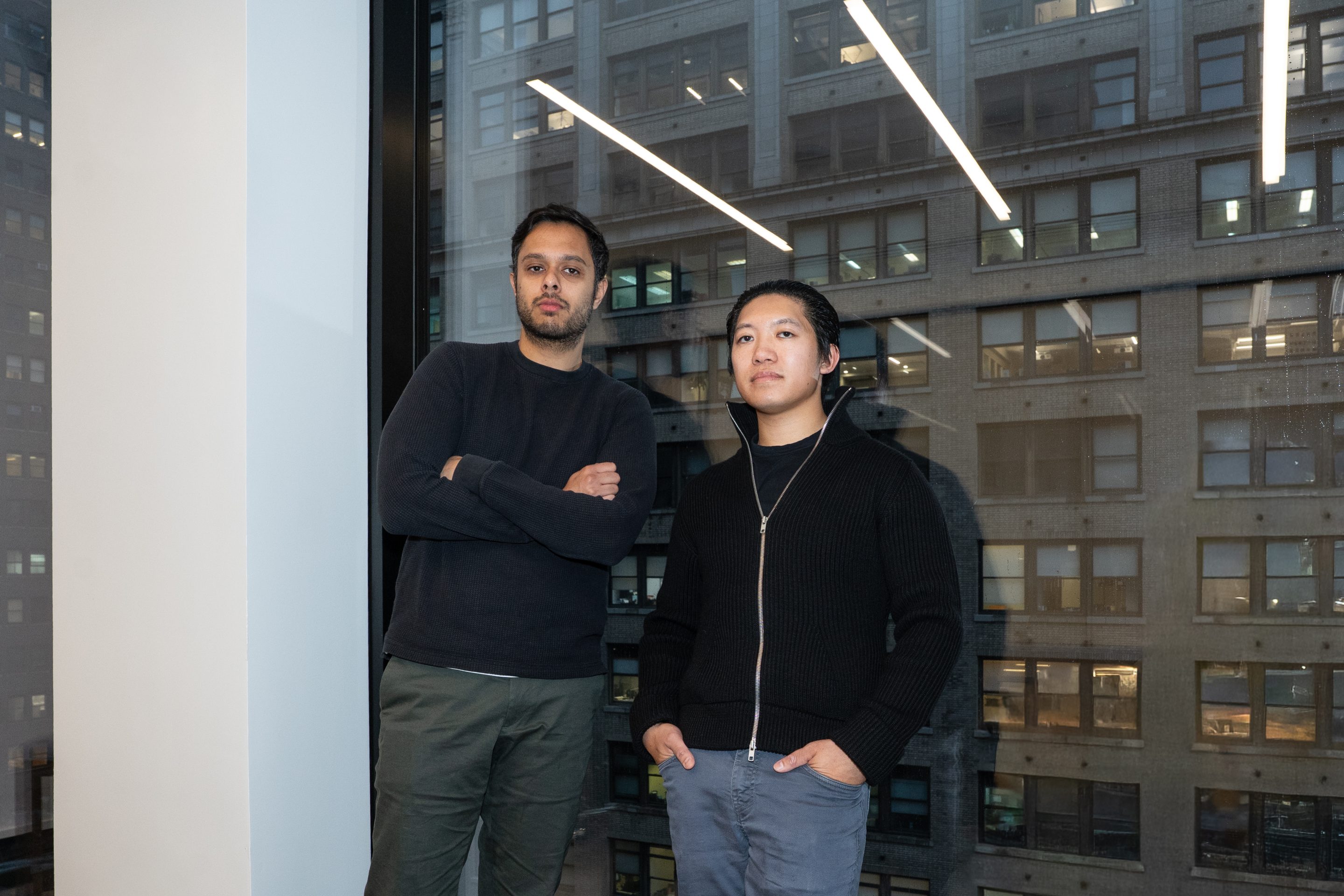
Return to the photograph of Wang and Gangopadhyay. They stand beside one another, both in dark knitwear, against a background of glass and city windows. There is no product in the frame. It is a photograph of the partnership: the CEO and CTO whose acquaintance began well before either title existed.
It would be easy to turn the two-week Palantir coincidence into destiny. The more interesting point is the sequence. A scholarship introduced them. Government work gave them another shared setting. Palantir brought a reunion. Starting Angle made the relationship a continuing business responsibility. Each stage put the same two people in a different arrangement.
Wang’s advice to founders includes surrounding themselves with technical people. In his own case, technical ability was present on both sides of the founding partnership. That does not remove the commercial or organizational work. It helps explain why his account of building a company moves readily between engineering decisions and the people needed to carry them out.
When he talks about taking the plunge, Wang emphasizes the obligation to make the company work. There is a trace of the founder’s predicament in that advice. Before the commitment, possibility can be considered at leisure. Afterward, the calendar contains other people.
Wang’s route to the chief executive’s chair passes through Colorado, an engineering education, government assignments, a technology company and a winter accelerator class. Along that route, an old acquaintance became a co-founder. The story now has a large financing headline. It also has the quieter continuity of two engineers who kept finding themselves at the same workplace, until they made one of their own.