Imagine a game studio watching a rival climb the download charts. The obvious response is to buy more advertising. But suppose those new players disappear after a week. Suppose the rival is purchasing an audience it cannot keep. Suddenly, the same chart suggests a different decision. Sensor Tower has made a business out of supplying the surrounding evidence: what people download, what they use, which ads reach them, and where attention goes next.
- The job: estimate competitors’ performance across apps, advertising, web, and games.
- The method: consumer observations, other datasets, and statistical models.
- The useful habit: compare acquisition with engagement before copying a rival’s spending.
That distinction explains its appeal to developers, marketers, publishers, and investors. Your own analytics can tell you what happened inside your business. Sensor Tower supplies an outside view. A subscription buys context for decisions that would otherwise involve a remarkable amount of squinting.
A screen-time app has a second life
The interesting machinery sits underneath the dashboard. Sensor Tower says its proprietary panel contains more than 10 million consumers. Its published app portfolio includes ActionDash and StayFree, tools people use to manage screen time, alongside utilities and browser products. Those apps deliver something useful while supplying observations that help Sensor Tower understand digital behavior.
The company combines panel information with first-party and public data, including app store APIs, then processes and models it. The result is an estimate of a larger population. Think of a carefully constructed sample, rather than a turnstile counting every person on the internet. The distinction matters whenever a tidy number appears in a presentation.
“no dataset represents 100% of all digital user behavior”
Sensor Tower · its published data methodology
- 01ObservePanel activity + store data
- 02ModelAggregate, enrich, estimate
- 03CompareMarkets, rivals, behavior
This also makes provenance part of the product. In 2020, reporting prompted scrutiny of Sensor Tower’s connections to VPN and ad-blocking apps; Apple and Google removed individual apps after inquiries. Sensor Tower said it did not collect personally identifiable information and promised clearer disclosure of ownership and data sharing. Its current methodology describes informed, opt-in panelists and de-identification before information leaves devices. The episode makes consent and disclosure central questions for anyone assessing the business.
The shopping list tells the story
Oliver Yeh and Alex Malafeev founded Sensor Tower in 2013. By May 2020, the company said it had grown with just $1 million in seed investment and was already profitable. Riverwood Capital then invested $45 million. In the founders’ account, the appeal included operating expertise to help scale the team and product roadmap. The investment followed a working business.
Then the company started widening the frame. Pathmatics, acquired in 2021, brought intelligence about the broader digital advertising market. Buying data.ai, formerly App Annie, in March 2024 added another mobile intelligence business and customers including Microsoft, Sky, and Bandai Namco. Bain Capital Credit led the transaction financing, with Riverwood and Paramark Ventures also participating. The purchase price was undisclosed.
Video Game Insights and Playliner joined the gaming suite in 2025, extending coverage into PC and console markets and mobile game events. AppMagic followed in May 2026 as a dedicated offering for small and medium-sized businesses. Read together, the deals suggest a strategy: follow customers beyond the original app dashboard, then give smaller teams their own entrance.
Different questions need different instruments
App Performance Insights covers estimated downloads and revenue, engagement, rankings, and store optimization. Advanced Usage Insights gets closer to the studio’s retention question through sessions, time spent, churn, and cross-app behavior. App Advertising Insights examines acquisition channels and creative patterns. Each offers a different explanation for the same apparent success.
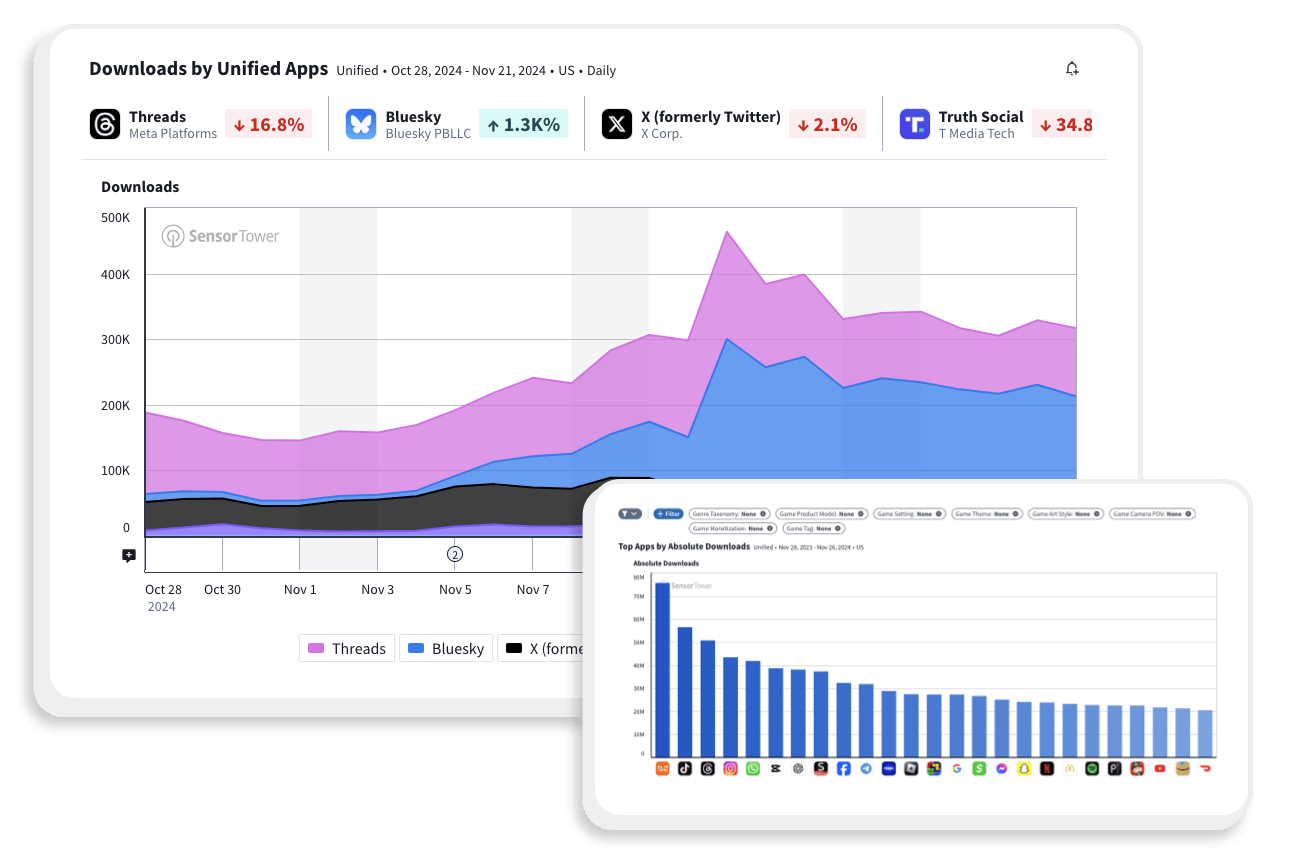
Pathmatics examines digital advertising spend estimates, impressions, and creatives. Web Insights adds traffic and audience behavior across devices; Retail Media Insights examines advertising around retailers. Gaming tools bring genre, platform, and Live Ops analysis. Sensor Tower’s distinction is the breadth of these adjoining views, backed by its panel. Similarweb overlaps in web and app intelligence; Appfigures offers app intelligence and ASO tools. The right choice depends on the question and coverage required.
Start with a decision, then open the dashboard
Consider a hypothetical publisher deciding where to launch. First, compare a handful of similar games in two countries over the same period. Look at downloads alongside revenue estimates, then examine engagement and advertising activity. A country with fewer installs may deserve attention if comparable games retain players there. That is a hypothesis to test with your own product.
Set a small acquisition experiment and judge it using your own retention and unit economics. External intelligence helps select the experiment; first-party results decide whether to continue. Copy the sequence: define the decision, choose comparable competitors, check several signals, then test. Copying a rival’s creative or apparent budget skips the part where you establish whether its economics resemble yours.
There are conditions where this approach provides little help. A tiny niche may have limited panel representation. A fresh launch may lack a useful history. Different countries, platforms, or revenue definitions can make comparisons misleading. Ad exposure does not establish incremental sales, and app-store revenue estimates should never stand in for a company’s complete accounts.
The cost of a better question
Sensor Tower sells subscription access, with free signup and paid coverage varying by features and markets. The practical buying question is which recurring decision justifies that subscription. Its MCP server gives API subscribers another way to query licensed datasets through compatible AI tools. A July 2026 Google Ads integration puts advertisers’ existing social creatives into campaign creation through Pathmatics. Both bring the information closer to work already underway.

The company advertises flexible remote, office, and hybrid work and emphasizes customer understanding and shared learning. Its business asks for a similar discipline from customers: be curious about the number behind the number. A download chart can start a conversation. Knowing whether those players came back makes the conversation worth having.
Keep following the signal
Sensor Tower ↗ Reports & analysis ↗ Product demo ↗ Company news ↗ LinkedIn ↗ X ↗ Facebook ↗ GitHub ↗
Explore the data methodology, the AppMagic acquisition, and the 2020 privacy reporting.