The awkward thing about a company research report is that somebody has to keep researching it. A business hires a chief executive, buys a rival, changes direction. Yesterday’s careful document becomes today’s slightly unreliable document. Owler’s early history turns on this maintenance problem: how do you persuade people to keep a picture of the business world up to date?
- The first attempt: sell detailed reports assembled by researchers.
- The change: invite a broader community to contribute company information.
- The business now: charge for deeper research, monitoring, team workflows and licensed data.
01 / The report nobody trusted enough
Before Owler, there was InfoArmy. Founded in 2011, it recruited researchers to assemble competitive intelligence reports. A 2012 industry profile described tablet-friendly documents that could run to 30 pages, with quarterly refreshes and a $99 price. Researchers were promised a share of continuing revenue. It was a tidy arrangement on paper. The paper was the problem.
Buyers questioned the estimates, particularly company revenue and competitors. Researchers had to revisit their work. In a later account, Jim Fowler described a market unwilling to buy again and a redesign that went much further than a few adjustments. The team had recruited people successfully; it had not produced information customers trusted enough to keep purchasing.
“It was our fault,” Fowler told Mixergy. That admission matters because he had already sold Jigsaw, his previous business, to Salesforce. Experience had supplied a hypothesis about crowdsourced data. Buyers supplied the correction. By 2014, the rebuilt company was emerging as Owler.
“It was our fault.”
Jim Fowler, on the original research model
02 / Make the contribution smaller
Owler’s answer was to gather information through a much broader business community. A professional might know a competitor, recognize a headcount estimate that looks wrong, or have a useful view of a company’s leadership. Each contribution can be modest. Collected together, those observations become material for a company profile.
There is still work between an observation and a usable database. Owler describes a process combining algorithms with human curation and validation. Its expertise sits in that assembly: matching information to companies, maintaining relationships between them, and turning scattered updates into something a reader can search or follow.
- 01ContributeCommunity knowledge
+ company news - 02CheckAlgorithms
+ human review - 03DeliverProfiles, alerts
+ connected tools
The distinctive feature is the competitive graph. A conventional company list tells you who exists. A relationship map helps you ask who competes with whom, including businesses you might never have typed into a search box. Owler advertises more than 45 million competitive relationships across over 20 million companies. Those are its own coverage figures.
03 / Sell the next useful question
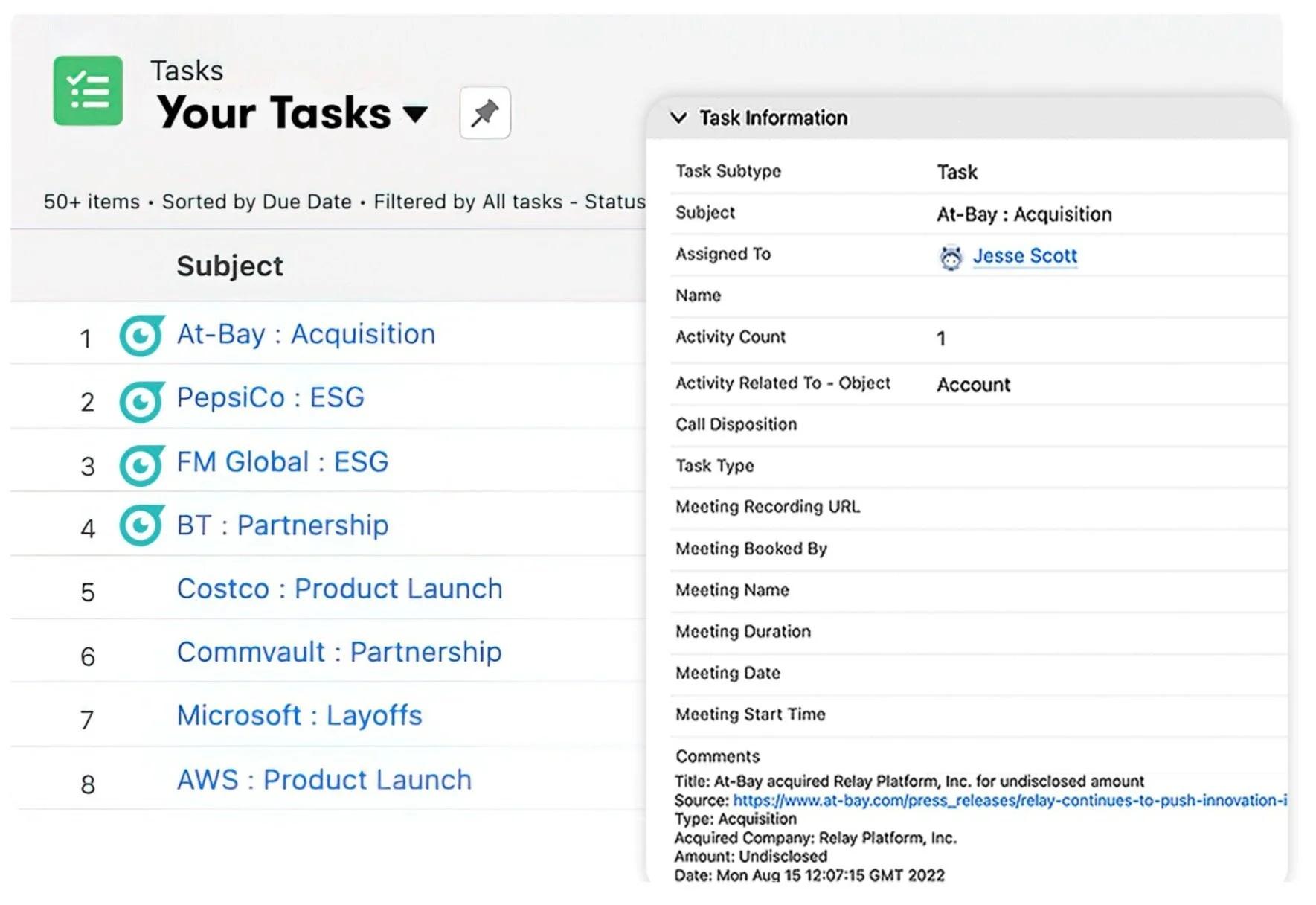
For a salesperson, the job begins with a short list of accounts and a limited amount of time. For a marketer, it might begin with an unfamiliar rival. Owler supplies profiles, company filters and news triggers that narrow the next search. Funding, acquisitions, leadership changes and product announcements become reasons to investigate.
Consider a hypothetical software seller following a prospective customer. A funding announcement arrives. The seller checks the original announcement, reviews the company’s competitors, and considers whether the new investment changes its needs. The alert has saved a search. The judgment still belongs to the seller.
Published customer stories make that use concrete. Owler names compensation specialist Culpepper & Associates, marketing technology company Openprise, Marketron and communications provider Inteliquent. Their accounts describe targeting companies, preparing outreach and keeping up with market changes. They illustrate possible uses; they do not establish a universal sales result.
04 / The price of paying attention
The commercial model has several doors. Community membership offers a limited free sample, including following up to five companies. Pro expands research and monitoring. At the time of this profile, Owler advertises Pro at $39 a month, billed annually: $468 for the year. Team-oriented Enterprise contracts have custom pricing.
$468 per year
Community: free, with limits. Enterprise: custom quote.
Data licensing is another door. Companies can bring Owler information into their own applications through APIs. Databar documents an Owler connector for company records, competitors, funding and news. Salesforce, HubSpot, Slack and Microsoft Teams integrations address the more ordinary inconvenience of leaving one tool to check another.
Some marketing pages retain the Max name, while current plan materials use Enterprise. The direction is easier to follow than the naming: move company context closer to the moment somebody uses it. Owler AI, announced in November 2023, extends that idea to drafting emails, LinkedIn messages and voicemail scripts from company information.
05 / A crowd finds a bigger home
Meltwater announced its agreement to acquire Owler in June 2021 for $24.5 million, split between cash and equity. Its stated attraction was complementary information: community-supplied business knowledge beside news and social monitoring. That purchase price describes a transaction. It should not be added to financing rounds and called money raised.
Within the company information market, Owler sits alongside alternatives such as Crunchbase, ZoomInfo and InsideView. Its particular appeal is the combination of company relationships and continuing updates. The right choice depends on the work: an account watchlist, a contact search and investment diligence require different kinds of evidence.
06 / Borrow the habit, keep the judgment
A reader can copy the useful habit immediately: choose a few companies, identify the changes that would matter, and decide who will act on an alert. Expand the list only when the existing signals produce useful decisions. Otherwise, monitoring becomes another inbox with better labels.
The conditions matter. Quiet companies leave fewer public signals. Private-company revenue can be an estimate. A competitive relationship deserves a closer look before it shapes a strategy. Owler can point a researcher toward a question; audited accounts, original announcements and customer conversations must carry the weight when precision matters.
The product lesson is equally practical. Before asking a community for more effort, examine the size of the contribution. Owler’s first ambition asked people to maintain a report. The business that followed found value in smaller observations, repeated often enough to help somebody else notice a change.