The troublesome part was at the bottom of the document. A customer in Bangalore wanted a laboratory that was completely paperless. Sekhar Surabhi and his team signed the requirement. Only once the work began did they appreciate how much the final few lines would ask of them. Every balance, every pH meter, every instrument had to connect. A little paper left over would still be paper.
It is a wonderfully awkward founding-business anecdote: the customer reads the contract exactly as written. Surabhi tells it without making the customer the villain. Caliber had agreed to the work. The response, as he recalls it, was to keep the commitment and solve the integration problems. He describes the result as India's first fully paperless laboratory.
The interesting achievement is the capability that remained afterward. A difficult implementation taught the team how to connect instruments more effectively on later projects. A promise became practical knowledge. For the Hyderabad entrepreneur, whose career began around analytical equipment, that is a particularly fitting kind of business education. The fine print had become a syllabus.
A promise became practical knowledge.
THE PAPERLESS LABORATORY LESSON
Before the software, the instruments
Surabhi came to enterprise software with experience of the physical work it would have to represent. Before founding Caliber Technologies, he worked in analytical instrumentation and pharmaceutical testing, including managing a commercial test house. Instruments, measurements and records were already part of his working vocabulary. The software business grew out of that familiarity.
His education included Sri Krishnadevaraya University, which his LinkedIn profile dates to 1986-1988. His subsequent career included senior roles at Nulab Equipments and Ashco Industries. That background matters because laboratory software has to accommodate what happens around a bench: a sample arrives, a test is performed, a result is recorded, someone reviews it. Each step has people and equipment attached.
A laboratory information management system, usually shortened to LIMS, gives that work a digital structure. CaliberLIMS became the company's starting point. The letters are dry enough to discourage casual conversation at dinner; the underlying problem is quite human. People need to know which record belongs to which piece of work, and whether they can rely on it.
Surabhi's professional biography describes a preference for making complex problems simpler. Here, simplicity has a demanding meaning. The user should have less friction even when the system behind the screen has to account for considerable complexity. Experience with instruments supplied a useful place to begin.
A small office, a first customer
Caliber began in 2001. Surabhi has recalled its beginnings in a two-room office, an image that gives some proportion to the later company. An enterprise software business starts small enough for its founder to remember the rooms. The work it hopes to win may already be spread across an enterprise.
Dr Reddy's was the first customer. Surabhi says an early opportunity involved replacing a small software system that was proving difficult to implement. Caliber delivered a replacement within a week. More automation work followed. His account makes the sequence clear: delivery came first, and a larger opportunity followed the customer's willingness to trust the team.
The timing also helped define the business. Web technologies were becoming a practical alternative to client-server systems, while regulated companies were moving toward electronic records and signatures. Surabhi saw those developments meeting in the same workplace. Someone would have to make the new technology useful within the customer's operating rules.
That is a more specific origin than a general enthusiasm for software. It joins a professional background, a change in technology and a paying customer's immediate problem. The company's subsequent expansion retained the same central concern: how to make records, processes and equipment work together without asking the customer to bridge every gap by hand.
- 01InstrumentationLearn the physical work.
- 02Laboratory softwareGive records a structure.
- 03Connected operationsFollow the information.
A conceptual map of Surabhi's career and Caliber's expanding product scope.
The work spread beyond the laboratory
The early laboratory focus gradually widened. Caliber's portfolio grew to cover quality assurance, manufacturing, and data and insights. Process, document and training management added different kinds of work to the picture. Electronic batch records and digital logs brought the company further into manufacturing operations.
A 2021 account of the business already described a product range extending across that quality chain. It also explained the appeal of integration: information from different applications could be brought together for analysis. The practical ambition was to give decision-makers a connected view of work that had previously lived in separate systems.
The expansion has a useful editorial clue in its name, Integrated Quality Management. Each word does some work. Quality supplies the purpose; management brings the everyday decisions; integration asks whether the information can travel. Buying several applications leaves that last question open. The interfaces between them are part of the job.
There are tangible markers along the way. His LinkedIn profile records a June 2012 software product award from ITs AP for CaliberBRM, the company's electronic batch records management system. A Dun & Bradstreet profile in 2016 listed more than 65 customer organisations and over 12,500 CaliberLIMS user licences. Those are dated snapshots of an expanding business, rather than interchangeable claims about its size today.
Caliber begins. The problem: making digital systems useful inside regulated operations.
A founder who keeps convening the room
Surabhi also works beyond Caliber's product catalogue. He serves as a director of the ISPE India Affiliate and chairs its Pharma 4.0 Community of Practice. ISPE is the International Society for Pharmaceutical Engineering. The roles put him in recurring conversations about how an industry changes its working methods.
His stated priorities include sharing knowledge, developing people and making adoption feasible for smaller organisations. That last point deserves attention. A transformation plan has to survive the resources and existing systems of the organisation attempting it. A programme that makes sense to a large exporter may need a different route through a smaller operation.
Caliber's own user gathering, Commune, provides another meeting place. Its 2024 editions took place in Ahmedabad on February 9 and Hyderabad on February 16. Together, the events brought more than 500 participants and over 30 speakers. Surabhi delivered a keynote, while the programme mixed product developments with discussions involving industry users.
The photographs show the less solitary side of building software: a founder at a lectern, a stage shared with other people, products presented to a room of users. There is something sensible about that arrangement. Customers who have spent a year using the software tend to arrive with rather specific thoughts about the next version.
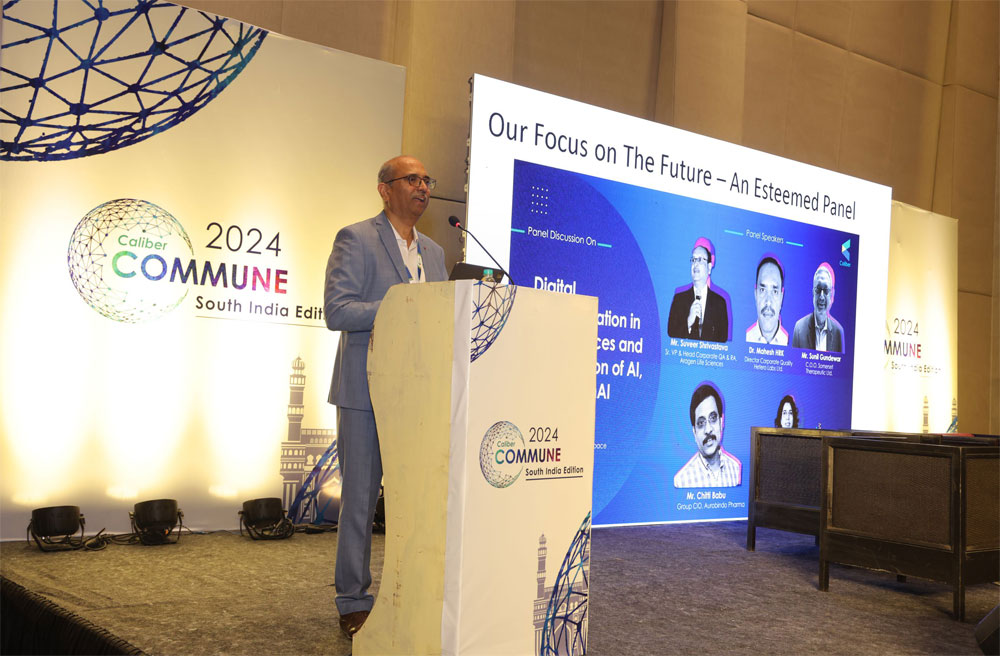
Caliber Commune 2024 - combined Ahmedabad and Hyderabad editions.
The dashboard has a follow-up question
By April 2026, Surabhi was pressing a further question: once a company has installed its digital systems, are its people making better decisions? He described businesses with more available information that still relied on repeated checking, escalation and waiting. A new screen could coexist quite comfortably with an old delay.
His concern was decision ownership. Someone needs to know when to act, what information supports the action and how much authority they have. Without that clarity, a dashboard can become an exceptionally tidy place to watch work stand still. That observation gives his more recent thinking an organisational edge.
“Who decides? When? With what data?” he asks. Those short questions shift attention from the appearance of a system to the working arrangements around it. They also give leaders something concrete to examine after implementation: where a decision pauses, which function holds it and whether the next person receives enough context to proceed.
For a founder whose company sells software, it is a useful test to put into public view. The installation itself cannot settle every question about responsibility. His argument asks customers to evaluate what happens during the working day, including the boundaries between departments. The benefit should show up in clearer action, rather than merely in a completed implementation checklist.
“Who decides? When? With what data?”
SEKHAR SURABHI · APRIL 2026
New tools, familiar obligations
Artificial intelligence now occupies part of Caliber's product agenda. In September 2025, Surabhi discussed CalGenie, its generative AI offering for master data creation, alongside preparations across the wider portfolio. He identified document work, data handling and support for validation as practical uses for the technology.
He also retained a place for validated systems and human judgment in consequential operational decisions. That position fits the business he has built. Customers are buying tools to help them carry out accountable work. A quicker first draft can be useful; deciding how it is checked and used remains part of the operating process.
His emphasis on learning has a similar practical cast. He describes teams continuing to develop their expertise and having room to experiment. In the public response to his founder podcast, colleagues repeatedly describe curiosity, optimism and an openness to other people's views. Those are their assessments, but they add a personal dimension to the formal executive titles.
A recommendation from Warford Reaney offers a particularly compact description: “quiet confidence”. It sits comfortably beside a career spent on integration, records and long customer relationships. This is work whose merits are often most visible when someone asks a difficult question and the system can supply a usable answer.
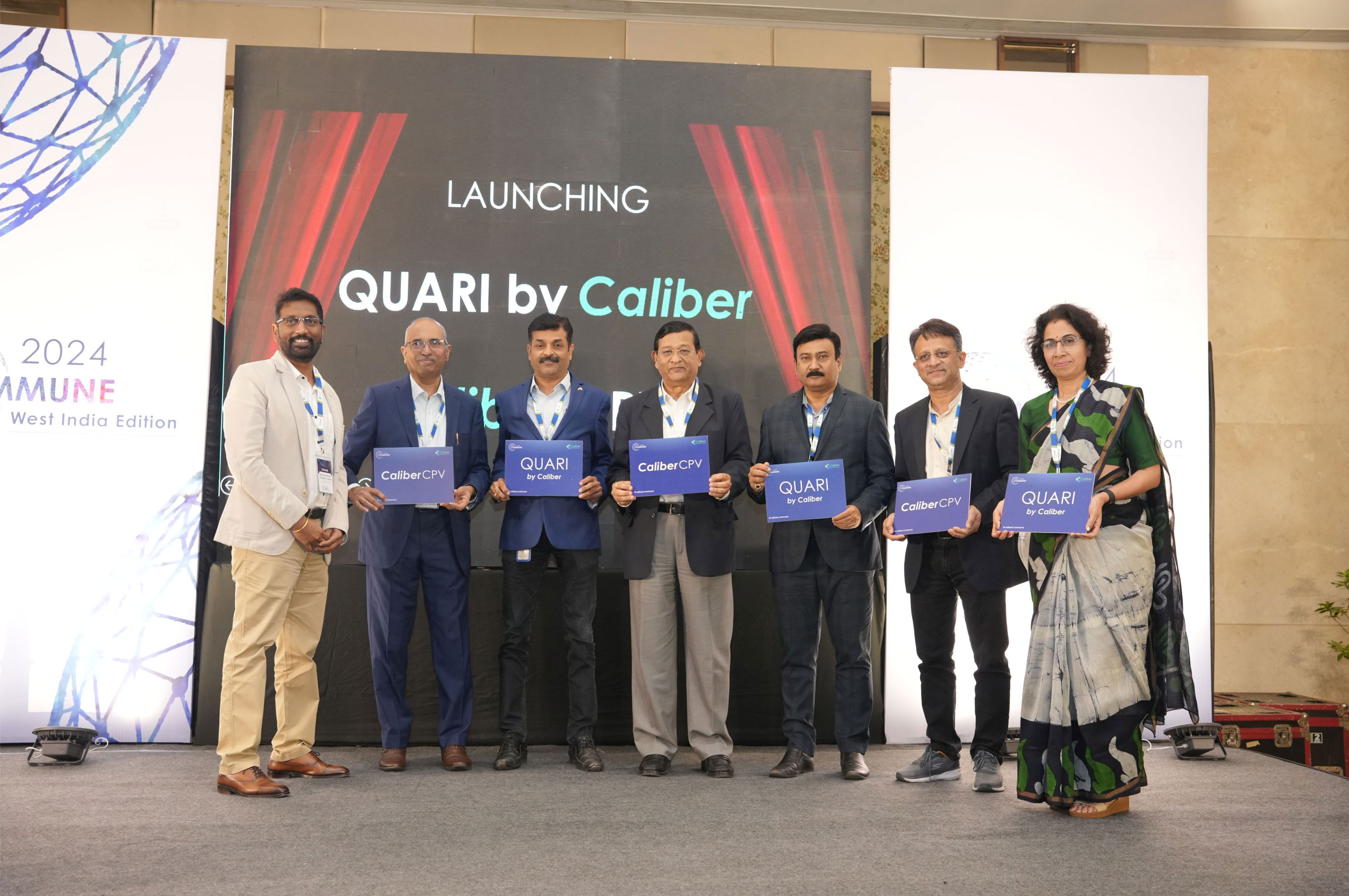
Still choosing the next problem
Surabhi's plans include expanding Caliber's international presence, particularly in North America, Europe and Asia, and investing in training and product development. The ambitions extend an existing business rather than supply a new origin story. The company has been building for overseas users for years.
There is a revealing answer near the end of one conversation, when he is asked what he would do if he were outside his present field. He still chooses innovation, perhaps application innovation. The attraction appears to lie in finding a useful way to make something work. A different industry would leave that preference intact.
Return, then, to the customer in Bangalore and the requirement at the bottom of the page. Its power in Surabhi's story comes from its precision. Every instrument. No remaining paper. The commitment left little room for a flattering interpretation of progress. It asked for a result that the customer could inspect.
His newer questions about decision-making apply a similarly practical standard to a more mature company. After the connections are built and the records are digital, somebody still has work to do. Can they understand the information? Can they act on it? The next problem begins where the last delivery ends. Surabhi seems quite prepared to keep reading the fine print.
Keep the conversation going
Explore Surabhi's work, writing and conversations.