The instrument has done its job. The result exists. Then comes the surprisingly complicated part: getting that result into the right record, under the right method, in front of the right reviewer. Somewhere between those steps, a person may print a worksheet and type the numbers again. For a company selling laboratory software, that small detour is a business opportunity.
- Caliber connects laboratory instruments, quality records and manufacturing workflows.
- Its customers include pharmaceutical manufacturers such as MSN and Adcock Ingram.
- The useful question for buyers: how many manual handoffs will actually disappear?
Caliber Technologies operates in this gap between scientific sophistication and administrative repetition. Its software helps regulated businesses retain the history around their work: samples, tests, documents, training, approvals. The attraction is practical. A result becomes easier to retrieve, investigate and review when its surrounding evidence travels with it.
A worksheet changes the plan
Consider Adcock Ingram. In Caliber’s account of the project, early discussions concerned a partly automated laboratory. Calculations could enter the system, but analysts would still print controlled worksheets, complete them manually and enter the details again. The proposed shortcut preserved a loop of paper and transcription. That remaining loop prompted discussions about going fully paperless.
The eventual implementation connected 25 instruments and registered 125 named users. Caliber reports that reviewers spent 60% less time reviewing records. Those are results from this particular customer project, reported by the supplier. The revealing detail is the sequence: requirements study, process mapping, software validation and connections to laboratory instruments and SAP. The software needed to fit the actual work.
At Adcock Ingram, according to Caliber’s published customer account. The unit of progress was a connection.
The record is bigger than the result
CaliberLIMS, the flagship laboratory information management system, follows samples through their lifecycle. It combines instrument integration, an electronic laboratory notebook, stability studies and reporting. A laboratory can connect file-based instruments, devices that transmit individual readings and chromatography data systems. This matters because equipment rarely arrives as one tidy, cooperative family.
There is a pleasingly concrete example in the glassware module. Caliber supports Glassco’s QR-LabGlass: glassware carrying etched QR identifiers. Scan the flask and its identity becomes usable in inventory and traceability workflows. Even the vessel can have a history. It is an unusually tangible illustration of a company whose output is mostly invisible connections.
The breadth continues outside testing. EPIQ QMS joins quality events, controlled documents and learning through assure-iq, docs-iq and learn-iq. These functions sit close together for a reason. A changed procedure creates questions about its approved version and the people trained to perform it. Connecting those records gives a quality team a more coherent account of what happened.
- 01RegisterIdentify the sample
- 02CaptureCollect instrument data
- 03ReviewCheck results and history
- 04ApprovePreserve the decision
Where the paper used to pile up
The MSN Laboratories case offers another view. Caliber describes records that were difficult to retrieve and approvals slowed by manual review. MSN initially operated without instrument connectivity, then introduced integrated systems in 2018. The account reports 336 integrated instruments and a 90% reduction in document storage. These are customer-specific claims, rather than a forecast for another installation.
The case also describes implementation during the COVID-19 lockdown and expansion from an existing unit to a newly constructed laboratory that began paperless. That distinction is useful. Retrofitting a working laboratory requires accommodating habits and dependencies already in place. A new facility has the opportunity to establish its workflows before paper acquires a permanent home.
“PAPER ON GLASS.”Caliber’s description of its electronic-logbook approach
The phrase comes from CalibereLog. Behind the cheerful shorthand are equipment usage records, cleaning logs, calibration controls and scheduled alerts. CaliberBRM extends into electronic batch records and in-process quality checks. EMpro handles environmental and microbial monitoring, including sampling locations, area mapping and contamination trends. Different teams, different records, familiar coordination problems.
A specialist in a crowded laboratory
Founder Sekhar Surabhi established Caliber in 2001. Industry biographies describe experience in analytical instrumentation and pharmaceutical testing before he built the business. That background fits the company’s product vocabulary: instruments, methods, quality control and the practical mechanics of recording work. Its expertise is most legible in those details.
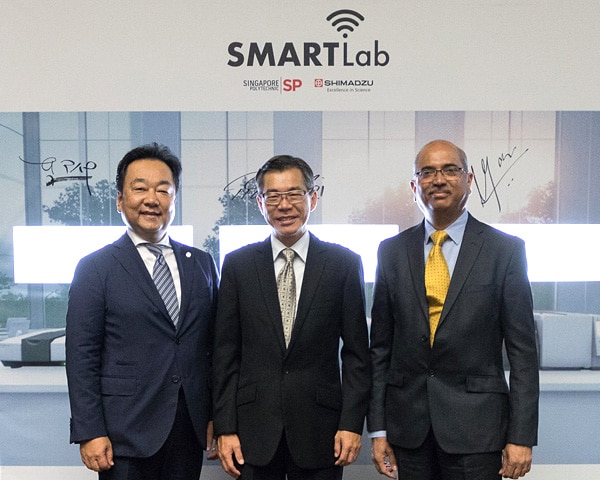
Shimadzu’s SMARTLab announcement documents Surabhi at the Singapore Polytechnic launch. The facility brought connected instruments into a teaching environment. Training is an essential companion to the software: people must understand the workflow they are being asked to trust. Caliber also runs its Commune user summit, giving customers a place to discuss products and practice.
Caliber competes with established laboratory platforms including LabWare and LabVantage. Connected laboratory capabilities exist elsewhere. Caliber’s proposition is its combination of laboratory, quality, manufacturing and review tools for regulated operations. Buyers should compare that combination against their own instrument estate, processes and support requirements.
Start with one awkward handoff
The business is enterprise software, with a sales process organized around demonstrations and customer requirements. Implementation brings its own work: configuration, integrations, validation, training and continuing support. A sensible budget must cover those activities alongside the software agreement. The Adcock project’s process study is a useful reminder of what buying the product entails.
Caliber’s newer CalGenie adds AI-assisted information retrieval and master-data creation. The company markets operation within customer infrastructure and connections to existing systems. Its practical value will depend on the underlying records and the checks surrounding generated output. A fast answer still needs a reliable trail.
There is a method here that readers can copy: choose one sample, map every handoff and ask a supplier to demonstrate the awkward exceptions. Include a corrected reading, a changed procedure and an overdue calibration. If instruments cannot connect, records remain inconsistent or staff cannot use the workflow, the paperless ambition loses ground. Begin where someone still has to type the same number twice.