The peculiar thing about an experiment is that it can succeed and still be lost. A scientist changes the proportion of a polymer, lowers the curing temperature, observes an improvement, and writes the result somewhere sensible. Six months later, someone in another building repeats the work because “somewhere sensible” was a spreadsheet on a departed colleague’s drive. The molecule remembered what happened. The company did not.
- Uncountable connects ELN, LIMS, quality, PLM, project work, visualization, and AI on one structured data model.
- Its buyers are enterprise R&D organizations in chemicals, materials, food, consumer goods, and pharmaceuticals.
- The company began as a consultancy in 2016, became a software platform by 2019, and raised a $27 million Series A in 2025.
- Customers report measurable gains: Ripple Foods cites 30% less data-reconciliation time; SCG Chemicals reports 20% faster R&D and more than 3x ROI.
This is the small, expensive absurdity Uncountable was founded to remove. Its software is sold to laboratories that make physical things - coatings, batteries, adhesives, foods, pharmaceuticals, polymers - where a result is rarely just a result. It has ingredients, process conditions, samples, instrument files, specifications, approvals, costs, and a long trail of “why.” Uncountable puts that trail on one record.
First, borrow the customer’s headache
In 2016, Noel Hollingsworth, Jason Hirshman, and Will Tashman had an observation rather than a product. Sales and marketing had acquired polished software systems; industrial R&D still ran on private spreadsheets, paper notebooks, shared drives, and tribal memory. Hollingsworth knew machine learning from MIT and Second Spectrum. Hirshman had built data systems at Palantir. Tashman, a materials scientist who had worked in Apple’s manufacturing plants, knew what happened when a promising design met the unruly physical world.
Their first sales strategy possessed none of the grandeur later attached to “enterprise go-to-market.” Tashman opened an MIT alumni directory and called materials companies. Cooper Standard answered. The difficulty was not merely demonstrating clever software. It was persuading a manufacturer to hand three people working from a Sunnyvale apartment some of its most guarded information: proprietary formulations.

So they changed the offer. Uncountable operated first as a high-touch data science consultancy. The founders performed analysis, learned the odd shapes of formulation data, and discovered which annoyances repeated across customers. By 2019, the service had hardened into software. It is a pattern worth copying: when buyers cannot yet trust the product, sell the work, acquire the context, and productize only the repeated parts. It is slower than a self-serve sign-up page. It is also how one learns what a real laboratory refuses to compromise.
“We chose the name Uncountable because we work with real-world data, which is often highly complex and even continuous.”The founders, on a name mathematicians might regard as a warning
The first failure was the handoff
A standalone electronic notebook can preserve what a scientist wrote. A LIMS can track samples and tests. A product-lifecycle system can govern a commercial formula. A quality system can document the deviation after a batch wanders out of specification. Each tool may work perfectly while the organization fails between them. Someone exports a table, renames a column, emails a file, and severs the reason from the result.
+ rationale
+ instrument
+ deviation
+ release
Uncountable’s difference is not that it invented every box in that chain. It is that ELN, LIMS, QC LIMS, QMS, PLM, project management, and reporting share a configurable data model. A formulation can travel from bench notebook to quality test to production record without being re-keyed at each border. More than 400 types of instruments and network configurations can feed the system. Audit trails, electronic signatures, access controls, and version history stay attached.
That breadth places the company between familiar categories. It competes with spreadsheets and home-grown databases at the bottom, standalone ELN and LIMS vendors in the middle, and established quality and product-lifecycle suites at the top. Its pitch is not “our notebook is prettier.” It is that the joins are the product.
What it costs - and what it is supposed to replace
There is no public price card. Uncountable sells tailored enterprise contracts after a demonstration, and the invoice necessarily depends on modules, users, migration, validation, instruments, ERP connections, and the amount of implementation help. This is not a subscription one slips onto a corporate card. It is closer to installing institutional plumbing.
The more useful cost evidence therefore comes from the other side of the ledger. Ripple Foods says reconciliation time fell by at least 30%, saving roughly half a day per scientist each week. SCG Chemicals reports that time spent on data management dropped by more than half, with R&D moving 20% faster and the project delivering more than three times its investment. Uncountable’s customer page also publishes examples of formula-review time falling from 74 hours to 40 and materials waste declining by 15%. These are vendor-presented customer results, not universal promises, but they show the business case: fewer repeated experiments, less clerical assembly, and shorter waits between evidence and decision.
AI arrives after the filing cabinet
In June 2026, Uncountable launched Bodie, an assistant built into the platform. It can find historic experiments, summarize projects, produce charts from plain language, help design an experiment, draft a notebook, edit tables, and update permitted records. Customers can connect their own models, and Uncountable says customer data remains isolated and is not used to train foundation models.
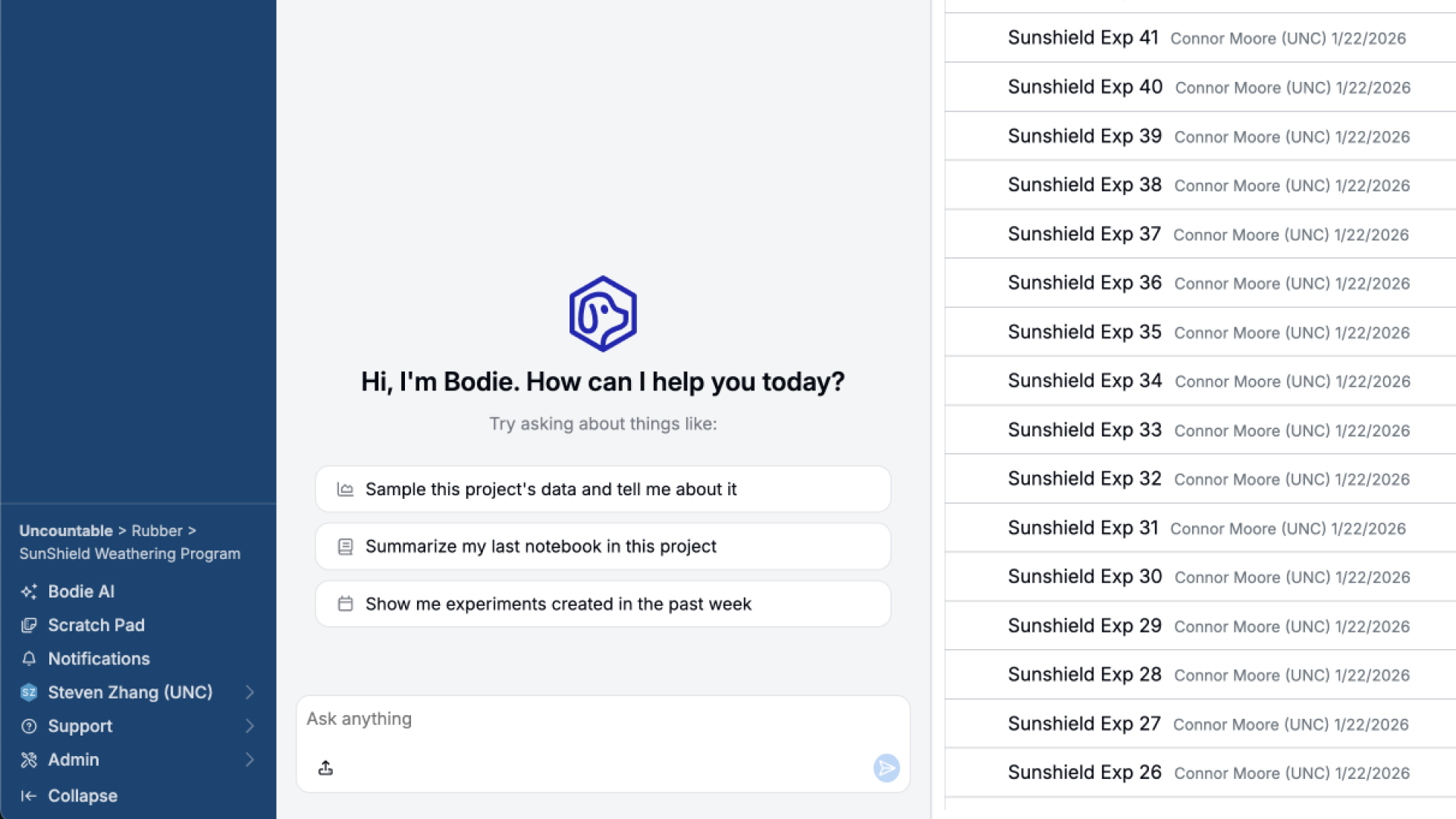
The dog is the charming part. The database is the consequential part. An assistant cannot reason reliably over filenames it cannot find, units that shift by department, or results detached from their formulations. Uncountable’s position is sensibly unfashionable: structure first, AI second. Bodie is useful because the older product did the dull work of giving experiments consistent identities and relationships.
A playbook made of unglamorous verbs
What can another company copy? Begin with a workflow narrow enough to observe. Do the work beside the customer. Notice where people re-enter data, where context disappears, and where a decision waits for somebody to assemble the evidence. Build a shared model before a clever interface. Prove value in hours not spent and experiments not repeated. Expand only when the next handoff can use the same record.
That sequence also explains what changed the founders’ minds. They did not abandon consulting because service had failed. Consulting succeeded at revealing a repeatable system. The recurring demand was not for another bespoke analysis; it was for an organization to retain what the analysis had learned.
For larger organizations, the proof is now visible in scale rather than slogans. Clariant reports more than 1,000 users across 35+ sites. Kuraray moved from pilots to an international rollout in 2026 with Nagase supporting training and integrations in Japan. Merck KGaA selected the platform to connect instrument data, LIMS, and reporting across central analytical laboratories. The company says more than 175 enterprise product-development teams use its software worldwide.
Uncountable raised $27 million in 2025, after years in which the founders publicly described the company as bootstrapped. That delay is revealing. The company learned its category at the speed of a laboratory: methodically, close to the bench, suspicious of easy conclusions. Its grand idea is finally quite modest. The experiment should not have to introduce itself twice.