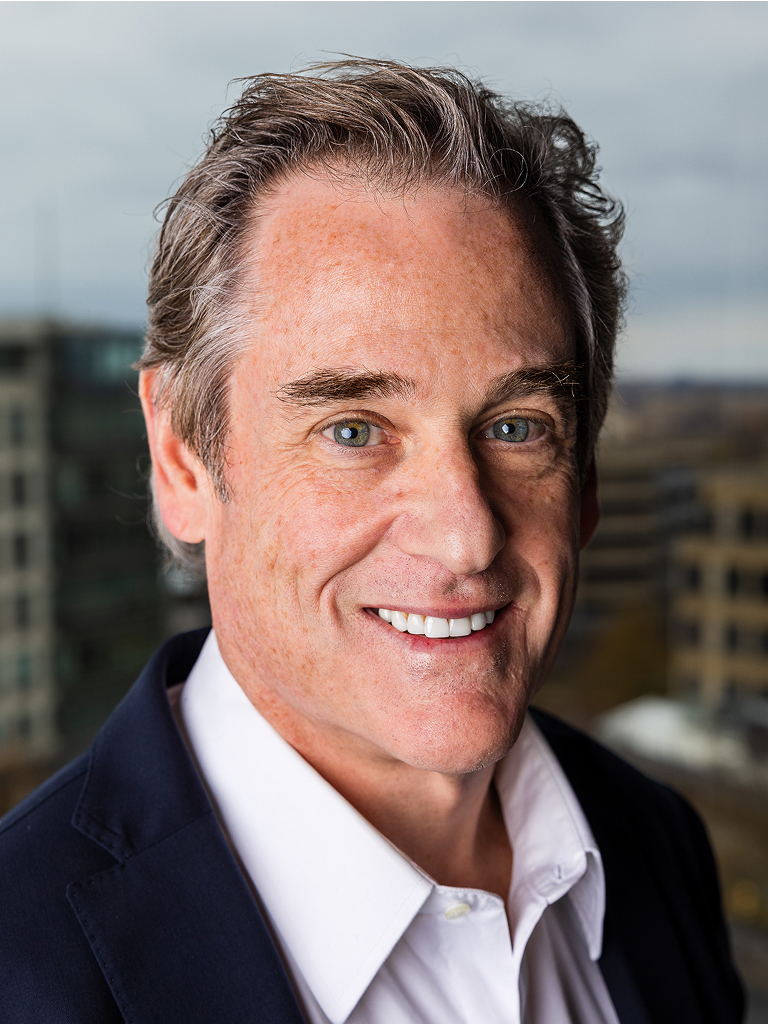
In 1997, Sean Moriarty took a job as a QA engineer at a company called Citysearch. He was writing test scripts for one of the earliest commercial internet search engines - one that existed before Google, before Yelp, before most people in America had a broadband connection. His colleagues included a future CEO of OpenTable and a co-founder of Peloton. Nobody knew that yet. They were just a group of people building something at the start of something enormous.
That instinct - show up early, do the unglamorous work, stay long enough to see what the thing becomes - has defined every chapter of Moriarty's career. He grew up in Springfield, Massachusetts, the son of a nurse and a civil servant, raised on the idea that you put in the work and you figure it out as you go. Nobody handed him a roadmap to corporate leadership. He made the maps himself.
"When you are early in your career, if you are working with really good, smart people, you are spoiled. It was such a positive, high-energy environment that I am really grateful for."Sean Moriarty, on his years at Citysearch
When Ticketmaster acquired Citysearch in 1999, Moriarty went along. He spent the next decade climbing through the organization - from EVP of Technology to Chief Operating Officer to, in July 2005, President and Chief Executive Officer. He transformed what had been an offline ticketing business into a top-5 global internet commerce company, generating $1.5 billion in annual revenue across 22 countries. He led the acquisitions of Paciolan and TicketsNow. He oversaw Ticketmaster's investments in iLike and Echo Music when the music-tech ecosystem was still being invented.
More telling than the revenue numbers is the timing. Moriarty ran Ticketmaster through the dot-com crash, through the grief and chaos of 9/11, through the Great Recession. The kind of executive who gets minted only by surviving real turbulence, not just riding growth cycles.
After departing Ticketmaster in 2009, he became Entrepreneur in Residence at Mayfield Fund - one of Silicon Valley's established venture firms - where he spent three years evaluating startups from the other side of the table. In 2013 he took the CEO role at Saatchi Art, the online fine art marketplace, where artists in 95 countries were selling original work to buyers in 77 countries. A year later, Saatchi Art was acquired by Demand Media (later renamed Leaf Group), and Moriarty came with it as the company's new chief executive.
At Leaf Group, he oversaw a portfolio that included Society6, the art-on-products marketplace, and editorial brands like Well+Good and Hunker. By 2020, Leaf Group had grown to 53 million monthly unique visitors and $212 million in annual revenue - up from $155 million the year prior. That run ended in 2021 when Graham Holdings acquired the company for $323 million. Not a bad exit for a company most people had never heard of.
"The real challenge of business is that you have to execute in the short term yet dream for the future. You must do your best each day."Sean Moriarty
In April 2023, Moriarty was named CEO of Primer.ai, a San Francisco company that had been founded by Sean Gourley to apply natural language processing to the hardest information problems in the world. Primer's clients are defense agencies, intelligence communities, and Fortune 100 enterprises. The software analyzes massive volumes of open-source and proprietary data, extracts actionable intelligence, and surfaces it to human analysts in seconds rather than hours.
The job is different from running Ticketmaster or Leaf Group in almost every meaningful way - the customer base, the data sensitivity, the consequences of error. But Moriarty's arrival at Primer was not a random pivot. He is the son of a Vietnam veteran. His grandfather served in World War II. For more than a decade, he served as Co-Chair of the Pat Tillman Foundation, working alongside the families of military veterans. He also serves as an Ambassador for the Special Operations Warrior Foundation. When he joined Primer, it was not purely a business calculation.
"This company exists to make the world a safer place," he said at the time of his appointment. Three words. No jargon. No mission-statement padding. Just a statement of purpose that explains everything about why a veteran tech executive would choose to run a defense AI company over something easier and more lucrative.
Two months after taking the job, Moriarty closed a $69 million Series D for Primer - the first close, led by Addition with participation from the U.S. Innovative Technology Fund. The round was not just capital; it was validation that the defense AI market had matured enough for serious institutional backing. Primer's total funding reached $237 million.
The signature achievement of Moriarty's tenure at Primer is a number that sounds small until you understand what it means. Most large language models, deployed in commercial applications, hallucinate - generate false information with false confidence - at a rate of around 10%. That is acceptable for consumer chatbots. It is catastrophic for defense analysts making mission-critical decisions. Primer reduced its hallucination rate to 0.3%. Moriarty put the stakes in concrete terms: "Imagine a world where an LLM is saying an adversary has five times as many aircraft carriers as they actually have."
His philosophy on AI is deliberately anti-hype. "Too many regard AI like it's magic, and we don't want magic," he has said. "It's about keeping it simple and using proven technologies that bridge current gaps. We want solid capabilities that can deliver immediate, near-term advantages now that can build trust and compound over time." Source citation. Traceability. Repeatability. These are the engineering values that Primer has built its reputation on - not the flashiest features, but the ones that matter when the stakes are real.
In September 2024, speaking at the Air Force Association conference, Moriarty made the case for urgency directly to defense leaders. "If you look at the nation's finest hours," he said, "it's typically been on the receiving end of some profoundly negative externality which gave us no choice but to respond to the threat. I think the big challenge upon us now is we recognize the world is increasingly dangerous. Can we actually get ahead, or is the necessary forcing function a terrible event?"
That question - whether institutions can move fast enough without being forced by catastrophe - is the one Moriarty is staking his current chapter on. With Primer's Delta platform, a self-curating knowledge base that processes millions of documents in seconds and is available through AWS Marketplace, he is trying to make the answer yes.
From Springfield to Citysearch to Ticketmaster to Mayfield to Saatchi Art to Leaf Group to Primer. The throughline is not obvious until you see it: he has spent three decades finding the early innings of enormous shifts - the internet, e-commerce, the creator economy, AI - and building things that work inside them. Not magic. Just the hard, unglamorous, consequential work of getting it right.