In May 2013, Sean Lane made a small piece of Baltimore technology news by removing more than 14,000 emails from his inbox in a day. He used Mailstrom. For someone whose companies have concerned themselves with military communications, artificial intelligence and the movement of information, it was an unusually domestic victory. Even ambitious founders must eventually contend with the unread message.
The detail belongs in his story because it brings the scale down to something recognizable. Lane keeps starting businesses around information that is difficult to find, move or use. Sometimes the obstacle is a network. Sometimes it is an organization. On that particular day, the obstacle was apparently his inbox.
His career has since included a company valued at $4 billion, its closure, a return to defense technology and another venture in Columbus. Read backward from his current work at Blacklight, the sequence has a certain consistency. Read forward, it contains enough abrupt changes to make a tidy founder biography rather difficult to maintain.
01 / Before the pitch deck, a field problem
Lane grew up in Ohio and calls Gallipolis his hometown. He graduated from Miami University, then worked in the United States intelligence community. His service included five tours in Iraq and Afghanistan. He received the Bronze Star Medal and the Defense Meritorious Service Medal.
The work put him close to a practical problem: people had growing quantities of information and needed better technology to handle it. In 2008, he founded Battlefield Telecommunications Systems, or BTS. Its business involved mobile telecommunications for military use. A communications system in that setting has a rather unforgiving audience. The people using it have other things to worry about.
By 2011, BTS Software Solutions was opening an office in Baltimore. Its work included software for managing cellular networks, and Lane was also interested in the city around the office. Technology businesses, in his version of the enterprise, could have an address and a local purpose as well as customers elsewhere.
That concern extended home. In January 2012, BTS announced plans for an office in Gallipolis, with an ambition to employ at least 20 people there by year’s end. The company was also sponsoring a proposal for free public Wi-Fi in the city park. The promised jobs were a target, rather than an accomplished tally. The geography, however, was a choice: he wanted technical work in the place he came from.
An editorial map of recurring problems in Lane’s work, rather than a claim that every venture followed one plan.
02 / An office with twelve French presses
In Baltimore, Lane joined Mike Brenner and Greg Cangialosi to create Betamore, a coworking and education campus. More than 150 people gathered for its launch in late 2012, on the fourth floor of a building in Federal Hill. The opening had slipped beyond its original September schedule. Even a place devoted to starting things must first survive getting started.
Betamore offered desks, classes and rooms where young companies could work near one another. Sliding chalkboards divided the teaching space. A mural of Baltimore occupied a wall. There were bike racks, a large television and a dozen French presses. A community could apparently run on quite a lot of coffee before requiring a more elaborate theory.
Lane and Cangialosi funded the original project. Its structure made a particular wager: proximity and education could help turn individual efforts into businesses. The product was partly the room and partly what might happen when the people in it stopped working alone.
Another undertaking approached the question from earlier in life. Lane founded the Digital Harbor Foundation in 2011. Through conversations with educator Andrew Coy, and with Shelly Blake-Plock joining the effort, its work developed toward practical technology education for Baltimore’s young people.
The foundation helped turn a former recreation center into a place for making and learning. That is a different sort of conversion from a software pivot. It requires a physical building, instructors and children who return after school. It also complicates the picture of Lane as simply a collector of venture-backed companies. Some of his institution-building happened before anyone had a product to sell.
03 / Four billion dollars, and a full stop
Lane co-founded the business that became Olive in 2012. It began as CrossChx and developed into an enterprise automation company. Chris Olsen of Drive Capital was an early investor. Olive became the venture most closely associated with Lane’s name, and eventually the one that made any account of his career impossible to write as an uninterrupted ascent.
In July 2021, Olive raised $400 million at a $4 billion valuation. Vista Equity Partners and Base10 Partners’ Advancement Initiative led the financing, with Tiger Global also participating. The plan included developing more products and expanding the workforce. Capital made a larger organization possible; it also made a larger organization necessary to manage.
The distinction between those first two numbers matters. One described new financing. The other described what investors valued the company at in a transaction. Neither was Lane’s personal fortune, and neither guaranteed that the organization would endure. Valuation is excellent at producing headlines and less useful as a substitute for a working business.
In July 2022, Olive cut 450 jobs. Lane acknowledged that expansion and insufficient focus had put pressure on product and engineering. His explanation included a direct sentence: “I take responsibility for this.” The company narrowed its efforts, then sold business lines. On October 31, 2023, it announced that it would wind down after selling its remaining core units.
That ending belongs beside the financing. Hundreds of people had worked on the venture; retrenchment was a consequential event in their lives as well as a development in a founder’s résumé. The available sequence supports a clear conclusion about Olive: an ambitious company raised substantial money, struggled to execute and closed. Any account of Lane’s next work has to carry that history with it.
04 / A day small enough to hold
There is a quieter Lane in a photograph from Miami University in May 2022. He stands in academic robes beside graduating student Rachel Duke, smiling at the College of Engineering and Computing’s recognition ceremony. He had returned as a keynote speaker. For once, the occasion required neither a launch nor a financing announcement.
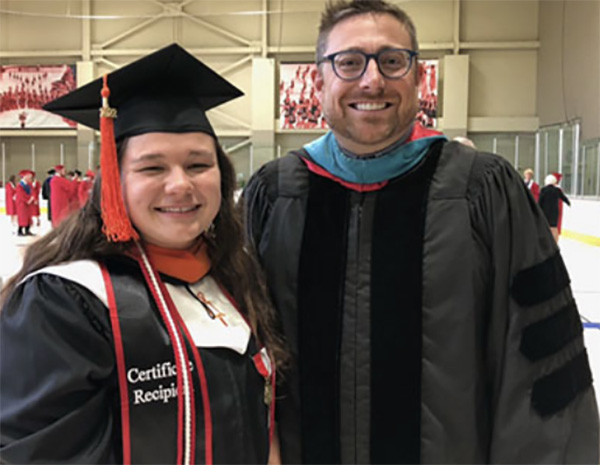
His advice to the graduates was unusually manageable: “You can do anything for a day.” He urged them to give their attention to the day they were actually living. Coming from a founder associated with expansive technological projects, the small unit of measurement is striking. A day has edges. A vision can keep expanding indefinitely.
He had returned to Miami the previous December for a founders-and-investors event, telling students that people with backgrounds like theirs could create companies and nonprofits. His own route supplied examples of both. The commencement address added something more modest to that argument: the future would still have to be lived one ordinary day at a time.
“You can do anything for a day.”
Sean Lane · Miami University, May 2022
05 / Back to the network
Ghostdog became public in December 2023, shortly after Olive’s closure. Lane introduced it through a return to the mission of his first business: technology for military and national-security work. The new company worked on secure search and intelligence tools. The change of setting connected his next venture to experience that predated Olive by years.
In August 2025, Ghostdog combined with Mission Essential under a new parent, The Mission Group. Ghostdog became Mission Sciences, its technology and product arm. Lane was announced as CEO of Mission Sciences and chief technology officer of Mission Essential. Carlton “Bubba” Fox, another Air Force veteran and Ghostdog co-founder, was part of the leadership.
The deal brought together a younger product business and an established services operation. Its investors included Drive Capital, Moonshots Capital, Shield Capital, 8VC and Cerberus. The recurring relationships are part of the story. Founders may change company names more often than they change the people willing to work alongside them.
The platform described in the merger announcement, Whispernet, was intended to let people and AI agents work as teammates. Treat that as the company’s stated design ambition. An announcement can explain the intended direction of a product; actual use must establish how much of the ambition it delivers.
06 / The colleague who needs a network password
Lane’s current venture, Blacklight, is based in Columbus. Its website names him as chief executive and describes infrastructure for people, devices, services and AI agents. The central idea is to put identity and permission into the connection itself, so a system can determine who or what is arriving before granting access.
This is a technical proposition with a familiar social equivalent. An office needs to know who has a key. A network supporting autonomous software needs to know which agent is acting, what it is allowed to do and how its authority can be withdrawn. Adding more capable software makes these questions harder to postpone.
Blacklight’s careers page describes the company as building and validating its approach. It lists engineering work in networking and identity, with Doug Thornton as chief technology officer and Keith Saffles as chief product officer. Those details locate the venture in the work of construction: protocols, credentials, permissions and people hired to make them function.
Lane has also introduced Nightshift, a shared workspace for humans and agents. His demonstration describes channels, roadmaps, standups and a place where agents report that they need a human decision. He says the team is using Nightshift to build Nightshift. The product gives software colleagues several recognizable office habits, including announcing that somebody else must unblock the work.
His terse LinkedIn introduction remains “I’m going for it...” It is an efficient description of someone who has founded companies, backed shared institutions and continued after a very public closure. It leaves the results to be judged separately, which they should be.
The inbox anecdote now looks like a small rehearsal for a recurring question. How much useful work gets buried under the business of coordinating it? Lane keeps proposing answers, in different organizations and at very different scales. At Blacklight, the next answer involves giving machines identities and people the means to stay in charge. The interesting part will be what happens when everyone logs in.
Keep the conversation going
Explore the work, hear Lane speak, or follow his next announcement.