Scott Riley used to think an internship meant answering the telephone and fetching coffee. Then some students helped his company find another business inside the one it already had. Fintech was paying alcohol bills. Its customers wanted to understand the information those bills left behind. The students got a better assignment. Riley got a reason to reconsider who belonged near a consequential business problem.
It is an appealingly unceremonious turn in a career that includes radio commercials, grocery-store advertising, a motor race and a company moving billions of dollars in payments. The useful discovery arrived among numbers and product codes. There was no need to invent a new customer. The existing customers had a question, and the paperwork contained part of the answer.
Riley’s connection with the University of South Florida supplied the people who could help. That relationship also gives his career its particular shape: a businessman who benefited from students’ work went on to devote more of his time to educational opportunity. The exchange had already worked in both directions.
The interns got a better assignment
In 2013, Fintech needed help cleaning its data. The university’s Information Systems and Decision Sciences Practice Center connected students with practical projects at local companies. Fintech offered a problem with consequences for an operating business: make its numbers useful enough to tell retailers and distributors what was happening in their market.
Cleaning up product information made a new sales-tracking product possible. A brand could learn which products sold well and where. Fintech gained a service to offer; the students gained experience that had to survive contact with actual customers. Riley hired one of them full time.
The attraction extended beyond a completed project. Working together gave the company time to see how a prospective employee approached a problem and fitted into the workplace. Students could make a contribution while learning the business. Coffee, presumably, remained available. It had ceased to be the job description.
“It helps us, it helps the University of South Florida, and it helps the students.”
Scott Riley, 2013
Fintech’s chief information officer, Joe Kwo, brought another connection to the university: he was a 2010 USF Executive MBA graduate. He supervised the student data project. The arrangement put technical work beside commercial judgment, the combination Riley wanted in his employees.
Before the invoices, an audience
Riley’s early ventures were closer to the beach than the back office. He sold sand dollars to tourists along Indian Rocks Beach. At Largo High School he played football, ran track and met Mary Jo, his future wife. A football scholarship took him to the University of Tampa. Three years in the U.S. Air Force during the Vietnam conflict came before his return to Tampa and studies at USF.
His professional route ran through advertising and broadcast management. Selling radio commercials, direct-mail coupons and corporate sponsorships gave him several ways to approach the same commercial question: how does a business reach the people it wants to serve? Fintech would eventually place him on a different side of the transaction.
There were television ventures, too. He helped develop the Real Estate Channel in the early cable era and helped establish the GTE St. Pete Grand Prix. Housing on television and cars on a racing circuit make for an unusual résumé. They also explain why calling him simply a payments executive leaves out much of the journey.
His grocery-store media work brought him into the retail environment. Parker Communications Network distributed advertising through satellite-based monitors in grocery chains. In Store Media worked on private-label merchandising with grocers including Publix, Kroger and Albertson’s. Before he was dealing with the bills behind a sale, he had spent years working on the messages surrounding it.
- 1996Joins Fintech ownership
- 2005Becomes CEO
- 2018Steps away from the role
- 2019Publishes his business memoir
A market hiding in the paperwork
Riley joined Fintech’s ownership group in 1996 and became CEO in 2005. Its work was specific: electronic payments between alcohol distributors and the businesses buying from them. Restaurants, stores and bars needed their bills settled. A useful service could live comfortably in that routine.
By April 2017, Fintech was processing more than half a million invoices weekly and over $25 billion in annual payments. Those figures describe money passing through the service. They also suggest the scale of the purchasing information accumulating alongside it: each bill was a payment obligation and a record of a business decision.
A partnership with the Florida Restaurant and Lodging Association brought the service to hospitality operators alongside purchase reporting and information about payment laws and industry developments. For a restaurant, the value of cleaner records is practical. Understanding purchasing costs belongs to the same working day as ordering stock and paying suppliers.
Annual payments processed by Fintech in April 2017.
Payment volume measures customers’ transactions.
The company was building its leadership around that broader use of data. Tad Phelps became president in October 2017, reporting to Riley and taking responsibility for operations and strategic priorities. In May 2018, Mark Kimber was appointed chief revenue officer, with a brief covering new business, existing customers and partners.
Both appointments brought experience from hospitality and technology. Riley’s comments about Kimber connected the hire to turning purchasing data and industry relationships into resources that could improve customers’ margins. The business had moved beyond the question of whether an invoice could be paid electronically. It was asking what else the resulting information could do.
That progression gives Riley’s later book title, Zero to 30 Billion!, its context. The figure belongs to the payments story. Imagine the invoices behind it and the number becomes less abstract: repeated, ordinary transactions, each requiring enough accuracy and trust for someone to use the service again.
A judge who could be persuaded
Riley’s university involvement preceded the student data project. He began sponsoring USF’s business plan competition in 2008. By 2013, the prize for the winning company was $15,000, with professional services available to help participants handle some of the practical business of starting up.
A cash award is easy to understand. Access to experienced people can be harder to price. Participants presented to judges who questioned their plans, giving the exercise a useful resemblance to the conversations a business eventually has with people whose money or reputation is involved.
That year, finance student Casey Henry pitched South Tampa Paintball. She had played tournament paintball herself and laid out the case for a local field. Riley began skeptical. The presentation changed his view. Henry won, and Riley praised the quality of her preparation.
“The best presentation of anybody today.”
Riley to Casey Henry, 2013
The episode is small enough to reveal something a large transaction cannot. A judge brought a reservation into the room and allowed the person presenting to answer it. Henry’s knowledge mattered. So did Riley’s willingness to listen long enough to be persuaded.
By 2018, the competition was approaching its tenth annual edition. Riley described the sponsorship as a way to return support Fintech had received during its development. The university relationship had become a place to test business ideas, recruit employees and offer the next group of founders a hearing.
An exit, then another kind of investment
In 2018, Riley sold most of his Fintech stock to TA Associates and stepped away from the CEO role after more than thirteen years. Education became a larger focus of his work in Tampa Bay. The choice followed years of university partnerships rather than appearing suddenly after a sale.
The Riley Education Foundation works across several stages of a young person’s education. Its initiatives include tuition assistance, support for Cristo Rey Tampa and work with USF focused on internships and job placement. The practical thread is opportunity: getting into a school, gaining experience and finding a route into employment.
That work is a family undertaking. Mary Jo is a foundation director, Brian Riley is president, Shelly Riley is a director and Nicole Riley is chief operating officer. The team page also lists Jax and Mardi as office helpers. Even an organization devoted to education apparently leaves room for less formal qualifications.
The foundation co-sponsors the Tampa Bay Chamber’s Collegiate Leadership program and supports scholarships at Saint Leo University. Those efforts extend the concern visible in Riley’s business partnerships: help students get experience and connections close to where they studied. A region’s investment in education has a different result when graduates can find a place to use it nearby.
In 2019, Riley and journalist Dave Scheiber published his 172-page business memoir. Its subtitle, Commonsense Lessons From the Life of Riley, makes the intended audience clear. The career was material to be passed along. A reader starting a company could use the experience without first having to repeat every venture.
Back in the room
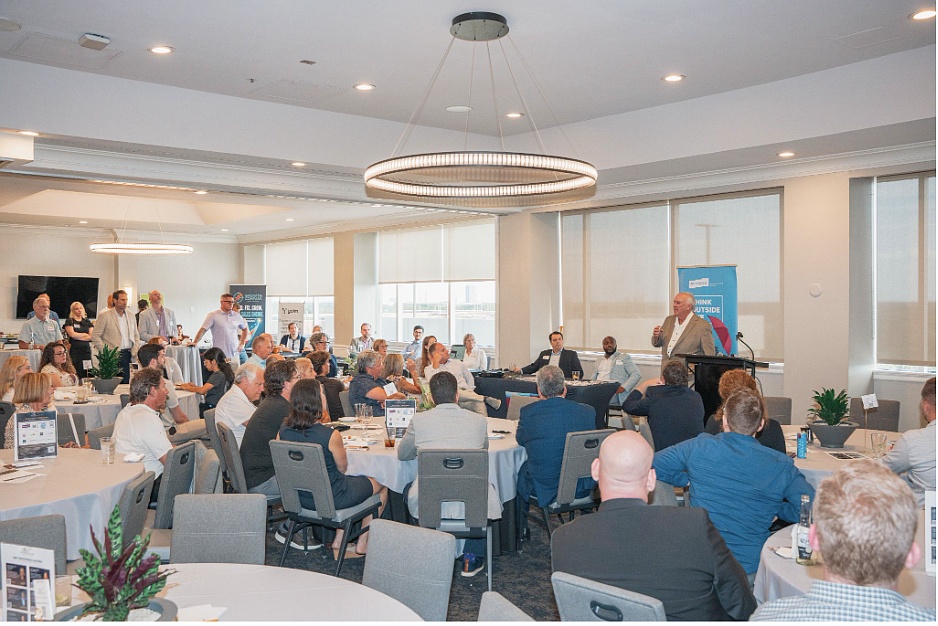
On September 15, 2026, Riley appeared at the inaugural Momentum Partners Exchange gathering at Tampa’s Centre Club. Seventy-four founders, executives, investors, advisers and strategic partners attended. The discussion was unscripted, with an entrepreneur whose career offered plenty of material for questions.
He had left the CEO’s job eight years earlier. He was still in a room with people trying to build something. Advertising, grocery aisles, alcohol invoices and student business plans had supplied different kinds of experience. Here, the useful thing was making that experience available to someone facing a decision of their own.
The students who worked with Fintech had brought skills his company needed. His later education work and founder conversations keep the exchange moving. There is a pleasing economy to it: learn from the people coming through the door, then make yourself available when they have a question.
Continue the conversation
Watch Riley’s 26-minute Suncoast Business Forum interview, explore the Riley Education Foundation’s initiatives, or look inside the listing for Zero to 30 Billion!
The USF partnership / The 2026 founder gathering / Founder Conversations