01 / A pig, a computer, a practical question
Scott Lien sold a pig to buy his first computer. It is a satisfyingly literal account of seed capital: raise an animal, sell it, acquire a machine, see what it can do. On the Iowa dairy farm where he grew up, south of Decorah, a computer had to compete with rather more urgent demands on everyone’s time. One of his early programs helped his father and older brother work out feed rations for the cows. The customers were close by. So were the consequences of getting the calculation wrong.
Lien taught himself to code. At Luther College, where he graduated in 1987, he studied computer science and business. A January Term class with Walter Will introduced a useful discipline: someone supplies the requirements, and the engineer builds a system to meet them. A program could be clever and still fail the person who needed it. That distinction would follow Lien through his career, eventually becoming a family matter.
His mother, Marlys, ran the Once Upon a Time Book Shop in Decorah. She understood customers, inventory and the daily improvisations of running a business. Years later, when everyday technology made her feel inadequate, her son had good reason to question the technology. The bookstore owner had already demonstrated that she could manage complexity. What, exactly, was the phone asking her to manage?
The family photograph that would not arrive
Lien’s corporate career included work at Target, Best Buy and Bank of America, followed by leadership of Intuit’s mobile technology innovation group. He knew the commercial promise of carrying a connected computer around in a pocket. Banking, shopping and correspondence could travel with the customer. The possibilities were considerable. So was the confidence of the people building them.
Meanwhile, Isaac, his son, was studying at Chapman University in California. His grandmothers were in Iowa. He wanted to send pictures, exchange messages and make video calls between visits. Ordinary services kept getting in the way. A family photograph ought to have been a small gift; delivering it had become a project. Scott and Isaac founded GrandPad in 2014, with that very particular audience in mind.
The early work took place through Chapman’s startup incubator, with student programmers including David Tyler and Ryan Burns. Interviews with more than 100 older adults helped the team decide what belonged on the screen. Their answers included privacy, readable instructions and fewer complications. Voice messages could take the place of an awkward onscreen keyboard. A small selection of familiar functions would do the job.
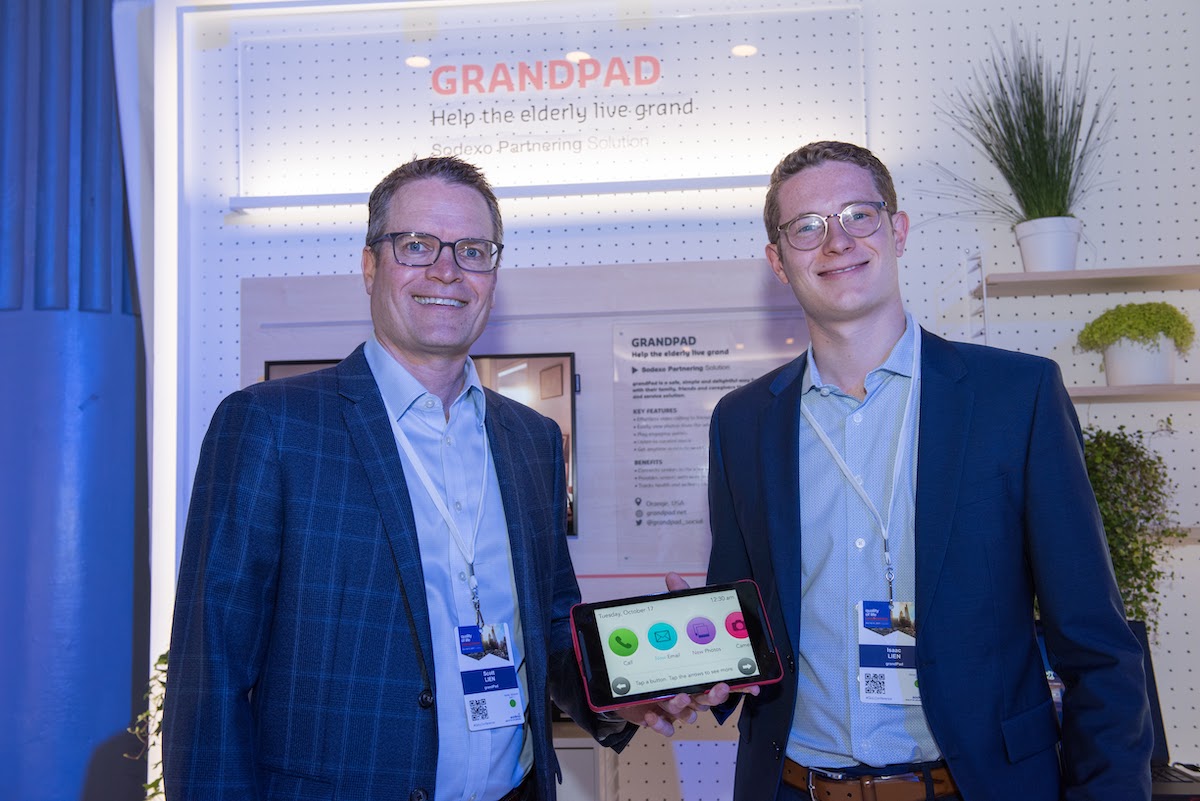
There is something quietly comic about assembling trained technologists to deliver the equivalent of opening an envelope of family snapshots. Yet that is where the interesting engineering begins. The photograph has almost no value while it remains inaccessible. The recipient’s pleasure is the point of the exercise. A successful transfer requires someone at the other end to feel comfortable enough to open it.
An adviser with a longer résumé than yours
GrandPad’s older advisers became a continuing part of development. The company calls them Grand Advisors. They try things, identify obstacles and send the team back to work. Lien has described the process as repeated observation and revision, with advisers well into their eighties, nineties and beyond. He could bring decades of software experience to the discussion. They brought experience of being the people expected to use the software.
He describes a process of asking, watching and working alongside the advisers. The modesty of that approach is useful. It leaves room for the adviser to disagree. It also makes listening sound like a recurring job, rather than a ceremonial visit conducted after all the important decisions have been made.
“We just ask them, and observe, and work with them.”
Scott Lien / on the Grand Advisors
His development brief included a memorable target: a person of 90 should be able to use GrandPad confidently in 90 seconds. Treat that as an ambition for the design, rather than a stopwatch guarantee. It forces a discussion about the whole journey. The box must open. Charging must be straightforward. Controls must behave consistently. A long manual cannot rescue an encounter that has already become discouraging.
The resulting details are pleasantly unglamorous: a broad charging cradle, large icons, a stylus, readable text. There is no glamour department in a charging cradle. But a device that is ready when someone wants to call has fulfilled an obligation. Lien’s early farm software and his later tablet share this practical streak. Each has to justify its existence in another person’s day.
The people who pick up
A product built around communication acquires an awkward obligation when a customer needs help: somebody must communicate back. GrandPad offers human support around the clock. Lien has said the company does not measure call-handling time, that familiar incentive to finish a conversation. If a customer wants to chat, the conversation belongs within the service. The support team also passes suggestions back to product development.
For Lien, hiring became another exercise in looking beyond the obvious pool. By 2023, he and his wife had returned to Wabasha, Minnesota, where they had raised Isaac. GrandPad recruited its customer-service staff from small towns, seeking people comfortable with patience and personal conversation. Lien still interviewed prospective member-experience hires, asking them about an older person who had mattered in their lives.
One employee, Jayne Dick, worked from her Wabasha home after earlier careers in teaching and insurance. Her work could include a technical check, a recipe exchange or a game. In one instance, she held up her phone so a customer could watch a great-nephew’s marimba performance at Carnegie Hall. That is a fairly elaborate route from a service call to a concert. It also makes sense for a company whose product is supposed to make sharing possible.
The employment model brought technology work to places outside the usual recruitment map. It made local relationships useful to a business serving faraway customers. Lien’s own childhood had involved solving problems with the people nearby. Here was a version of that habit conducted over a network, with a payroll attached. The calls were remote; the instinct was familiar.
A family business acquires a world map
In June 2022, Lien received an EY Entrepreneur Of The Year Heartland Award. His response credited the GrandPad team, then numbering more than 160 employees. Awards tend to put one person’s name on the invitation. The product itself provided an inconvenient reminder of how many other people had contributed: a son, student programmers, advisers, engineers and the people answering calls.
By April 2023, GrandPad reported connecting 1.6 million people across 120 countries and having raised $31 million. Those connections included relatives and friends as well as older tablet users. The distinction matters. It describes a family network, with more than one participant benefiting from each device. It should never be read as a count of tablets sold.
The geography had changed enormously since Lien’s childhood. He has recalled three generations of his family living within ten miles of one another. GrandPad’s families could be scattered across countries. Built-in cellular connectivity and an approved circle of contacts were ways to make that distance less demanding. For the person placing a call, the desired result remained disarmingly ordinary: someone familiar answering.
Behind that ordinary moment sits a less visible technical operation. Lien chose cloud infrastructure to support the service and preserve family material if a tablet was lost or damaged. His explanation of the economics was practical: engineers could spend their time improving the product instead of recreating the infrastructure underneath it. The machinery could grow complicated backstage while the customer’s task stayed small.
What he wants to hear next
Lien’s interest in older people extends to what they have to say. Through Living Legends, he interviews people with long lives and substantial stories. In 2025, he described leaving a conversation with World War II veteran Harold Terens feeling energized. Terens had married his sweetheart in Normandy at 100. A business concerned with grandparents’ photographs had found another reason to keep the conversation going.
That June, Lien was in Normandy during a return trip for almost 30 World War II veterans, organized with GrandPad, Delta Air Lines and the Best Defense Foundation. He spoke about the opportunity younger generations had to hear those experiences firsthand. On such a trip, the oldest person in the room may also be the person with the most urgent claim on everyone’s attention.
His public work also includes Safe and Sound, a cybersecurity podcast produced with the Leighton Media Podcast Network. Its episode list continued into September 2026. Helping people participate online includes talking about the hazards they may encounter there. A useful device and a patient explanation are complementary parts of the same undertaking.
There are smaller clues to the person behind these projects. In a 2019 questionnaire, Lien named The Leadership Challenge as a favorite book and Pink Floyd as the musical group of his youth. The combination suits someone willing to discuss both management and the people management overlooks. One imagines the listening equipment has improved since his first computer; the interest in finding out what a machine can do has endured.
His ambitions remain rooted in a simple rearrangement of family life: older relatives should be active participants, able to contribute stories, ask questions and see what everyone is doing. Lien has encouraged younger people to treat their grandparents as mentors. That invitation carries a little more weight from a founder who employs older people as design advisers. He has made room for their judgment in the work itself.
A pig bought him the chance to start programming. His mother gave him a reason to reconsider who the programming was for. Between those two events lies a career in which technical knowledge kept encountering people with practical objections. Lien’s answer was to keep them in the conversation. The computer could wait its turn.
Keep the conversation going
Explore Lien’s work, interviews and the people behind GrandPad.