The first thing GrandPad's founders built was not a senior tablet. It was a series of failed calls. Isaac Lien, then a college student in California, wanted to send family photos and video-chat with his grandmothers in Iowa. Skype was too fussy. Facebook and email were no better. The women were smart; the tools were simply asking them to memorize a dialect invented by younger engineers. Isaac and his father, Scott, stopped trying to teach Grandma the dialect.
That decision became GrandPad, founded in 2014. The Minnesota company makes an all-in-one tablet and phone for people generally 75 and older, wrapped in a recurring service. It has large, consistent controls, a charging cradle, remote family administration, a private circle of approved contacts and optional built-in cellular data. It also has something mass-market electronics companies tend to treat as an expensive afterthought: a person who will help.
Subtraction as product strategy
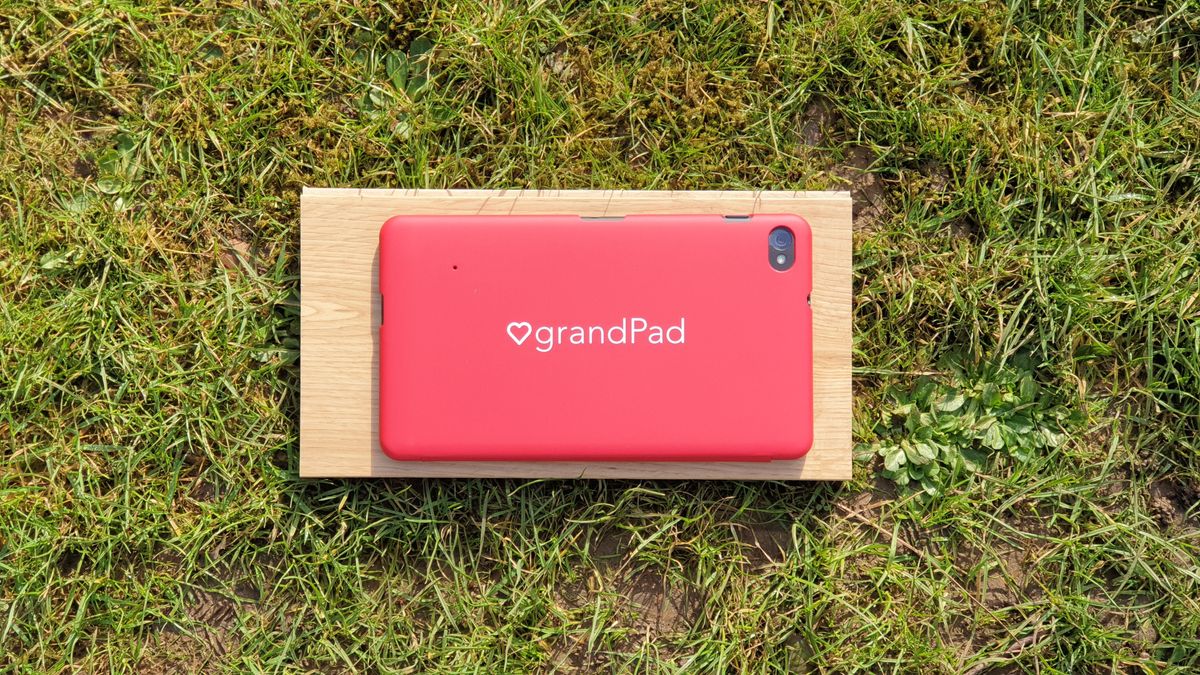
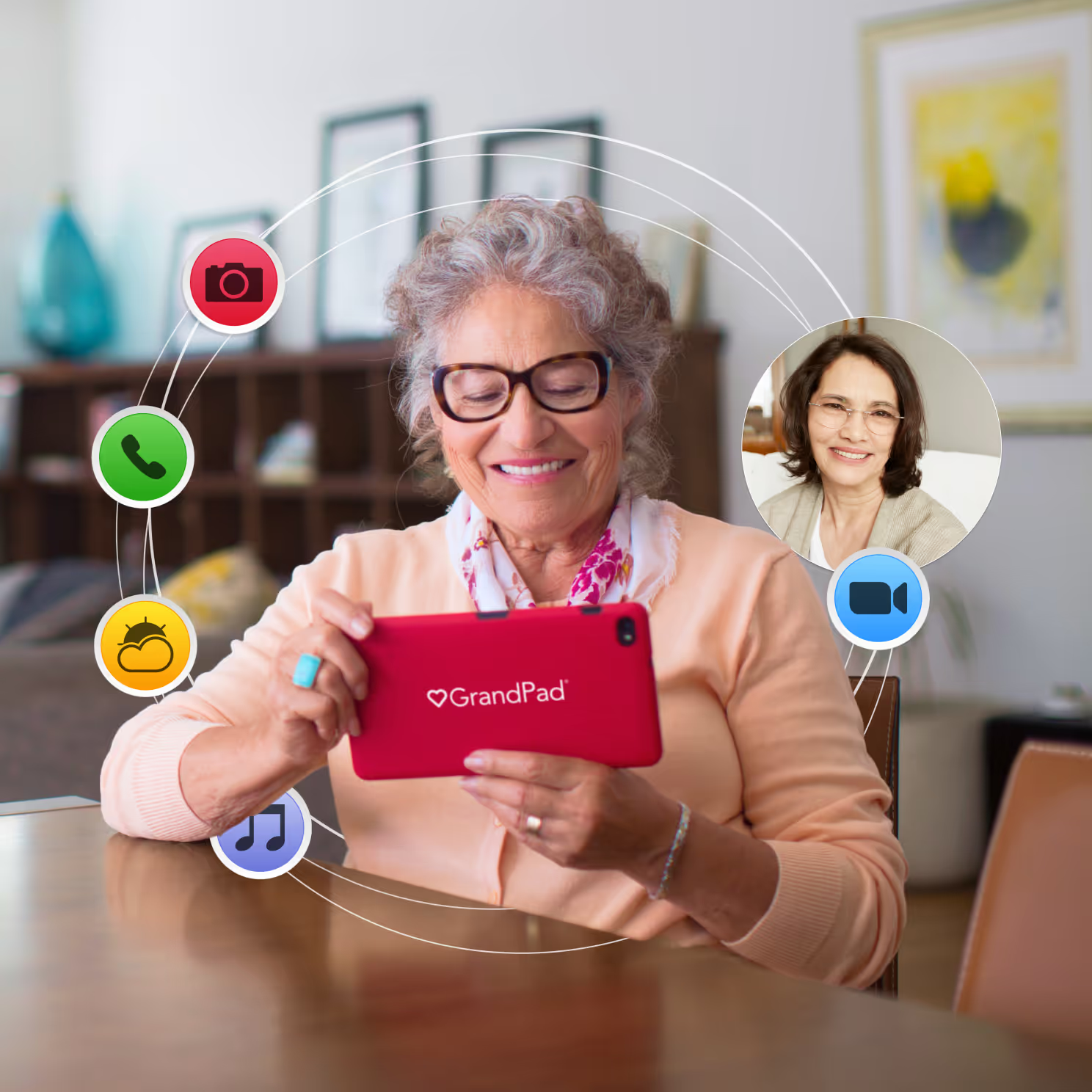
Most consumer technology is sold by addition. More cameras, more apps, more settings, more ways to gesture at glass. GrandPad moved in the other direction. Early prototypes, including one based on a modified Nexus 7, were pared down to calling, photos, messages, weather, games and music. The interface gives instructions on every screen. Unknown people cannot wander into the private family network. Passwords and pop-up ads disappear from the older adult's daily experience.
The details are almost comically specific, which is why they matter. The team learned that older users can have dry fingers, making capacitive touchscreens unreliable, so it adjusted sensitivity and included a stylus. Small tremors make tiny targets punishing, so controls grew and the software tried to infer intent. Tiny charging connectors turned a basic ritual into a dexterity test, so the device rests in a broad charging cradle with a long attached cord. Even the packaging was considered: could a 90-year-old open it without scissors and start using the device within minutes?
“A 90-year-old should be able to confidently use GrandPad in 90 seconds.”GrandPad's 90/90 development philosophy
This is the useful distinction between “simple” and “limited.” Simplicity is not the absence of engineering. Here, it is the result of engineering aimed at physical, cognitive and emotional constraints that ordinary tablets mostly hand back to the customer. GrandPad's Grand Advisors - a panel of older adults, including people in their eighties, nineties and beyond - test and refine the experience. Company leaders have said features do not ship without their approval. The people most product teams interview last get a veto.
A tablet on the surface, a service underneath
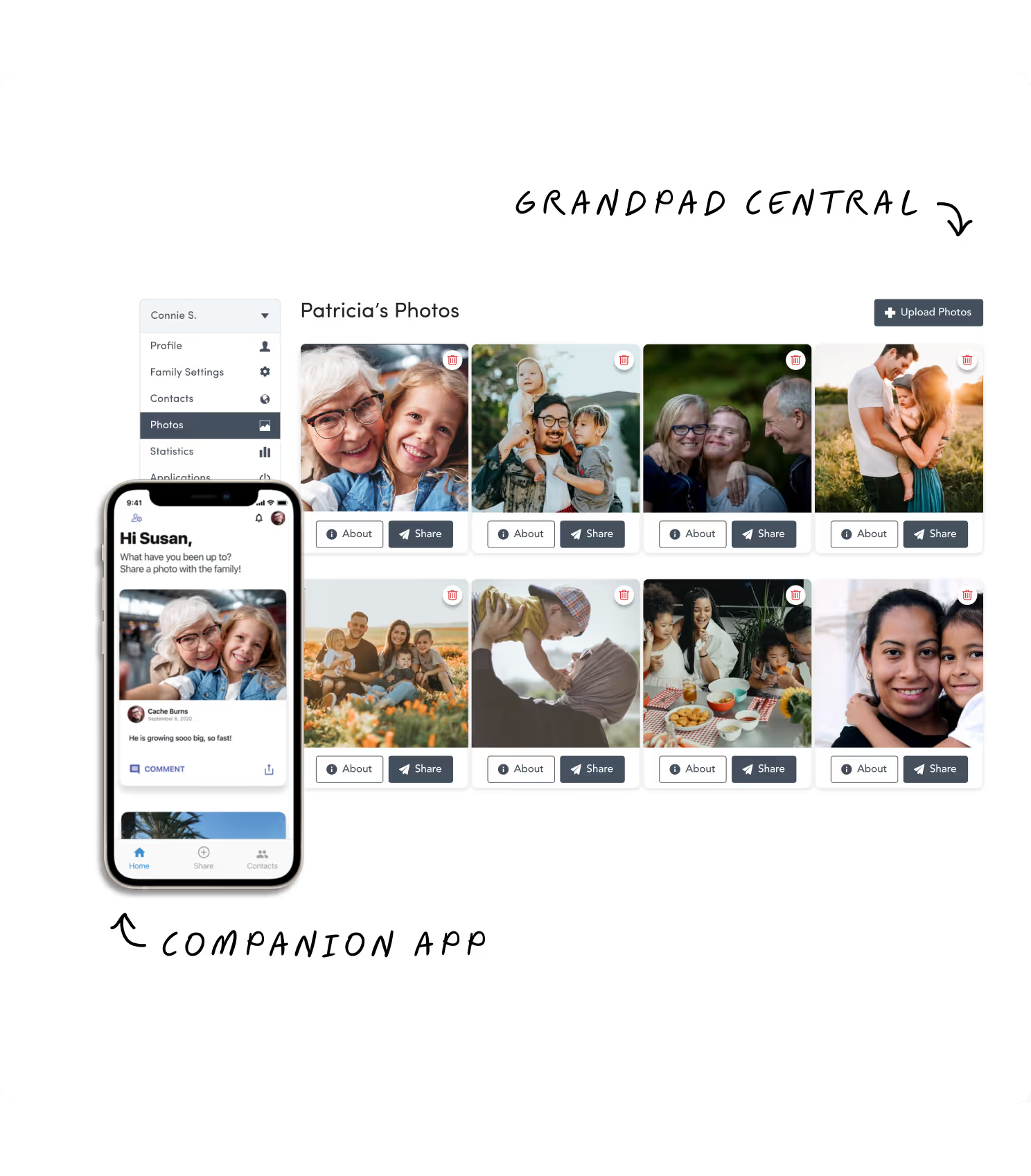
GrandPad serves two connected markets. Families buy the consumer product for a parent or grandparent who wants calls, photos, music, games, news and a safer way to stay in touch. Relatives use the companion app and GrandPad Central to invite trusted contacts, share media and adjust the experience remotely. The older user does not become the household system administrator.
Healthcare providers, payers, PACE programs, home-care groups and libraries buy versions of the same capability for a different reason: many older patients never get through the “digital front door.” A portal that requires broadband, an app download, a fresh password and a one-time code is technically available but practically closed. GrandPad's enterprise platform packages the device, connectivity, secure communication, support, remote management and workflow integrations so care teams can conduct virtual visits, deliver reminders and run wellness checks.
Families + care teams
Share photos, place calls, configure contacts, conduct visits and coordinate follow-up.
GrandPad layer
Purpose-built hardware, private network, LTE, remote controls and human help.
That bundle explains the price. The current store lists the tablet at $349 before promotions. Service runs from a $25 monthly Wi-Fi plan to $45 with 3GB of data and voice calling, then $65 with 10GB, priority care, onboarding and supportive check-ins. There are optional protection and onboarding fees. A spare family iPad can look cheaper because its unpaid setup, troubleshooting and fraud prevention are hiding in somebody else's Sunday afternoon.
The economics also run business-to-business. GrandPad has worked with Kaiser Permanente, UCSF, WelbeHealth, Home Instead and multiple PACE organizations. In March 2020, WelbeHealth moved from an initial call to more than 250 configured devices in under 72 hours. GrandPad staff remotely assigned devices while they were still on FedEx planes, then trained clinicians and helped with local delivery. It is a vivid picture of what the company actually sells: not boxes, but adoption.
That puts GrandPad in a peculiar market position. It is too managed to be a general-purpose tablet, too social to be merely a medical device and too hardware-dependent to be ordinary software-as-a-service. Age-tech is the convenient label, but the company's expertise is really engagement under constraint. It knows how to reach a person who may lack broadband, mistrust unfamiliar calls, struggle with a touchscreen and still very much want to see a new great-grandchild. For care organizations, that competence can make the difference between purchasing access and achieving participation.
The company has also learned to share the interface without surrendering it. Partners can tailor content, care messages and workflows, yet the older adult keeps a familiar visual grammar. That consistency is easy to undervalue. Every custom portal normally creates another place to get lost. GrandPad's bet is that the care plan should enter the trusted environment, not force the patient to learn a new one. Its private network and controlled software can look restrictive beside an iPad, but restriction is doing deliberate work: fewer surprises, fewer strangers and fewer paths into a scam.
The company followed the calls
GrandPad's original problem was family connection. Healthcare became an adjacent market because a device used every day could also become a trusted point for virtual care. During the early pandemic, the company reported 56,000 telehealth visits and 1.7 million video visits over one 90-day stretch. A UCSF home-based primary care study found 82.5 percent of participating patients considered the tablet easy to use, while 78 percent felt more connected.
Then customer behavior uncovered a problem no dashboard needed to translate. Some older members were calling technical support because they wanted someone to talk to. In 2023, GrandPad launched Connections, pairing participating seniors with volunteers for scheduled conversations. The company later reported that 58 percent felt less lonely after 90 days and 83 percent after nine months. Those are company program results, not a universal clinical promise, but the origin is instructive: support calls became customer research with a pulse.
The platform has kept widening. Grandie Chat is a voice-first generative AI companion designed with input from Grand Advisors aged 80 and above. Suggested prompts and spoken interaction reduce the need for typing. Grandie Games takes accessible classics such as checkers, chess and solitaire to a broader mobile audience. In March 2025, GrandPad said the app had passed 10,000 downloads in three months, with people favoring multiplayer play over solo play. The through-line is not AI or gaming. It is a reason to come back tomorrow.
The thing builders can steal
GrandPad's moat is not a red Android tablet. Competitors range from configured iPads and Amazon smart displays to Claris Companion, Lively, simplified memory phones and Consumer Cellular's ConnectPad. Hardware can be copied. The harder asset is a decade of observing the moments mainstream product teams dismiss as user error, then owning the service work required to remove them.
Borrow the method, not the tablet
- Recruit the customers who struggle most and give them power to reject features.
- Map every point where the user feels confused, ashamed or dependent.
- Treat packaging, setup, connectivity and support as product surfaces.
- Remove choices before adding tutorials.
- Watch off-script behavior. The “wrong” support call may reveal the next product.
This method works best when the customer has a recurring, important job and mainstream tools impose genuine barriers. It also helps when a second buyer - an adult child, insurer or care organization - values reduced support burden and higher engagement. GrandPad can charge a subscription because connectivity, safety and assistance continue after the box arrives.
When the model does not fit
GrandPad is less compelling for a tech-confident older adult who wants an open app store, advanced computing or the lowest monthly bill. Cellular plans still depend on coverage. A restricted contact network trades openness for safety, which will frustrate users who prize flexibility. And an organization that buys devices without staffing onboarding, workflow change and follow-up can still produce a drawer full of expensive rectangles.
That last condition is the point. GrandPad did not win its niche by declaring older adults incapable. It noticed that the rest of the industry had normalized a stack of tiny indignities - forgotten passwords, missed taps, suspicious pop-ups, dead batteries, family members saying “just click the thing” - and called them features of modern life. The Liens changed their minds first: the user did not need fixing. The product did.
Explore GrandPad
Company pages, social profiles and product demonstrations.