The first SciAps sales pitch was hiding inside a piece of aerospace aluminum. The alloy contained 1 to 2 percent lithium, a light element that a handheld X-ray fluorescence analyzer could not measure. Don Sackett and Dave Day had spent years around portable scientific instruments. In early 2013, with future CFO Gary Lortie, they bought equipment, ran tests and asked a blunt question: could a laser read what the X-ray gun missed, without sending the sample away?
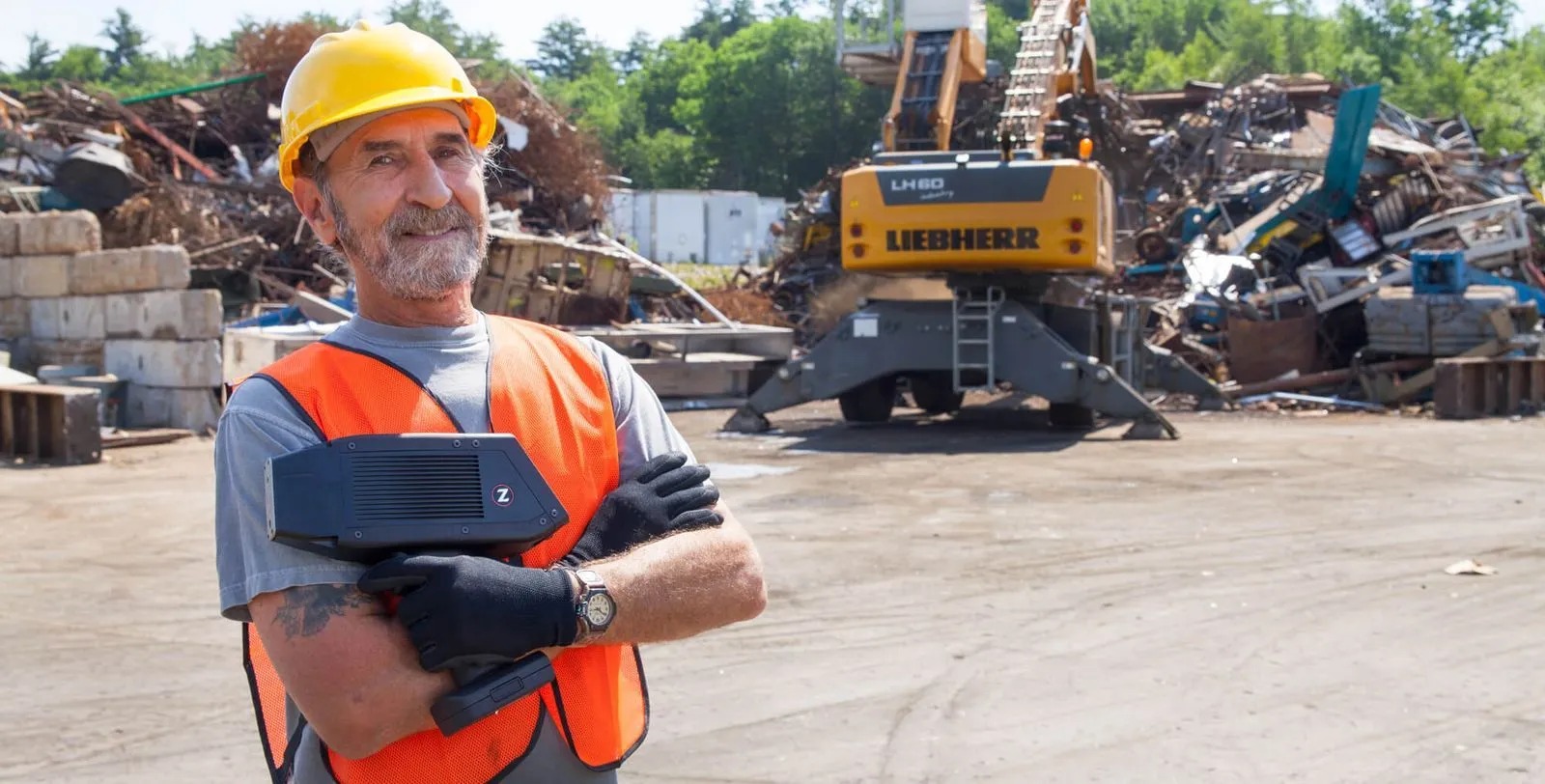
That question became a company. SciAps, founded outside Boston, builds instruments that look like unusually serious cordless drills. Point one at a steel pipe, rock core, pile of scrap, painted wall or spice sample and it can report the material's elemental composition in seconds. The point is not the gun shape. It is that the operator gets an answer while the object, the decision and often the expensive machinery are still in the same place.
A blind spot with a business model
Portable XRF was already established. It excites a sample with X-rays and reads the fluorescent signal, a fast and non-destructive way to identify many transition and heavy elements. It is useful for sorting alloys, screening soil and checking precious metals. But physics gives it weak spots. Light elements such as lithium, beryllium and carbon are difficult or impossible for a typical handheld XRF to measure.
SciAps began with laser-induced breakdown spectroscopy, or LIBS. A focused pulse creates a tiny plasma on the sample. The colors emitted as that plasma cools reveal which elements are there. The founders' bet was that newer lasers, spectrometers and processors finally made a high-precision handheld practical. Carbon mattered to refineries and fabricators verifying steel. Lithium mattered to aerospace and, soon, battery exploration. Beryllium mattered to environmental teams. One technical gap opened several markets.
Two ways to ask matter what it is
LASER + PLASMA
Reaches light elements including Li, Be and C
Can perform microanalysis
X-RAY + FLUORESCENCE
Strong on transition and heavy metals
Fast, non-destructive bulk screening
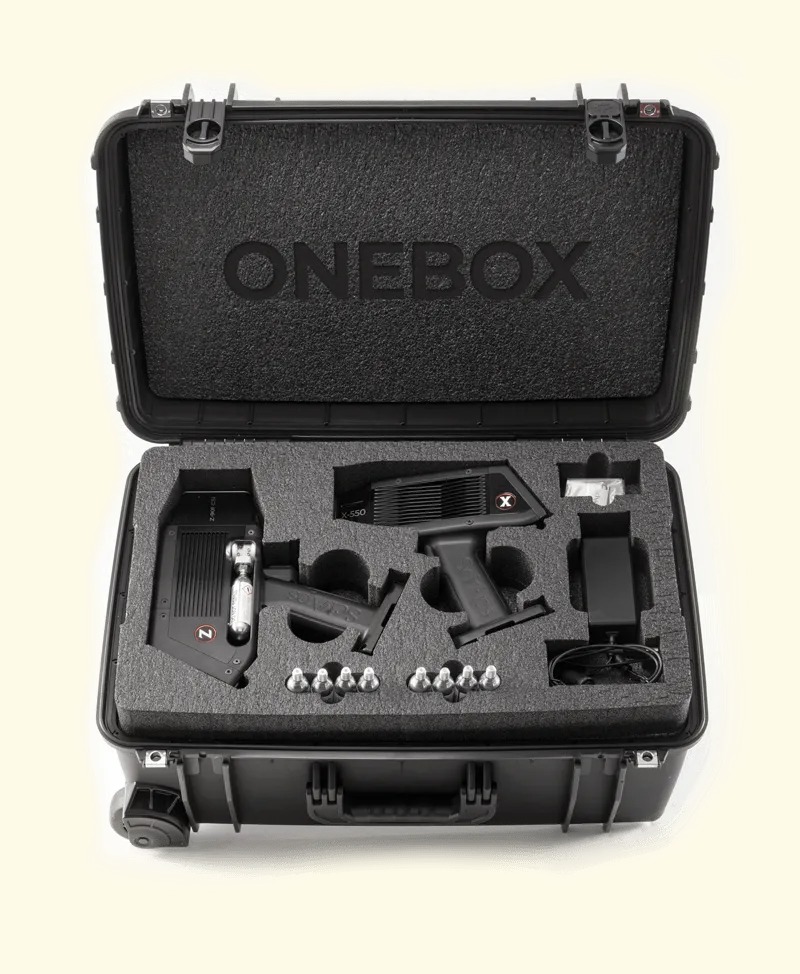
The useful twist is that SciAps did not force a technology religion. LIBS and XRF are complements. The company's OneBox puts a Z-Series LIBS unit and an X-Series XRF unit in the same case, on the same Android-based interface, with common batteries and accessories. If a scrap processor needs fast heavy-metal sorting and accurate aluminum work, the operator can switch tools without learning an entirely new system.
“Can you measure this material?”Don Sackett's enduring product question
The product is a decision, not a spectrum
The catalog now sprawls across jobs that share a need for immediate answers. X-Series models identify alloys, value catalytic converters, inspect lead paint, screen restricted substances and analyze ores. Z-Series models target carbon in steel, lithium in rock and broader research applications. The Z-903 stretches across three spectrometers from 190 to 950 nanometers. PowerHouse X moves toward the benchtop with a battery-powered, shielded 80 kV XRF system for difficult rare-earth measurements. reveNIR and the later FieldSpec, TerraSpec and LabSpec lines add visible and near-infrared mineral identification.
Customers are less interested in spectral range than in what happens next. A scrapyard can price and sort metal while it is on the scale. A refinery inspector can check carbon and carbon equivalent before the wrong pipe enters service. A geologist can change a drilling plan before the samples reach a distant lab. A lead inspector can test painted surfaces without owning and disposing of a decaying radioactive isotope. In Ethiopia, a nonprofit used an X-550 to screen more than 200 spice samples for added lead, then sent a subset to a lab for confirmation. The handheld narrowed the question while the study was still under way.
This is also where the limitations matter. A field reading is not automatically a laboratory certificate. Moisture, surface condition, sample heterogeneity, calibration and operator technique can affect results. Some methods demand lower detection limits, elaborate preparation or a prescribed lab confirmation. SciAps works when speed at the sample changes the next action. It is a weaker fit when nothing important happens before a definitive laboratory result arrives.
What it cost - and what the buyer saw
In July 2024, British precision-instrument group Spectris agreed to acquire SciAps. The price was $200 million in cash up front, with up to $60 million more tied to agreed financial metrics. The transaction closed in August and SciAps joined Malvern Panalytical inside Spectris Scientific. This was not a mystery multiple attached to a pre-revenue science project. At announcement, Spectris expected SciAps to produce about $70 million in 2024 sales and $12.1 million in adjusted EBITDA after more than 30 percent compound annual sales growth over five years.
The acquisition, divided
Spectris saw a portfolio fit. Malvern Panalytical was strong in laboratory and benchtop analysis; SciAps lived beside the sample. Together they could cover the path from field screening to deeper lab characterization, cross-sell into mining, recycling, batteries, agriculture and manufacturing, and feed more measurements into a digital system. Spectris estimated about $6 million in synergies. The buyer was purchasing distribution and data possibilities as much as a clever laser.
SciAps had financed the climb before the sale. A 2021 amended SEC filing reported $4.49 million sold to six investors in a debt-and-warrants offering that began in April 2020, against a planned $5.37 million. The company also built recurring touchpoints around the instruments: calibration, repair, firmware and software updates, training, accessories and fleet data. Rentals through Pine Environmental let customers buy access by the day, week or month rather than owning a specialized analyzer outright.
What failed first?
There is no public founder tale of a flaming prototype or near-death pivot. The documented failure was more useful: the incumbent measurement and workflow failed first. XRF could not read the lithium in that aerospace alloy. Central labs could deliver stronger answers, but only after collection, labeling, shipping, queueing and analysis. Large instrumentation companies could improve existing products, yet Sackett and Day believed they had less room to build the distinct handheld they wanted.
What changed their minds was not a motivational epiphany. It was an experiment. The three founders met several times, bought equipment and tested whether available technology could support a portable LIBS analyzer. The lithium result supplied a concrete application. Their previous careers supplied distribution knowledge, manufacturing discipline and a list of product shortcomings. They did not begin with “all industries.” They began with a measurement that a known customer could not make.
That experience still shows in the design. SciAps makes its own lasers and spectrometers, which it says lets technicians repair at component level. The Z-Series uses laser rastering across multiple positions to average an uneven sample. An onboard argon purge boosts certain signals. Automatic calibration reduces the ritual of carrying check samples. Android supplies a familiar interface, Wi-Fi, Bluetooth and GPS. Cloud+ addresses the decidedly unscientific problem of valuable analyzer data dying on a USB stick.
The part worth stealing
- Start with the blind spot in a tool customers already understand and budget for.
- Prove the wedge on a real sample, not a generic technical demonstration.
- Build around the whole field job: calibration, batteries, reporting, repair and training.
- Let complementary technologies share a workflow instead of pretending one replaces everything.
- Own components that improve service economics and protect application know-how.
A market between the lab and the guess
SciAps competes with serious incumbents: Thermo Fisher's Niton analyzers, Evident's Vanta line, Bruker's S1 TITAN and Hitachi's X-MET8000. All sell versions of portability, ruggedness, speed and connectivity. SciAps' sharper position is breadth across handheld LIBS, XRF and NIR, plus application work for the awkward elements and field cases that sit outside a standard alloy-identification pitch.
Its customers sit in markets where a small analytical mistake can create a large operational bill. Misidentified alloy can compromise a component. Mispriced catalytic material can erase margin. A missed pathfinder element can redirect exploration. A false lead-paint result can disrupt a family or a project. The analyzers are expensive industrial equipment, not consumer gadgets; competing vendor guidance places handheld XRF broadly around $14,000 to $40,000 depending on configuration. The calculation is therefore about avoided delay, lab spend, downtime and error.
It works when...
- An answer changes an immediate field decision
- Teams test many samples or assets
- A calibrated screening result is sufficient
- Portability saves shipping or downtime
It does not when...
- A prescribed laboratory method is mandatory
- Detection limits exceed handheld capability
- Samples need extensive preparation
- Users cannot maintain calibration or training
The company has kept an unusually playful public face for a spectroscopy manufacturer. It backed recycling education, put the Recycled Materials Association on a NASCAR Xfinity car and connected sorting speed to racing. Behind the color is a sober commercial instinct: go where users already gather, teach the application and make a technical instrument memorable. The new Andover headquarters separates floors for research, service, manufacturing and sales, but the culture the company advertises is still field-led and responsive.
The acquisition did not end the product story. In 2025 SciAps took on the established ASD FieldSpec, TerraSpec and LabSpec spectroradiometers. Integration with Malvern Panalytical and Micromeritics expands the bridge from quick field identification to particle and laboratory analysis. Cloud+ pushes in the other direction, toward fleets, automatic backup and reporting. The gun remains the visible object; the widening business is the workflow around every trigger pull.
SciAps' most copyable lesson is also the least cinematic. Deep technology became valuable because the founders kept translating spectra into jobs. Carbon became safer material verification. Lithium became faster exploration. Lead became an on-site inspection. The reader does not need to build a laser. Find the expensive wait, the measurement the standard tool misses and the moment when an answer changes what someone does next. That is where a narrow technical capability starts behaving like a company.