- EVOLOH sells AEM electrolyzer stacks in standardized 3 MW and 12 MW modules.
- Its edge is systems-level simplicity: abundant materials, roll-to-roll production, ordinary power hardware and container shipping.
- The promise is still being proved: 0.5 MW is validated, 5+ MW is contracted, and a 2.5 MW 3M pilot is planned for 2027.
There is a revealing sentence on EVOLOH’s product page: “We sell stacks.” Four words, none of them dressed for a climate conference. The stack is the tightly layered heart of an electrolyzer, the place where electricity persuades water to become hydrogen and oxygen. Most customers do not want to admire it. They want it to arrive on time, fit through the gate, connect without a small army of specialists and keep running after the ribbon-cutting photographs are gone.
That is the company’s wager. Founded in 2020 by hydrogen researcher and former climate-tech investor Jimmy Rojas, EVOLOH is not presenting another hand-built scientific instrument. It is trying to turn electrolysis into manufactured hardware: repeatable, shippable and replaceable. Its Nautilus platform uses anion-exchange-membrane chemistry, or AEM, and avoids precious-metal catalysts, rare-earth materials, PFAS and caustic liquid electrolytes. The shopping list sounds almost disappointingly normal - steel, plastic, aluminum, carbon. Disappointment, in supply-chain planning, can be a virtue.
The clever bit is the factory
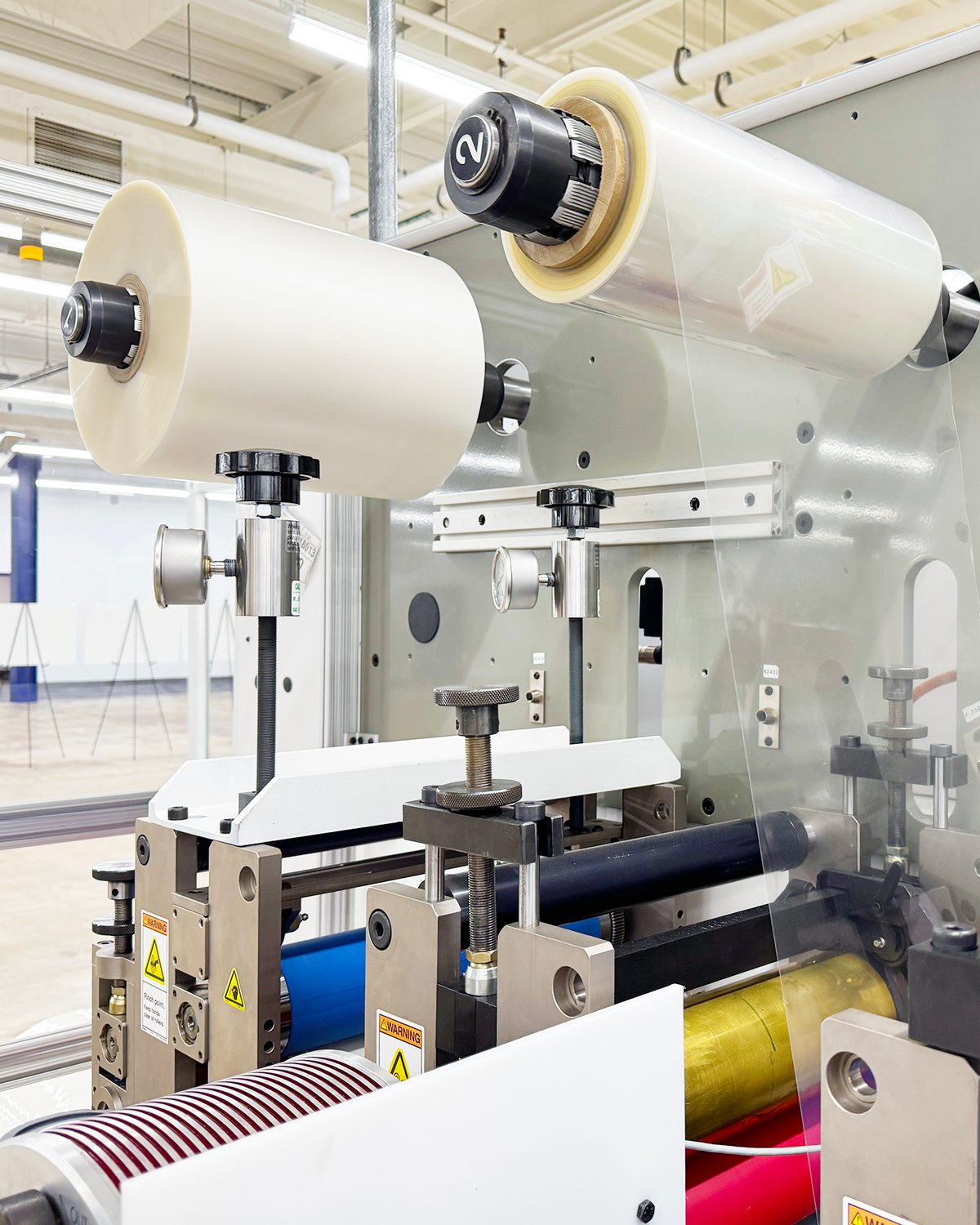
Electrolyzer companies usually lead with chemistry. EVOLOH leads, increasingly, with throughput. The membranes and electrodes are designed for roll-to-roll processing, the continuous method used to print labels, coat battery films and manufacture sheets of solar material. A roll unwinds, a functional layer is applied, and another roll collects the result. The attraction is not romantic. Continuous production can replace a sequence of slow, discrete operations.
A SoCalGas-supported research program gives this claim more substance than the usual factory animation. Its public report identified coating as a major manufacturing bottleneck. The project developed catalyst inks, demonstrated intermediate-speed coating and validated cells and stacks made by the process. When the work concluded in 2024, SoCalGas reported a 15 percent increase in hydrogen-production efficiency and estimated that the improvements could cut electrolyzer capital cost by roughly 25 percent.
The bars compare the two percentages, not absolute system performance. The capital-cost figure is an estimate from the joint research announcement.
A cheap stack can still make an expensive plant
This is where EVOLOH’s pitch becomes more interesting than its membrane. A hydrogen project pays for everything around the stack: pumps, water treatment, compression, piping, power conversion, civil work, controls, maintenance and financing. The company says its high-voltage, low-current design can use standard power electronics. For off-grid projects, its Direct-to-DC architecture is designed to connect straight to an on-site DC source, respond to intermittent renewable output and avoid inverters, transformers and rectifiers.
“We sell stacks.” The useful subtext is: the customer buys fewer complications.EVOLOH product positioning
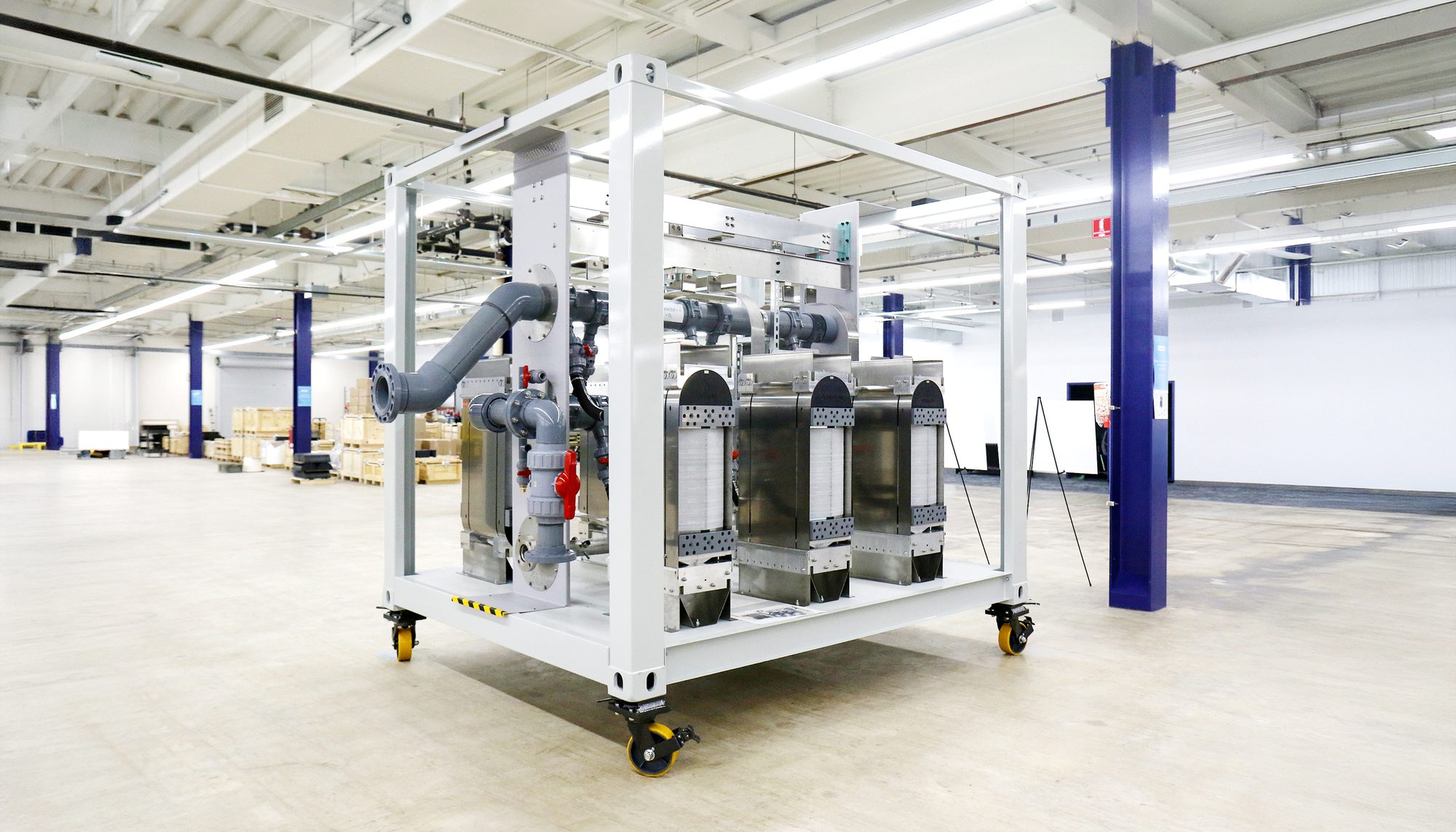
Its modules make the same argument in physical form. A 3 MW unit fits a 10-foot container; a 12 MW unit fits a 40-foot container. Both are meant to travel through ordinary freight channels and to be swapped with standard industrial equipment. An insurance-backed long-term service agreement adds remote diagnostics, scheduled maintenance and stack replacement. This is what industrial buyers actually purchase: an expected cost per operating hour, not an elegant cross-section.
The gigawatts came before the megawatts
EVOLOH’s first public scale story was enormous. In 2024 it said a Lowell, Massachusetts, manufacturing center would target 3.75 GW of annual stack production by 2025 and 15 GW by 2027. It announced a half-gigawatt supply agreement with an unnamed American renewable developer, supported by a non-refundable deposit but conditional on completion of that factory. The company also said it had signed more than 16 GW of supply intent.
Then the calendar did what calendars do to hardware plans. By November 2025, EVOLOH was announcing successful megawatt-scale testing and the beginning of commercial manufacturing. Its current website foregrounds a validated 0.5 MW standard stack and more than 5 MW contracted for 2026. The old factory ambition has not vanished, but the evidence has become smaller, nearer and easier to inspect.
The schedule, not the underlying manufacturing thesis. The original 3.75 GW-by-2025 goal ran ahead of demonstrated commercial output. EVOLOH’s answer was to lead with tested stacks, initial deliveries and named field projects.
The most useful of those projects is with 3M. The materials company invested in EVOLOH’s $20 million Series A, supplies sealing materials for the stacks and plans to host a 2.5 MW S440 system at one of its factories in 2027, subject to approvals. The companies intend to operate it jointly and collect live performance data. That is a better test than a glossy target: a demanding plant, an actual emissions-reduction use and an investor that is also supplier, host and customer-side witness.
Who needs this machine?
EVOLOH is selling to businesses that already understand the inconvenience of hydrogen: industrial-gas and ammonia producers, chemical and fuels plants, warehouse and fleet operators, utilities, renewable developers, EPCs and system integrators. For a plant that consumes hydrogen on site, local production can replace truck deliveries. For a solar developer, a behind-the-meter electrolyzer may turn curtailed electricity into a saleable chemical without waiting through a grid interconnection queue.
It will not pencil out everywhere. Cheap equipment cannot rescue expensive electricity, a distant buyer, low utilization, scarce water or hostile permitting. Direct-to-DC is most attractive where a project controls its generation and can tolerate variable output. A factory with a steady hydrogen requirement may instead prefer a grid-connected system and value predictable uptime over clever intermittency. The technology must also prove durability outside test stands; AEM’s commercial record is younger than conventional alkaline electrolysis.
Competitors approach those trade-offs from several directions. Enapter also sells modular AEM systems. Verdagy pursues large-scale membrane electrolysis. Nel, Plug Power, thyssenkrupp nucera, ITM Power, Cummins and Siemens Energy bring various alkaline and PEM systems, manufacturing footprints and service networks. EVOLOH’s distinction is not simply AEM. It is the combined package: common materials, continuous manufacturing, a compact high-voltage stack, simpler power integration, standard freight and planned rapid replacement.
What another hardware company can copy
- Design the product around the production process, not after it.
- Count installation, power conditioning and maintenance as product costs.
- Use ordinary logistics as a design constraint.
- Turn replacement speed and monitoring into part of the commercial offer.
The ordinary-machine test
The green-hydrogen industry loves one-dollar-per-kilogram forecasts. EVOLOH once used that number too; it now says its system creates a path below $1.50 without incentives and advertises a “proven” full-system capital cost of $600 per kilowatt. Those are company claims, not public purchase prices. The actual invoice will depend on electricity, utilization, installation, financing, service and the balance of plant.
The better question is almost boring. Can the module arrive by normal truck? Can technicians connect it to familiar equipment? Can it follow a solar field without expensive electrical furniture? Can a worn stack be changed in hours? Can it survive long enough for the spreadsheet to remain true? If EVOLOH can answer those questions inside the 3M plant, the company will have done something more valuable than making hydrogen exciting. It will have made the machinery routine.