The consequential question in Don Sackett’s career is not dressed in a lab coat. It arrives from a customer holding an inconvenient piece of material in an inconvenient place: can you measure this? The sample might be alloy scrap, mineral-bearing rock, steel waiting to be welded, or brine that may contain commercially interesting lithium. The setting may be noisy, dirty, remote, and impatient. The answer is needed here, while a decision can still be made.
Sackett, a nuclear physicist by training, found his work in the distance between that question and a useful answer. He has spent more than three decades collapsing the distance. His companies make instruments that move elemental analysis out of the central laboratory and into a person’s hand. The science is elaborate. The user experience is closer to point, test, know.
The physicist leaves the building
After earning his doctorate in nuclear physics at Michigan State University, Sackett joined Niton, an early developer of handheld X-ray fluorescence analyzers. XRF identifies elements by exciting a sample with X-rays and reading the fluorescent signal it gives back. It is a conversation with matter, though matter is not known for small talk.
Nine years in the young industry gave him something no textbook could supply: a catalog of field frustrations. At customer sites, he learned how instruments were actually carried, aimed, calibrated, and occasionally asked to do jobs their designers had not imagined. Product development became less a procession of specifications than a set of commercial riddles. Could a tool be modified to make one difficult measurement? How much would that cost? Would the same need appear in ten more yards, factories, or mines?
“Can you measure this material?” was the puzzle that kept opening markets.Don Sackett on the attraction of portable instrumentation
In 2001, Sackett co-founded Innov-X Systems. The company developed portable XRF instruments, including an analyzer that used an X-ray tube rather than a radioactive source. By 2009, Innov-X reported $40 million in annual sales. Olympus acquired all of the company in July 2010 and kept its management and employees in place. Sackett had helped turn the field notes into a business, then seen what a larger industrial owner valued in it.
Starting again, with a missing element
A sale can be an ending, a holiday, or a provocation. Sackett chose provocation. Existing handheld XRF tools were good at many jobs, but certain light elements remained difficult or impossible to measure at useful concentrations. Carbon in steel was a particularly stubborn gap. A portable device that could read it accurately would matter to manufacturers, fabricators, refineries, and anyone responsible for confirming that the right alloy was in the right place.
The alternative was laser-induced breakdown spectroscopy, mercifully shortened to LIBS. A laser fires at the sample, creates a tiny plasma, and the instrument reads the light emitted by the elements inside it. Laboratory systems existed. The audacious part was making the method genuinely handheld while covering a broad spectral range.
Sackett met with David Day, an instrumentation veteran who became SciAps’ chief technology officer. They bought equipment, ran tests, and worked through the feasibility in early 2013. Gary Lortie, who had been Innov-X’s finance chief before its sale, joined as SciAps’ third co-founder and CFO. Sackett once described the division with cheerful candor: Lortie handled finance, HR, operations, and administration - the things Day and Sackett did not want to do. A founding team is often an argument about ambition. This one was also an agreement about chores.
SciAps’ proposed mission was immodestly comprehensive: any element, any compound, any mineral, anywhere on the planet. Yet the route to it was admirably specific. Build the analyzer. Put it in the field. Listen when customers use it in ways you did not predict. One customer might be sorting aluminum. Another might be verifying carbon before a weld. Researchers later used the instruments for food authentication. Each application made the slogan a little less theoretical.
In 2016, SciAps introduced its first handheld LIBS analyzer with carbon measurement as an initial manufacturing focus. The product did not abolish the laboratory. It changed which questions deserved the trip back to one. A fast answer in the field could guide sorting, safety checks, exploration, or quality control; the expensive centralized work could be reserved for what truly needed it.
The value of arriving with the sample
By 2024, SciAps sold handheld XRF and LIBS tools into mining, metal recycling, aerospace, batteries, manufacturing, food, agriculture, and other markets. Spectris, the London-listed precision-measurement group, saw a portable complement to Malvern Panalytical’s laboratory and benchtop instruments. It agreed to pay $200 million up front for SciAps, with as much as $60 million more due if the business met agreed financial targets.
The disclosed numbers made the strategic point unusually legible. SciAps was expected to produce $70 million in 2024 sales, after a historic five-year compound annual growth rate above 30 percent. The buyer wanted not only a pair of technologies but proximity: measurements closer to the sample, answers closer to the decision, and more field data feeding a larger digital system.
Sackett’s own role had always straddled the technical and commercial. At SciAps, he led distribution and marketing while helping decide what products should do. His fascination was the intersection - physics and chemistry meeting mathematics, then all three meeting a purchase order. The pattern complicates the familiar mythology of the scientist-founder. He did not emerge from the lab carrying a pristine invention in search of a market. He kept returning from the market with scuffed-up instructions for the lab.
A marketing experiment at 180 miles per hour
Then there are the race cars. SciAps began sponsoring NASCAR programs, eventually putting its name on the SciAps 200 at New Hampshire Motor Speedway. At the 2024 race, Sackett stood before the crowd and delivered the command to start the engines. A photograph catches him mid-syllable, microphone in hand, one arm extended, the giant race logo behind him. It is difficult to imagine a more complete departure from the hush of a physics department.
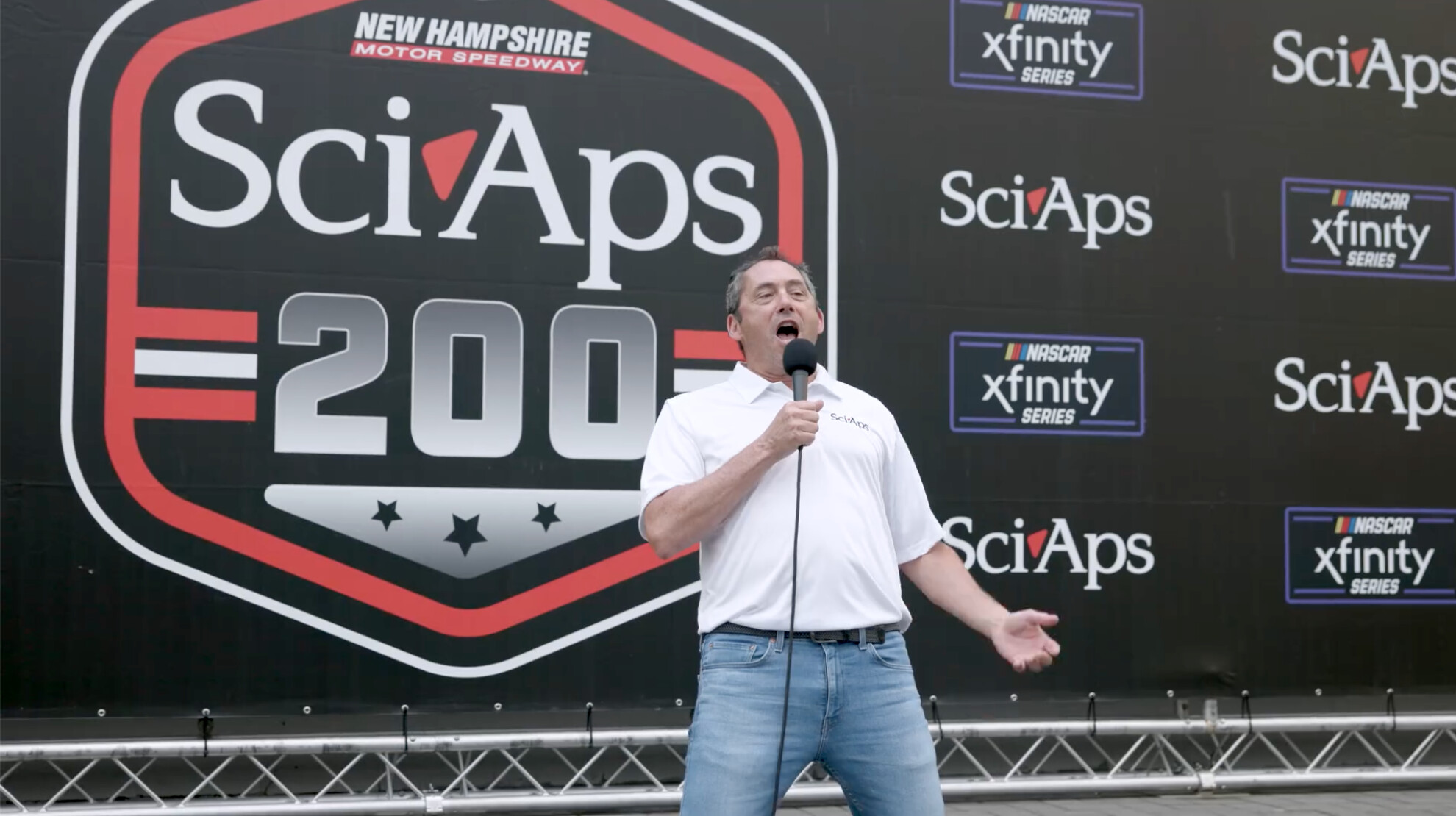
The connection is not as strange as it first appears. Scrap recycling is an important SciAps market, and race sponsorship gave the company a vivid way to reach industrial customers. During the 2024 weekend, SciAps and partners collected recyclable aluminum cans, with proceeds benefiting a local school. Drivers demonstrated an analyzer. The sponsorship was hospitality, demonstration, community project, and brand theater sharing the same asphalt.
On a scrap-industry podcast, Sackett described marketing as an art as much as a science - trying different avenues, seeing what resonates, and admitting when an idea does not work. This is the experimental method without the white coat. A technical founder may crave a clean attribution model. Sackett sounds more willing to place the bet, observe the crowd, and inspect the result.
The bet expanded. After years as a sponsor, he wanted greater impact. A 2024 trial fielding the No. 38 car developed into Viking Motorsports, an independent NASCAR Xfinity Series team based in the Charlotte racing hub. Matt DiBenedetto returned as driver as the operation changed manufacturers, crew chiefs, and car numbers. Sackett’s name appeared again at a frontier where performance is measured constantly and improvement happens in public.
The line from spectroscopy to stock cars is useful speed: measure sooner, decide sooner, adjust sooner.Two laboratories, one operating instinct
What a founder can steal
The obvious lesson in Sackett’s career is to listen to customers. The useful version is narrower. Listen for the request that is both annoying and repeatable. An awkward sample can be a market signal. A measurement that fails in the field can be a product brief. But science alone does not make the answer commercial. Sackett’s questions always included cost, demand, distribution, and the customer’s actual working conditions.
A second lesson lives in the architecture of the founding team. Day owned deep technical work. Lortie took on finance and operations. Sackett worked the seam between product, customer, distribution, and promotion. Their roles overlapped enough to share conviction but differed enough to keep important work from becoming orphaned. Even the joke about chores contains an org chart.
The third lesson is theatrical. Serious B2B companies can become visually anonymous: another booth, another blue logo, another claim about precision. Sackett’s motorsports program gave SciAps motion, noise, and a place for customers to gather. The analyzer still had to work. The car gave people a reason to look.
Sackett has now built, sold, rebuilt, and sold again while remaining close to the operating work. The instruments became smaller; the range of applications became wider. The marketing became louder; the product question stayed plain. Somewhere, someone is holding a material and wondering what it is. Don Sackett’s business has been arriving before the sample leaves.