The beam in brief
- Lyncean replaced a long magnetic undulator with a laser pulse, shrinking the electron ring to laboratory scale.
- Its first commercial machine began operating in Munich in 2015 and supported years of biomedical and materials research.
- A complete Munich-like facility was estimated at €12 million to €18 million - expensive, but a fraction of a major synchrotron.
- The company later won a €49 million gamma-ray contract. Romanian records say financial trouble surfaced in 2022 and the contract ended after bankruptcy.
The remarkable thing about Lyncean Technologies is not that it tried to make a synchrotron small. Engineers have been making grand machines smaller since the first mainframe met the first microprocessor. The remarkable thing is that Lyncean's small synchrotron actually worked. It crossed an awkward gap in X-ray science: too capable for an ordinary laboratory tube, too modest for the national facilities whose beam time is rationed like a very expensive campsite.
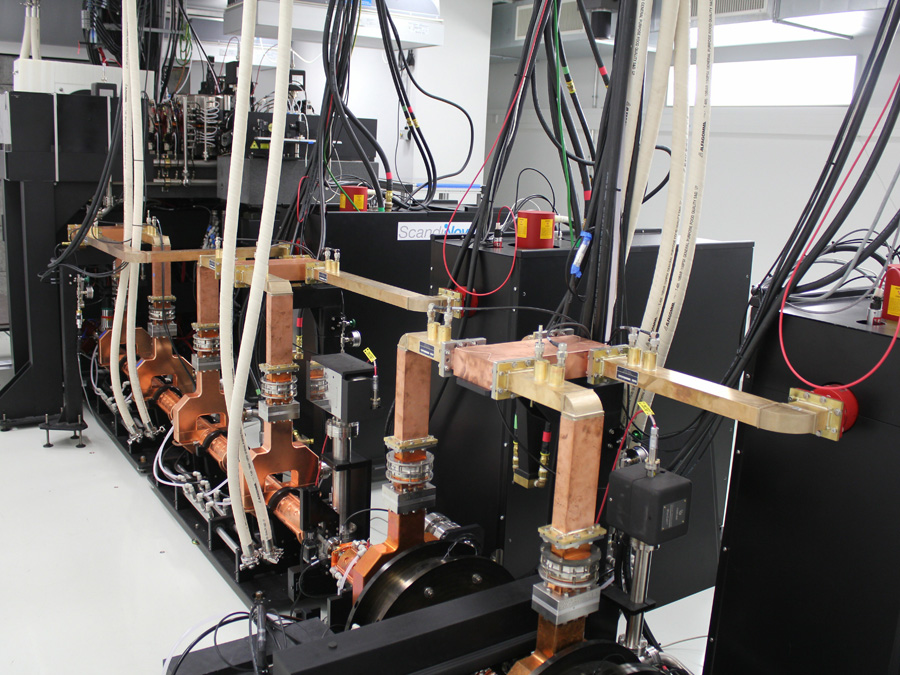
In March 2015, inside a purpose-built room at the Technical University of Munich, a bunch of electrons began circling a ring only 4.6 meters around. An infrared laser pulse ran the other way. The two met nearly 65 million times each second. On March 27 - Wilhelm Röntgen's birthday, an engineer's idea of a joke - the machine produced its first X-rays.
Two weeks later it was operating. The machine had been designed and built by a small company in California. It would go on to image soft tissue, watch contrast agent move through tiny vessels, study catalysts and perform diffraction experiments. Lyncean had turned a Stanford and SLAC idea into the first commercially sold compact synchrotron.
The trick was to replace the long part
A normal synchrotron persuades fast electrons to wiggle through a long row of magnets. That oscillation produces useful X-rays, but it also demands an electron beam with enormous energy. Enormous energy means a large accelerator. Large accelerators acquire tunnels, committees and cafeteria systems.
Ronald Ruth and Zhirong Huang had another idea in 1997. Use light itself as the wiggler. When relativistic electrons collide head-on with laser photons, the photons rebound at X-ray energies. The laser's electromagnetic wave has a period roughly ten thousand times shorter than a magnetic undulator. That cuts the required electron energy dramatically, which in turn makes a small storage ring possible.
The product was not one magic component. It was a choreography of an electron gun, linear accelerator, storage ring, high-finesse optical cavity, cooling, vacuum and feedback controls.
Ruth, accelerator physicist Rod Loewen and Jeffrey Rifkin formed Lyncean in 2001. NIH small-business funding supported the prototype as a tool for protein-structure research. By 2009, it had produced a scientific paper, micro-CT images and a crystallography data set. The science had escaped the whiteboard. The next question was whether it could escape the prototype.
“Scientists have to sign up weeks or months in advance to perform experiments at large synchrotrons.”Ronald Ruth, Lyncean founder
A workstation, not a mainframe
Lyncean's neatest sales analogy called the CLS a workstation to the national synchrotron's mainframe. This was accurate in two ways. It was smaller, and it gave one laboratory control over its schedule. A researcher could repeat an experiment tomorrow instead of writing a proposal for beam time months away. Fragile samples did not have to travel. Longitudinal studies became practical. Students could learn on the instrument that they would actually use.
It did not make the mainframe obsolete. Independent tests of the Munich machine measured about 9.65 billion photons per second at 24.8 keV, with a source roughly 42 micrometers wide. The beam was tunable from 15 to 35 keV and varied by less than five percent over three hours. Those are useful numbers for phase-contrast imaging and spectroscopy. They are not the numbers of a major synchrotron.
The distinction mattered to customers. A laboratory needing maximum flux, ultrafast pulses or the broadest menu of beamlines still booked a national facility. A team satisfied with lower flux but desperate for local, repeatable access had a reason to buy. TUM and Ludwig Maximilian University became the reference customer, ordering the machine in 2012, accepting it in 2014 and building two experimental stations around it.
The price lived in the middle too. Lyncean did not publish a sticker price, but Munich researchers later estimated €12 million to €18 million for an entire comparable facility, including the source, shielding, infrastructure and beamline. That is not an appliance budget. It is, however, a few percent of a large synchrotron facility and a way for a well-funded institute to own its schedule.
The machine found more jobs than buyers
The Munich installation proved unusually versatile. Researchers used phase contrast to reveal soft tissue that ordinary absorption imaging struggles to separate. They tested mammography techniques, distinguished fat types, studied mouse lungs, watched liquid move in living animals, mapped chemical states in a palladium catalyst and eventually ran high-energy diffraction. The machine's job description expanded every time a scientist attached a clever detector or optic.
But scientific versatility is not the same as a large market. The buyer needed millions of euros, radiation shielding, accelerator expertise and a research program busy enough to justify ownership. Conventional tubes were cheaper. National synchrotrons were stronger. Other compact Compton projects, including France's ThomX and China's TTX-II, were chasing related territory. Lyncean occupied a real gap, but a narrow one.
The company tried to widen it. A $13.75 million Series B round in 2018, backed by Intel Capital and existing investors, was intended to expand CLS manufacturing, install a demonstration unit and begin work on a coherent extreme-ultraviolet source for semiconductor lithography. The theory was familiar: take technology associated with huge facilities and compress it into something industry could own. This time the performance requirements belonged to chip fabs, where reliability and throughput are measured without sentiment.
Then came the €49 million promise
In October 2019, Lyncean won its largest public order. Romania's ELI-NP research center hired it to build VEGA, a variable-energy gamma-ray source tunable from 1 to 19.5 MeV. The contract was worth €49 million, including maintenance and support. First experiments were expected in 2023.
There was visible progress. Lyncean delivered klystrons and an RF electron-source subsystem assembled in California. Then finance, not physics, failed first. Romanian government documentation says the company's financial problems became public in February 2022. Lyncean told the institute it could not meet the deadline. On December 8, the customer recorded the company's bankruptcy, making the supply contract void.
The project continued without it. A later contractor planned to use accelerator components Lyncean had already delivered and finish the missing interaction laser, controls, collimation and diagnostics. The corporate outcome was grim: a public investment fund eventually marked its Lyncean preferred shares to zero, and the old company website now offers the domain for sale. Yet California records still listed the corporate entity as active in 2025. The cleanest description is not resurrection. It is administrative afterlife.
What survives the company
There is an impatient habit in technology writing: if the company fails, the invention must have been a mirage. Lyncean resists that simplification. Its machine in Munich generated years of published research. It demonstrated that a laser could stand in for an undulator and move advanced X-ray work closer to the scientist. The product solved the access problem under specific conditions.
Those conditions are the lesson. The user must value control of the schedule more than maximum flux. The institution must tolerate an eight-figure facility, specialized staff and roughly 80 kilowatts of power. The experiment must benefit from tunability, narrow bandwidth or coherence. And the manufacturer must finance a long build before a tiny population of customers pays.
The copyable part
- Find the component that makes the incumbent system enormous. Lyncean targeted the magnetic undulator.
- Change the physics of that component, not merely its packaging. A laser's tiny wavelength lowered the required electron energy.
- Win one demanding reference site and let it build applications around the platform. Munich became proof, laboratory and showroom.
- Price the whole operating environment, not just the machine. Shielding, cooling, beamlines and expert staff decide whether “compact” is actually affordable.
- Keep bespoke project risk smaller than the company. A contract can be four times a financing round and still arrive before its cash does.
Lyncean's original wager was modest only by accelerator standards: that a scarce national capability could become a local instrument. It was right. The second wager was that the same small company could leap from one compact X-ray platform to industrial EUV and a record-setting gamma-ray installation. That was a different experiment, conducted on the balance sheet. The beam survived. The company did not.