Person / Deep Tech / TAU Systems
Jerome Paye
He spent twenty years shipping cars and engines. Now he ships particle accelerators - the kind that used to need a building a mile long.
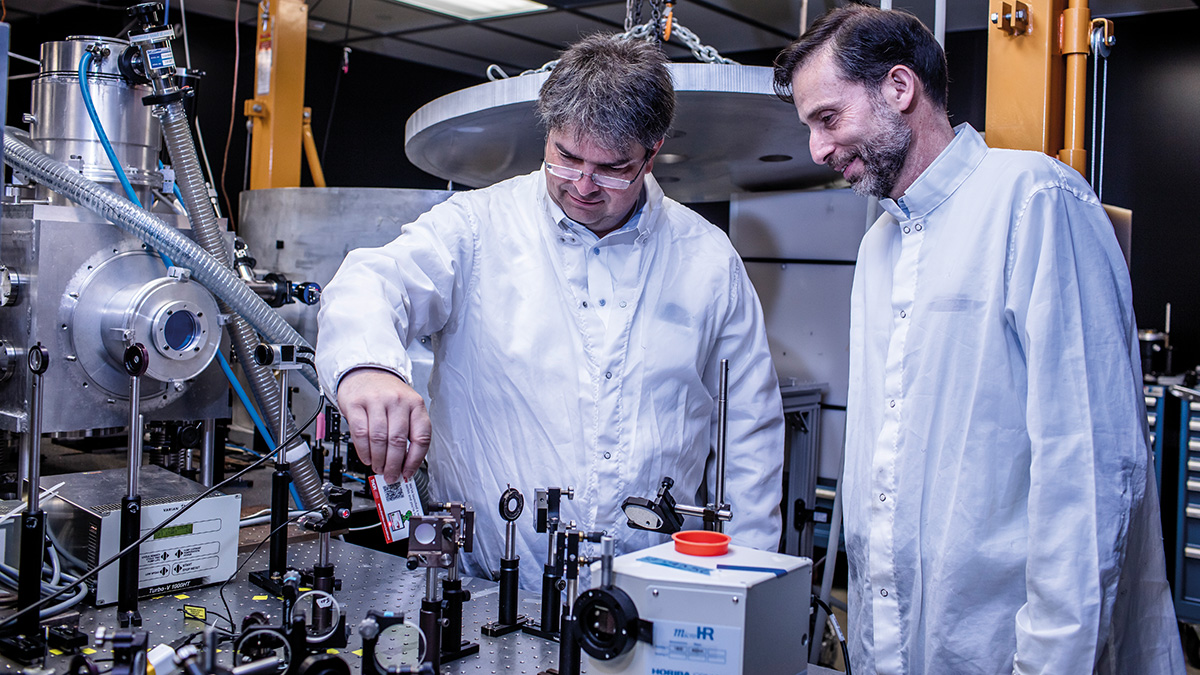
He spent twenty years shipping cars and engines. Now he ships particle accelerators - the kind that used to need a building a mile long.
Particle accelerators have a real-estate problem. The famous ones stretch for kilometers, cost billions, and book out years in advance. If you are a battery chemist or a vaccine researcher who needs an intense burst of X-rays to watch atoms move, you queue behind everyone else on the planet. Jerome Paye runs the company trying to end that queue.
As CEO of TAU Systems, Paye is commercializing a laser-plasma accelerator - a device that fires an ultrashort, ultra-intense laser pulse into a puff of gas. The pulse rips the gas into plasma and leaves a wake behind it, the way a speedboat leaves a wake on a lake. Electrons surf that wake and pick up energy at a rate a thousand to a million times higher than the metal cavities of a conventional machine can sustain. The result: acceleration measured in centimeters instead of miles.
TAU's specific trick is timing. The team injects nanoparticles into the gas target at a precise moment, seeding the plasma wave earlier and letting electrons reach roughly 10 GeV over about 10 centimeters. Feed those electrons into a compact undulator and you get a coherent X-ray free-electron laser - the crown jewel of light sources - small enough to design around a standard shipping container.
The pitch writes its own headline. When TAU raised its seed round, the company summed up the ambition in six words: miles to meters, billions to millions.
Our goal is to replace the EUV light source for modern lithography machines with highly efficient X-ray lasers.- Jerome Paye, CEO, TAU Systems
Every advanced chip in your pocket owes its existence to extreme-ultraviolet lithography, a technology so difficult that exactly one company, ASML, makes the machines. At the heart of each one sits an EUV light source - a device that vaporizes tin droplets with lasers to produce the short-wavelength light that prints the tiniest features. It is a marvel, and it is a bottleneck.
Paye wants to change what sits at that heart. TAU's compact X-ray lasers, he argues, could deliver a brighter, more efficient source that speeds up each lithography step and reduces the need for the expensive multi-patterning tricks chipmakers rely on today. Less patterning means lower cost per wafer.
He is careful about the economics, not just the physics. TAU's light sources, he says, will have high wall-plug efficiency, recapturing unused energy and pairing X-rays with wavelength-matched reflective optics to cut operating costs by increasing production speed. That is the language of an operator who has spent a career worrying about throughput, not just theory.
It is early, and the incumbents are formidable. TAU is one of a handful of contenders - alongside names like Substrate and XLight - circling the same prize. But the fact that a UT Austin spinout is even in the conversation about the semiconductor industry's most sacred component tells you something about how fast compact accelerators have matured.
Most deep-tech CEOs arrive from a lab or a venture fund. Paye arrived from the factory floor. He trained as a physicist at France's École Polytechnique, earning degrees in engineering, solid-state physics, and a doctorate in physics, then did postdoctoral research at MIT and picked up a joint manufacturing-and-business master's from the University of Michigan.
Then he went industrial. At Ford he was program management leader for the Mustang and the launch leader for the 2005 Mustang convertible - the person responsible for turning a design into cars rolling off a line. At Renault he served as pre-program engineering deputy director for electric vehicles, steering early EV development in partnership with Nissan. At Achates Power he rose to Executive Vice President and Chief Operating Officer, running opposed-piston engine programs with global automakers.
That is the through-line. Paye is the person who takes an audacious idea and makes it manufacturable, repeatable, and shippable. TAU has no shortage of physics genius. What a laser accelerator needs to become a product is exactly what Paye has spent decades doing to cars and engines.
Our light sources will have a high wall-plug efficiency from electrical to optical energy. Unused energy will be recaptured to further improve the efficiency.
Using a bright source of X-ray light will speed up production for each lithography step and reduce the need for multi-patterning. This will reduce the associated costs per wafer.
Our goal is to replace the EUV light source for modern lithography machines with highly efficient X-ray lasers.
Our high repetition rate laser driver also makes TAU Labs an ideal location to test the resistance to space radiation of satellite electronics - and prolong the life of satellites.
His resume runs from Mustangs and electric Renaults straight into particle acceleration.
A physics doctorate in France, then postdoctoral research at MIT.
TAU Systems spun out of the University of Texas at Austin.
Funded in part by German internet entrepreneur Lukasz Gadowski.
TAU's laser driver doubles as a space-radiation testbed for spacecraft electronics.