The particle accelerator, reinvented not bigger - but small enough to fit in a room.
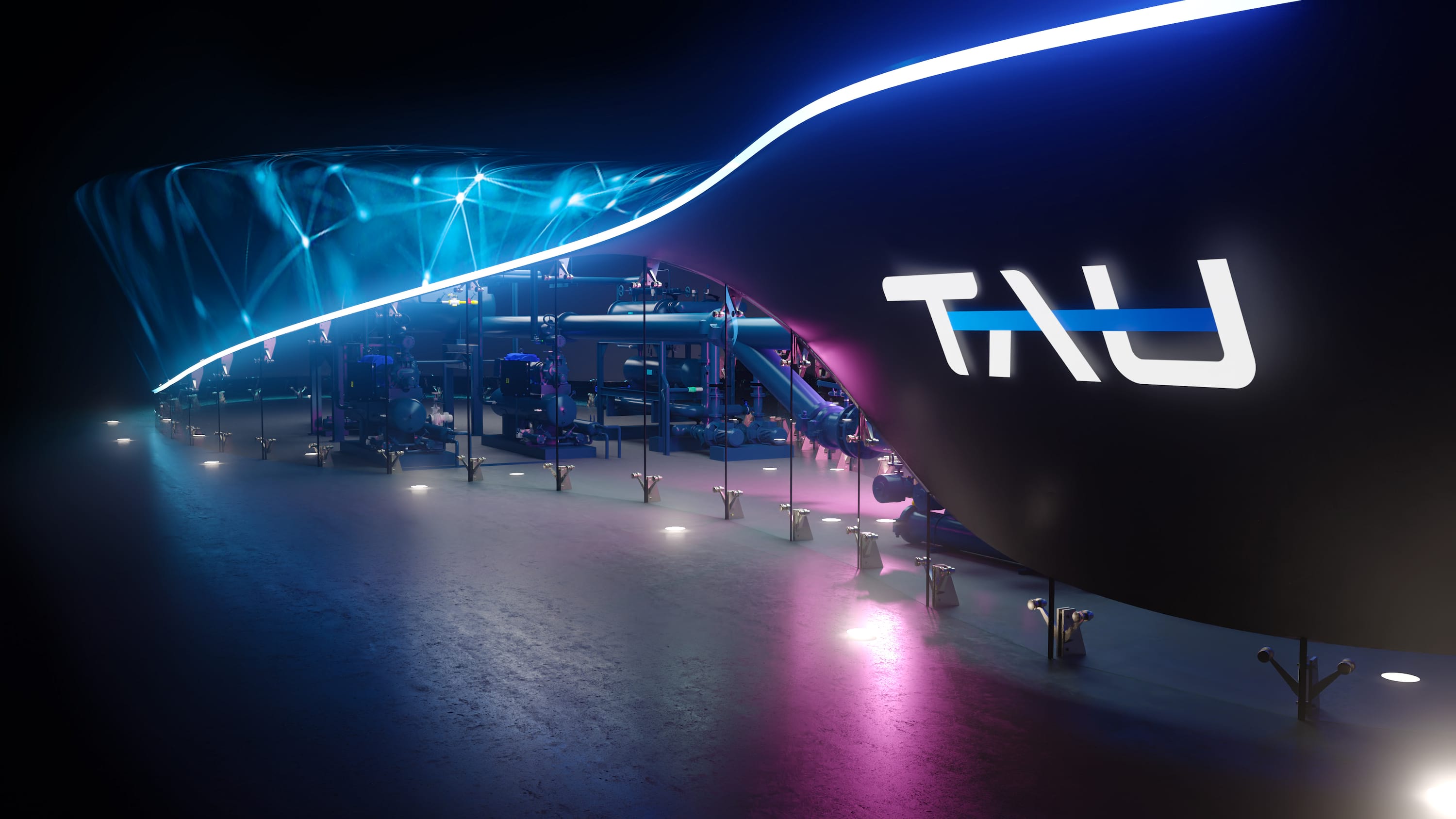
The room where miles disappear. A rendering of a TAU accelerator floor - the whole machine occupies the space a national lab spends a kilometer to achieve.
The Front Page
Walk onto the floor and the first thing that surprises you is how quiet the room is. There is no kilometer of tunnel. No county-sized ring. Just a table of ultrafast lasers, a puff of gas, and a jet of plasma no longer than your thumb.
In that plasma, for a few millionths of a billionth of a second, electrons get shoved forward harder than any block of copper on Earth could shove them. Two thousand times harder. They come screaming out the far end carrying the energy of a machine that would normally stretch past the horizon - and here it all fits under one roof, near a coffee machine, in Austin.
This is the trick TAU Systems is selling. Not a faster accelerator. Not a cheaper one, exactly. A smaller one - small enough that you might, one day, rent time on it the way you rent anything else. The particle accelerator has spent sixty years growing. TAU decided the interesting direction was down.
By The Numbers
"This is a major breakthrough. Laser-plasma accelerators represent a transformative shift in how we design and use particle accelerators."- Bjorn Manuel Hegelich, Founder & CEO
The Idea
The physics is not new. In 1979, two researchers proposed that a laser pulse fired into plasma could raise a wake - like a speedboat on water - and that electrons surfing that wake could be accelerated absurdly fast over absurdly short distances. Elegant on paper. Brutal in practice. For decades it stayed a lab curiosity, thrilling and unreliable in equal measure.
TAU's wager is that the curiosity has grown up. Founded as a spinout from the University of Texas at Austin in 2021, the company doesn't just want to publish record energies. It wants a machine that turns on in the morning, behaves all day, and hands a customer a usable beam - the unglamorous virtue of reliability. That's the difference between a physics result and a product.
EXHIBIT A - the acceleration itself happens over millimeters to centimeters of plasma. Everything else in the room is laser, optics, and the beamline that makes the beam behave.
What They Build
Room-sized accelerators that drive plasma waves with high-power ultrafast lasers, pushing electrons to multi-GeV energies over centimeters instead of kilometers.
Free-electron lasers that emit coherent EUV and X-ray light in a few meters - the capability of a national facility, minus the county-sized footprint.
Application centers - the first a 22,300 sq ft building near San Diego - where customers book beam time instead of building their own accelerator.
Ground-based testing of satellite and aerospace electronics against the high-energy radiation they'll meet in orbit.
In-house high-peak-power lasers, beam diagnostics, and TAU-designed beamlines - including the upgrade of UT Austin's tabletop laser to 40 terawatts.
Who It's For
Here is the quiet scandal of big science: the ideas aren't the bottleneck - access is. There are only a handful of X-ray free-electron lasers on the planet. Getting time on one can mean a multi-year queue, a grant, and a plane ticket.
TAU's answer is to make the machine common enough to turn that queue into a booking. Chipmakers chasing EUV metrology, battery and materials researchers, medical-imaging developers, aerospace teams frying test chips with radiation, and physicists chasing fundamentals - all of them need accelerator-grade light. TAU wants to hand it over without the pilgrimage.
The Cast
UT Austin physics professor and laser-plasma expert who previously led laser-acceleration research at Los Alamos National Laboratory. The scientist turning his own field into a company.
Serial entrepreneur and Delivery Hero co-founder who wrote the first checks. His stated aim: "building a machine for cutting-edge innovation across industries."
Accelerator veteran focused on the unglamorous prize - not just producing beams, but producing them reliably enough for a free-electron laser to actually lase.
The Record
TAU Systems spins out of the University of Texas at Austin to commercialize laser-driven particle accelerators.
Raises $15M, with entrepreneur Lukasz Gadowski as founding investor and chairman.
Upgrades UT Austin's tabletop laser to 40 terawatts and debuts a TAU-designed particle accelerator beamline.
Signs a lease on a 22,300 sq ft building at Carlsbad Research Center near San Diego - the future TAU Labs.
Closes a $20M seed round led by Quantonation, bringing total funding to $35M.
With Berkeley Lab, demonstrates intense, coherent FEL light driven by a laser-plasma accelerator. Published in Physical Review Letters.
A laser-plasma accelerator powers a free-electron laser for more than eight hours of stable coherent output - a breakthrough in reliability.
"The fact that the FEL gain is so significant proves the accelerator is producing the high-quality electron beams required to make it work."- Sam Barber, Staff Scientist, Berkeley Lab
Allies
The Money
Marginalia
Plasma accelerates electrons with fields over 2,000× stronger than a conventional metal cavity - roughly 100 GV/m versus 50 MV/m.
The actual acceleration happens over millimeters to centimeters. The rest of the room is laser and beamline.
The core idea dates to 1979. TAU is turning a 40-plus-year-old concept into hardware you can point at.
A traditional XFEL can run kilometers and cost billions. TAU's target footprint is a few meters.
Lukasz Gadowski co-founded Delivery Hero. A food-delivery fortune, quietly funding particle physics.
Hegelich once led laser-acceleration physics at Los Alamos before bringing the work to Austin.
The Last Word
Come back to that quiet room. The lasers hum. The plasma flickers for an instant and is gone. But now picture the door left open - and a stranger walking in with a booking, not a grant application and a two-year wait.
That is the whole ambition, stripped of the physics: to take the rarest instrument in science and make it ordinary. Not to build the biggest machine, but to build enough small ones that the word "accelerator" stops meaning "somewhere else, someday." TAU Systems hasn't finished the job - the labs are still being outfitted, the beam time still being proved. But the room already looks different than it did in 1979. It looks, for the first time, like a place you could walk into.