On a construction site, a lot of important information still travels by clipboard. An engineer drives out, climbs to an instrument, writes down a number, and drives back. Multiply that by a few hundred sensors on a dam, a mine, or a rail cutting, and monitoring becomes a logistics problem before it is ever a data problem. Ackcio, a company that started in a Singapore university lab in 2016, decided the site should read itself.
The company builds wireless data acquisition systems for industrial monitoring. In plain terms: it makes small, battery-powered radios that plug into the sensors engineers already trust - tiltmeters, piezometers, strain gauges, inclinometers - and quietly ship their readings back to a gateway, and from there to whatever software the client already uses. No trenching cable across an active site. No standing appointment with a ladder.
The problem, stated plainlyCables break. People miss readings. Sites are remote.
Every failure mode in traditional monitoring comes back to one of those three lines. Wired systems are precise but fragile - a single severed cable on a busy site can silence a whole run of sensors. Manual reading is flexible but slow and easy to skip. And the places that most need watching - a tailings dam in the mountains, a slope above an open pit, a tunnel face - tend to be exactly the places where a reliable signal is hardest to get.
Ackcio's answer is a mesh. Instead of every node needing a clear shot back to base, nodes relay for each other, hop by hop, until the data reaches a gateway. The protocol - called Ackcio Mesh, and patented - is built to be long-range and self-healing: if a node drops out, the network reroutes around it and keeps reporting. That last property matters more than it sounds. Industrial sites move. Equipment blocks line-of-sight. A mesh that adapts to terrain changes is a mesh that survives the real world.
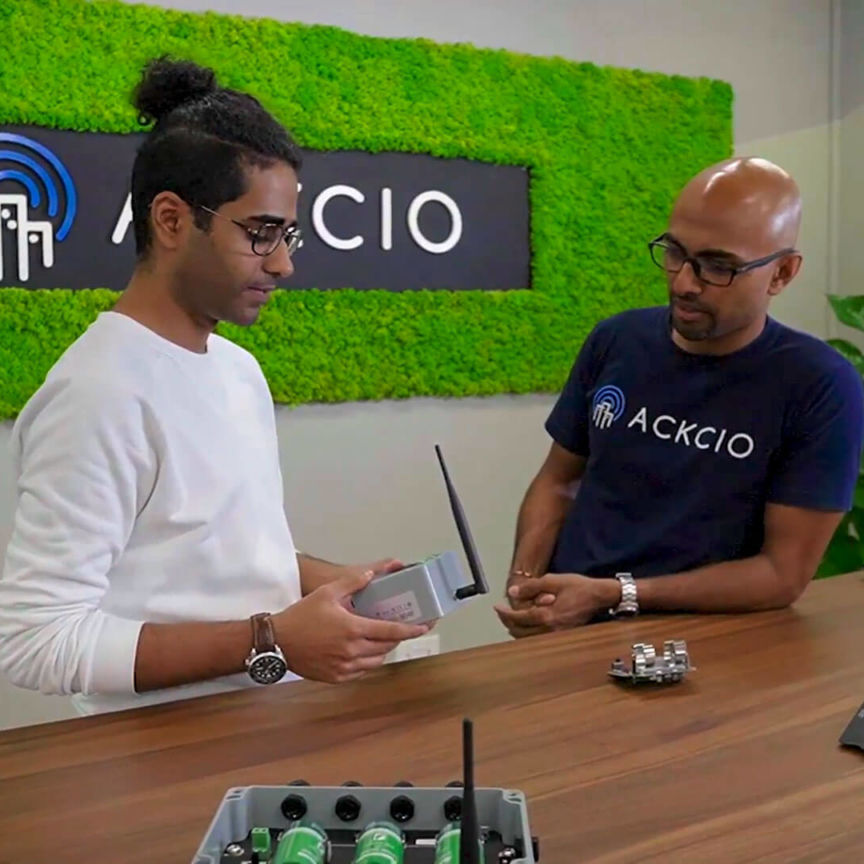
A node, a mesh, a gateway - and no internet required
The flagship system is called Ackcio Beam, and one design choice sets it apart from the crowd of connected-everything startups: it runs on the edge, with zero cloud connectivity required. Data is gathered and stored locally first. The internet, when it exists, is a convenience for shipping data onward - not a dependency the system falls over without. For a monitoring rig sitting in a valley with no coverage, that is the difference between a product and a paperweight.
Around that path sits a small, coherent product family. The nodes come in flavours to match the instruments in the field - analogue, vibrating wire, digital (RS485, RS232, SDI-12), tiltmeter, and a plain repeater node for stretching range. The gateway is the master that collects and forwards. Two pieces of software round it out, both with names an engineer clearly enjoyed choosing: Snape, the web-based configuration and data tool that runs on the gateway, and Nimbus, the Android app for commissioning nodes on-site. A newer 3D displacement sensor, the Ackcio GeoArray, extends what the system can watch.
The customer is anyone who cannot afford a surprise
Ackcio's users are geotechnical and structural engineers, monitoring contractors, and the firms behind construction, mining, rail and infrastructure projects. What they share is a low tolerance for surprises. A tailings dam that shifts unnoticed is a catastrophe; a rail embankment that creeps between inspections is a derailment risk. In a deployment at a gold processing facility in Kalgoorlie, Western Australia, Ackcio Beam pulled regular real-time readings from piezometers and in-place inclinometers on a tailings dam - the kind of continuous watch that a monthly site visit simply cannot provide.
Sell the hardware, stay friendly with everyone else's software
Ackcio is a B2B hardware-plus-software business, and its most strategic decision is a restraint: the hardware is sensor-agnostic and platform-agnostic. Nodes read whatever instrument is on site; gateways hand the data to whatever monitoring platform the client already runs. Rather than force customers to abandon their tools, Ackcio slots underneath them. That posture also shapes its partnerships - a 2020 tie-up with the IIoT firm sensemetrics paired Ackcio's field hardware with cloud analytics, and a 2021 partnership with mining systems integrator Ramjack Technology Solutions pushed the hardware deeper into mining. Distribution partners such as HMA Group carry the kit into their own markets.
The foundersA thesis that walked out of the lab
The company was founded by Mobashir Mohammad and Nimantha Baranasuriya, both of whom earned PhDs in wireless networking and IoT at the National University of Singapore. That academic root is not decoration. Building a radio protocol that holds together underground and across shifting terrain is a physics problem before it is a product problem, and it is the sort of thing hard to reverse-engineer from the outside. Mohammad, who leads the company as CEO, came up through the R&D and product side; Baranasuriya, an early CEO, now sits as a non-executive director. The team around them is small - roughly 15 people - which is itself a quiet argument that in industrial hardware, reliability scales further than headcount.
The fieldA crowded shelf, and a narrow edge
Ackcio is not alone. Wireless geotechnical monitoring has real incumbents - Worldsensing's Loadsensing, Senceive, Move Solutions and instrument houses like GeoSIG and Campbell Scientific all court the same engineers. The differentiator Ackcio leans on is the mesh itself: long-range, self-healing, and comfortable underground, with an edge-first design that does not assume connectivity. In a category where the buyer's real question is not "how clever is the dashboard" but "will the data still be there tomorrow," that is a pointed place to compete.
The company raised a S$4 million Series A in September 2021, led by Atlas Ventures with Seeds Capital (the investment arm of Enterprise Singapore), Wavemaker Partners and others, following an earlier pre-Series A round. It is not a headline-grabbing war chest, and it does not need to be. Ackcio sells something closer to insurance than to novelty: a steady stream of numbers from places that must not fail, arriving whether or not anyone drove out to check. When it works, nothing happens. That is the point.