The strange thing about a 3D printer is how much time it spends negotiating with gravity. An overhang needs scaffolding. A hollow chamber needs a way to keep its walls from collapsing. A silicone part, soft before it cures, is especially unruly. At MIT's Self-Assembly Lab, the people who would start Rapid Liquid Print found an elegantly messy answer: put the nozzle in a vat of gel, and let the gel hold everything still.
The result looks like drawing underwater. A needle traces a path through a clear, reusable suspension; liquid silicone follows, cures, and emerges as a finished flexible shape after a rinse. The company calls it Gravity Free Manufacturing. The phrase is theatrical. The practical advantage is more specific: the material can travel through space without the disposable supports that ordinary layer-by-layer extrusion often needs.
- RLP prints complex silicone parts in a reusable gel bath.
- Levity is its industrial printer; Veer plans the non-planar paths.
- It serves medical, industrial, automotive and design teams.
- The Coperni Ariel Swipe Bag tested a functional hollow form in public.
- Printer buyers request a quote; RLP also develops and makes parts with customers.
First, solve the soft part
The founding team had reason to distrust a pretty prototype. CEO Schendy Kernizan had managed projects at the MIT lab; CTO Bjørn Sparrman had led its technical operations. They founded RLP in 2018 with Skylar Tibbits and Jared Laucks, who directed the lab. The original printing process had been shown at Design Miami in 2017, where experimental furniture made a natural stage. Furniture is wonderfully visible. A gasket is seldom photographed, though it might be purchased again and again.
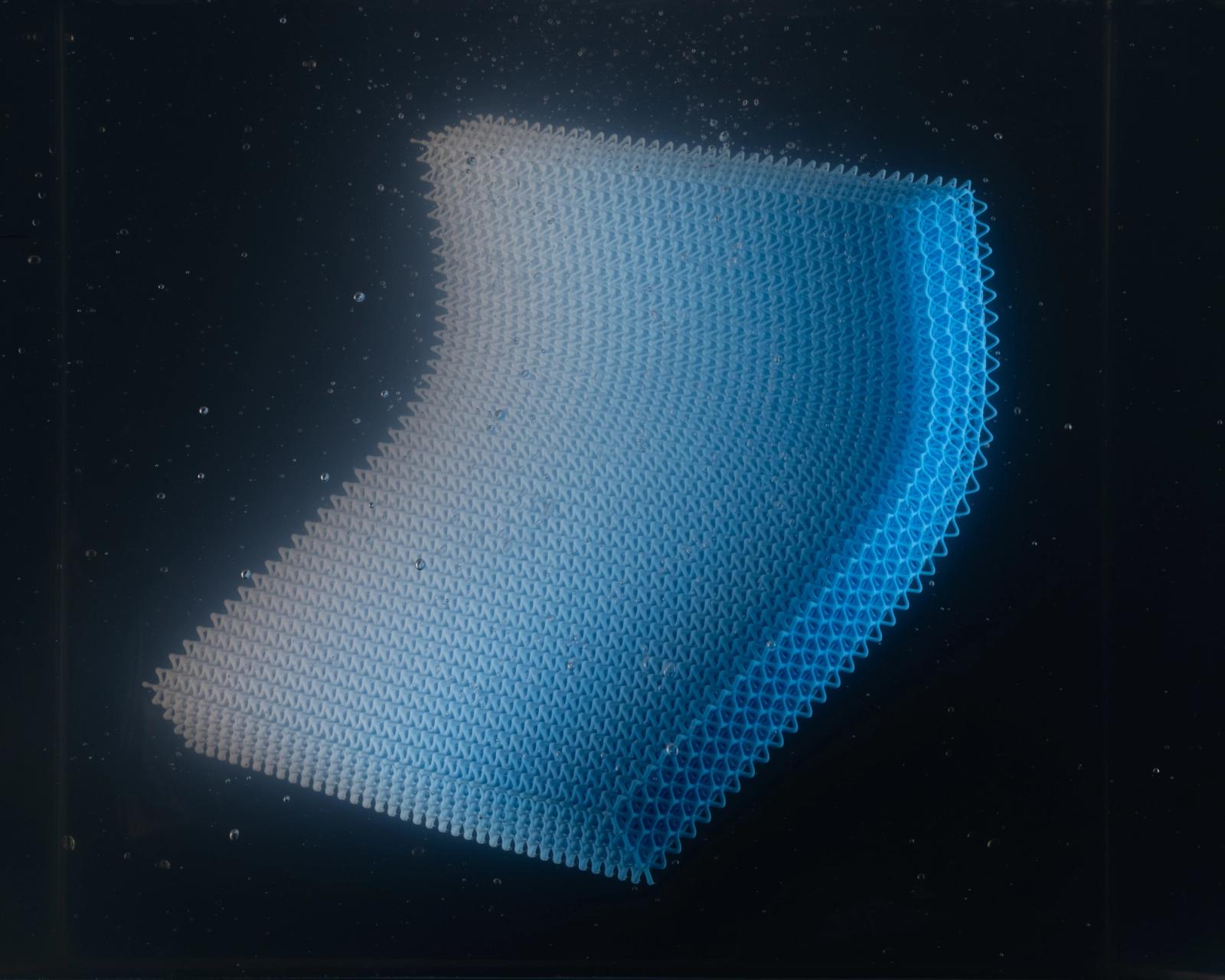
That move from spectacle to specification is RLP's real plot. Its parts now include lattices for cushioning, prosthetic liners shaped to a patient, inflatable medical bladders, bellows and seals with more than one stiffness. A manufacturer's problem is often painfully ordinary: a new mold costs time and money, while a conventional printer may leave supports to remove from a complicated flexible cavity. RLP's gel acts as temporary support throughout the print and can be used again. The part comes out and is rinsed with water.
The gel supports overhangs and cavities; Veer chooses a path through the form rather than treating every shape as a stack of flat slices.
A bag with a stubborn mouth
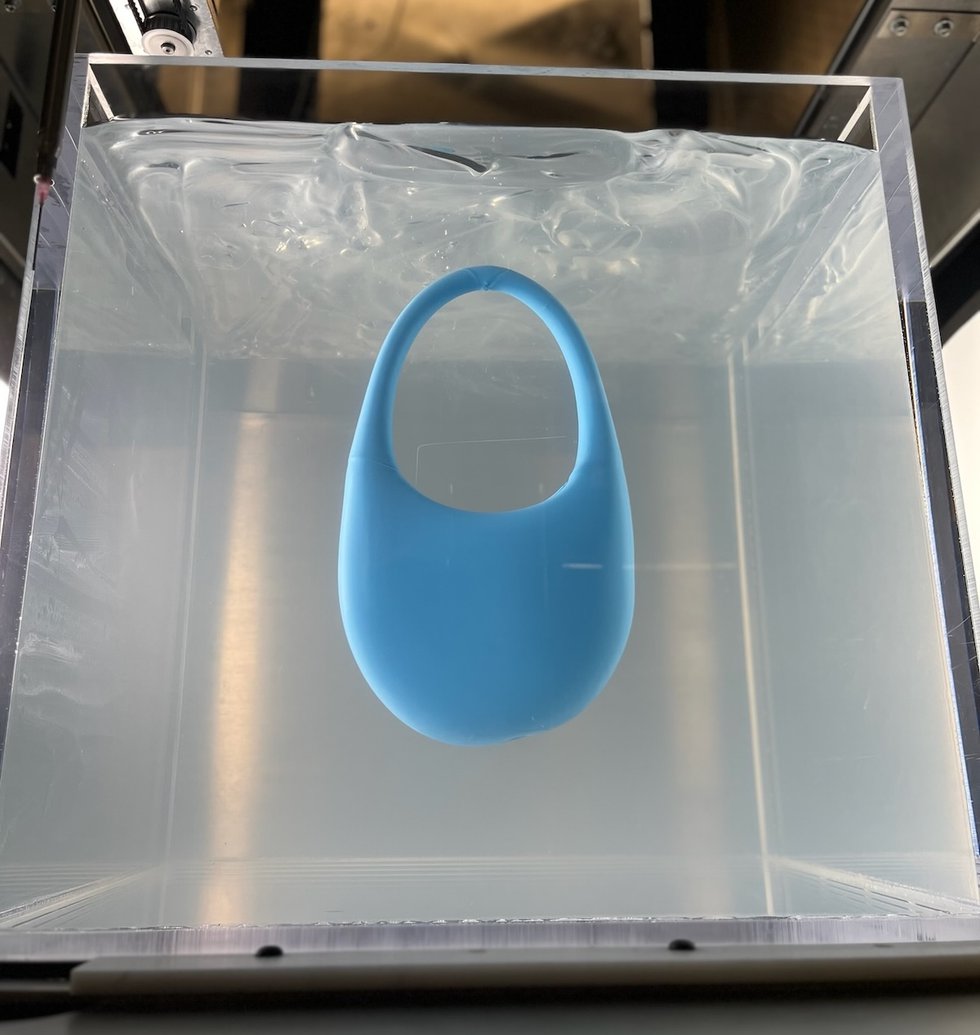
In 2024, Coperni asked RLP to make a silicone version of its Swipe Bag for a Paris Fashion Week show at Disneyland Paris. It was the sort of assignment that can make industrial people roll their eyes: another runway stunt. Yet the bag had to be a bag. It needed an opening that worked, a body that did not sag when filled, and the familiar double-curved shape. The companies exchanged test prints across the Atlantic for six weeks. Three final bags were made, each taking roughly four hours to print.
The opening proved the interesting part. RLP's team said the project pushed its software to divide a complex surface into printable sequences and taught it to reinforce the opening for repeated use. Those are lessons a prosthetic liner or a chambered medical part can borrow. A photogenic commission became a test of whether design freedom could survive a hand reaching inside.
“Our gel acts as the mould and it can be reused countless times.”Schendy Kernizan, speaking to TCT Magazine
Now sell the machine
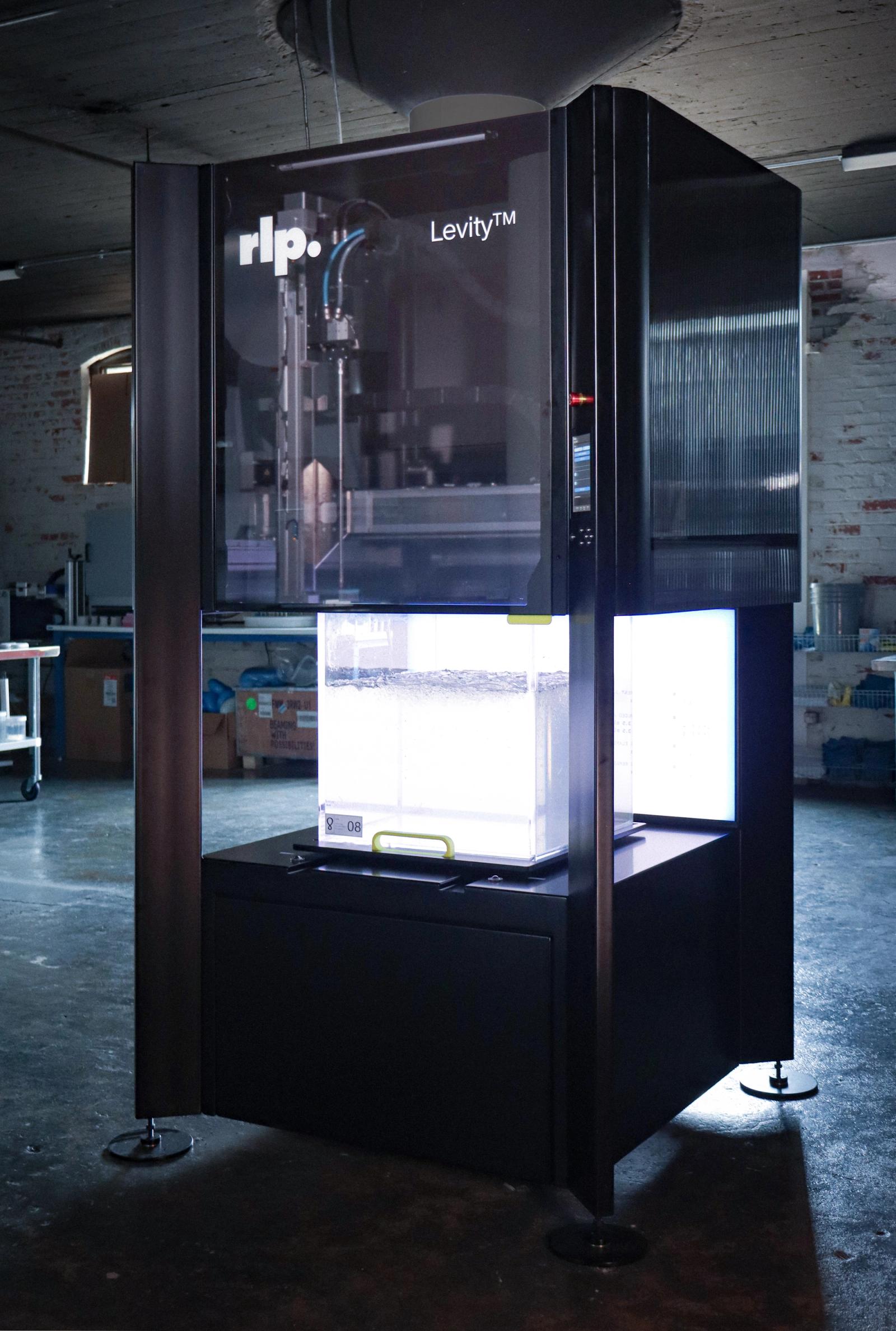
For years, RLP chiefly made parts as a service in Boston. By late 2024, it had also sold two machines to early medical adopters, according to its CEO. The wider pitch arrived with Levity, unveiled at RAPID + TCT in 2025. This is no desktop curiosity: the published machine weighs 700 kilograms and has a 50 × 50 × 50 centimeter build volume. It prints platinum-cured silicone in a stated hardness range from Shore 00-50 to 50A. Customers bring STL or PLY files, while Veer software plans paths and allows changes to thickness, hardness, color and local fit.
There is a business hiding in the specifications. RLP can sell a printer and software to organizations that want the process on their own floor; it can also work with customers on applications and produce parts itself. Its current order page invites a request for quote, so a precise printer price is not publicly stated there. For a buyer, the economic comparison is specific to the job: how many designs will change, how expensive is tooling, how much hand finishing is avoided, and what is the required volume? A mature mold remains a formidable way to make the same part in very large numbers.
The capital raised tracks that transition. BMW i Ventures led a seed round in 2021 with MassMutual's MM Catalyst Fund. In 2024, HZG Group led a $7 million Series A, with the earlier backers joining. The company said it would expand production, hiring and new business areas. In January 2026, it named Amecos its European distribution and market development partner. That is less cinematic than a runway. It is also what a machine company needs: people who can qualify applications, install equipment and help customers turn a demonstration into production.
The useful limit
RLP's strongest claim is also a useful filter. The process suits soft, complex, custom parts in its printable silicone range. The company has published a 68-minute, 32 × 32 × 5 centimeter multi-stiffness gasket and a 37-minute non-manifold seal. Those are sample jobs, not universal cycle times. RLP's engineers say nozzle diameter constrains tiny features, and a long nozzle affects how quickly material changes can be purged. Very small openings and perfectly sharp corners still demand design work. Levity's advertised build volume is a real box, not a metaphor for unlimited size.
That offers a lesson anyone developing a new process can copy. Start with the ugly geometry customers already pay to solve. Let a demanding demonstration expose the weak detail. Then turn that detail into repeatable software and machine behavior. RLP's bag did not replace a gasket; it helped teach the printer how to make one. The cleverest manufacturing trick may be knowing when to leave the runway and return to the seal.