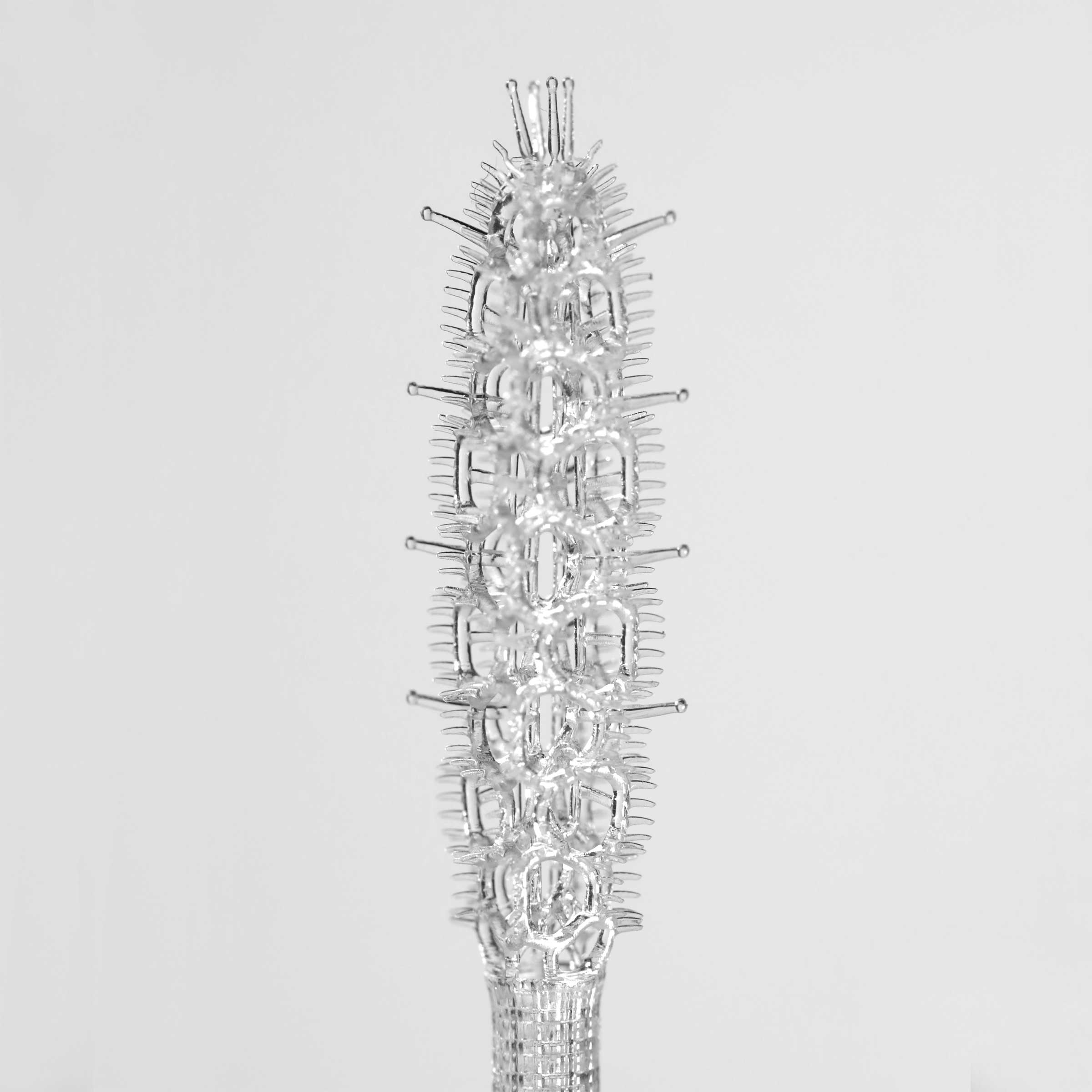
A factory that runs all night, printing things by the mile
Inside a 14,000-square-foot building in Medford, Massachusetts, a machine is printing a continuous sheet of plastic so finely textured it looks like fur. Nobody is standing over it. It is 2 a.m. The line has been running, uninterrupted, for hours, and it will keep going until the roll runs out - which, by design, it never quite does.
This is OPT Industries: not a print shop, not a 3D-printing hobby shop, but what the founders insist on calling a materials foundry. The word is deliberate. A foundry casts. OPT prints - continuously, at unlimited length, with features measured in microns. The output has been a COVID-19 nasal swab, a mascara brush with no glued-on fibers, and a false eyelash you could not flock by hand if you tried for a year.
"One process, endless possibilities."- OPT Industries' own tagline, and an unusually honest one
It is a strange thing to build a company around a printer. Printers, after all, are famously the least beloved object in any office. But OPT's bet is that the rest of manufacturing has been doing it backwards - and that the fix is a machine most people have never heard of, doing a job most people assumed was impossible.
Manufacturing forces a choice. OPT refused to make it.
Here is the trade every manufacturer knows by heart. You can have precision - the fine, intricate, custom geometry of 3D printing - or you can have volume - the cheap, fast, endless output of injection molding and roll presses. You almost never get both. 3D printers are slow and stop between parts. Molds are fast but frozen: change the design and you re-tool the whole line.
So the world settled. Anything that needed to be intricate stayed expensive and rare. Anything that needed to be cheap stayed crude and identical. A swab is a stick with a cotton ball. A mascara brush is fibers glued, or "flocked," onto a plastic stem - a process that is messy, manual, and leans on overseas labor.
The old line: pick precision or pick volume. OPT looked at the line and asked why it was drawn there at all.
That "or" is the tension the whole company hangs on. Most startups pick a side and optimize. OPT decided the "or" was the actual product - or rather, deleting it was.
Seven years in a lab, one idea worth leaving with
Jifei Ou grew up in China, studied design and engineering in Germany, and then spent seven years at the MIT Media Lab - the place where people glue circuits onto origami and call it research. Ou's work sat at the seam between computational design and materials: how do you describe, in code, a structure as complicated as fur or foam, and then actually make it?
In 2019 he left with the answer, or at least a machine that behaved like one. The bet was specific and slightly reckless: that you could take the continuous, roll-to-roll logic of an industrial press and fuse it with the geometric freedom of additive manufacturing. Run them together and the old "or" dissolves. You get fine features and infinite length, on the same line, lights out.
The lab DNA
OPT is a Media Lab company through and through - interdisciplinary, software-first, comfortable on the factory floor and in the codebase at the same time. The MIT-affiliated E14 Fund was an early backer and still is.
The wager
That the natural world - fur, foam, fabric, feathers - is full of micro-structures worth copying, and that the only thing stopping us was a manufacturing process that could finally make them at scale.
"Designed in microns, built in millions."- The other OPT tagline, which is also a business plan
RAMP: the world's first roll-to-roll 3D printer
RAMP is the heart of the whole thing - OPT's flagship platform and, by the company's account, the first roll-to-roll additive manufacturing system anyone has built. Picture a printing press, except instead of laying down ink it grows three-dimensional micro-architecture, layer by layer, onto a sheet that never stops moving. No part-by-part start and stop. No length limit. Just material, unspooling.
The trick that makes it useful is the software half. OPT pairs RAMP with computational design tools that let engineers describe a structure mathematically - a micro-mesh tuned for absorbency, a bristle field tuned for how mascara clings - and then print exactly that. Change a parameter, print a different thing. No re-tooling. That is the whole magic act: customization that costs the same whether you make one or a million.
A mold makes the same thing forever. RAMP makes a different thing every time, for the same price. That is the entire pitch, and it is a big one.
It also happens to run 24/7, fully automated, in a facility built to GMP standards and certified to ISO 13485:2016 - the standard you need to make medical devices. Which is convenient, because the first thing the machine got famous for was a medical device.
From a Media Lab desk to a 24/7 line
OPT Industries, briefly
Spun out of MIT. Jifei Ou leaves the Media Lab with seven years of additive-manufacturing research and a patented printing system.
The swab emergency. Beth Israel asks for a better COVID-19 nasal swab. OPT designs and prints the InstaSwab, with a computationally optimized micro-mesh tip.
The factory opens. A 14,000 sq ft, ISO 13485-certified, GMP-compliant facility in Medford starts running continuous 3D printing around the clock.
Series A. $15M led by Northpond Ventures, with Crosslink Capital and the MIT-affiliated E14 Fund. Reported cumulative funding reaches roughly $24M.
Into beauty. OPT Cosmetics launches a roll-to-roll system for the personal care sector - flockless applicators and false eyelashes.
Five years, one machine, three industries. The timeline reads like a startup that kept finding new things to print.
The swab that made the case
In the spring of 2020, a Boston hospital called with a problem the whole country had: not enough nasal swabs, and the ones available were the same molded sticks they had always been. OPT had a machine that could print a better one. So it did.
The InstaSwab is not a cotton ball on a stem. It is a 3D-printed tip with a variable size and shape and a computationally optimized micro-mesh - the geometry tuned, in software, to grab and release more sample. OPT went on to ship more than 800,000 of them to healthcare and at-home testing organizations. For a five-year-old company, that is not a demo. That is a supply chain.
Numbers OPT will say out loud. The ones it won't - revenue, margins - are the ones every startup keeps in the drawer.
Why "endless length" is the point
Continuous output vs. start-stop printing · conceptual, illustrative of the platform's claim
Illustrative comparison of continuous length capability, not a measured benchmark.
The partnerships follow the same logic. Beth Israel was the first design partner. The investors - Northpond, Crosslink, E14 - are the kind that fund hard-tech, not apps. And the newest customers are beauty brands, who want lashes and applicators that no flocking machine can make.
"A new kind of materials foundry."- OPT Industries, describing itself as more chip-fab than print shop
Erase the seam between designing and making
The grander version of OPT's pitch is that design and manufacturing should be a single step. Today they are two: someone designs a part, then someone else figures out how to tool a line to produce it - a translation that loses detail, time, and money at every pass. OPT wants the design to be the manufacturing instruction, fed straight to RAMP.
There is a quieter, more practical thread too. Flocking applicators and assembling swabs lean heavily on manual labor and overseas supply chains. A machine that prints the finished thing, continuously, in Massachusetts, is a different kind of supply chain - one that does not depend on a container ship. In 2020, that argument stopped being theoretical.
The dream is custom materials made on demand, near where they're used. The unglamorous version: fewer container ships, fewer glued-on fibers.
Back to the machine, still running
OPT says the next frontiers are microneedles and skin-contact applicators - places where form, function, and safety all have to be right at once, and where a tuned micro-structure beats a molded approximation. Healthcare, cosmetics, automotive, consumer goods: the through-line is any product that has been quietly settling for crude because precise was too expensive to scale.
Return to that Medford floor at 2 a.m. The line is still running. The sheet is still unspooling - fur, or mesh, or bristle, depending on what the software told it this week. Five years ago that was a research demo at MIT. Now it is shipping by the hundreds of thousands, and the machine has stopped being the strange part. The strange part is that everyone else is still choosing between precision and volume, as if the "or" were a law of physics instead of a habit.
OPT Industries is a 20-person company betting it was only ever a habit. The printer runs all night to prove it.